No major gains projected for count of women in Congress after midterms
Oct 06, 2026 | 5:02 pm ET
Description
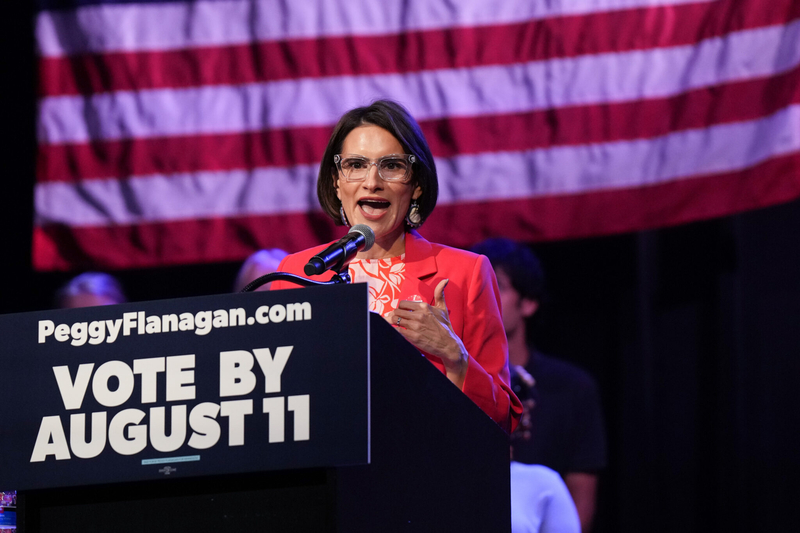
Minnesota Lt. Gov. Peggy Flanagan, a Democratic candidate for U.S. Senate, at a July 2026 rally in Minneapolis. Flanagan and former U.S. Rep. Mary Peltola, an Alaska Democrat, could become the first Native American or Alaska Native women elected to the Senate. (Photo by Glen Stubbe/Minnesota Reformer)
WASHINGTON — The number of women in the U.S. Senate is unlikely to increase and may decline following the November midterm elections, though there are still opportunities for candidates to make history in the upper chamber.
Kelly Dittmar, director of research at the Center for American Women and Politics, said on a call with reporters Tuesday that Peggy Flanagan in Minnesota and Mary Peltola in Alaska, both Democrats, would become the first Native American women in the Senate if they’re elected.
“And if Juliana Stratton wins in Illinois, a record three Black women will serve concurrently in the U.S. Senate for the first time in U.S. history,” Dittmar said. “Only five Black women have ever served in the U.S. Senate. So the three women who would be serving in the 120th Senate would represent 50%, or half, of all Black women who've ever served.”
The Cook Political Report with Amy Walter rates the Illinois race as solidly Democratic, the Minnesota election as likely Democratic and Alaska as a toss-up.
When it comes to overall representation, voters would need to elect six new women to replace outgoing female senators and keep the number of women in that chamber level during the next Congress, which is set to begin in January.
“At present, four women non-incumbents are favored to win in November, and two more non-incumbent women are in competitive contests,” Dittmar said. “In addition, one incumbent woman senator, Susan Collins in Maine, is currently deemed as vulnerable in her bid for re-election.”
That means there would need to be some unexpected victories for women Senate candidates in order to actually increase representation in that chamber, likely leaving the percentage of women senators flat or in decline.
Any path possible in House
The House of Representatives, where 125 of the 435 seats are held by women, is in a somewhat different position.
There will be at least 271 women on the ballot for House seats, giving voters the opportunity to surpass the previous record of 127 women in that chamber at one time.
“Net gains, loss, or stasis all remain possible outcomes for women's U.S. House representation from 2026 to 2027,” Dittmar said. “And these are all possible outcomes as well when you look by party for Democratic women or Republican women specifically.”
Democratic women hold a record of 95 seats, while Republican women have previously maxed out their representation at 34.
No parity in either party
CAWP, part of the Eagleton Institute of Politics at New Jersey’s Rutgers University, aims to be a “leading source” of research and data on women in politics.
Chelsea Hill, the group’s director of data, said there were a record 590 women running for a seat in Congress at the start of this year’s campaign cycle, though that number decreased as voters decided which candidates they wanted in this fall’s general election.
“It's important to note, even with these candidacy records, women continue to be significantly underrepresented as a percentage of all U.S. House and U.S. Senate candidates,” Hill said.
And while Democratic women are represented in higher numbers in their party than Republican women, neither has reached gender parity, she said.
In total there are 198 Democratic and 73 Republican women candidates on ballots this fall, which Hill said is an increase from the last election cycle but “short of the record high of 298 women nominees for the U.S. House set in 2020.”
“When broken down by race and ethnicity, only Latinas reached new highs for U.S. House candidacies and nominations this year,” she said.
“On the Senate side, the number of Native American, Alaska Native, or Native Hawaiian women nominees for the U.S. Senate, three, is an historic high,” Hill added. “And the number of Black, four, and Latina, two, Senate nominees match existing records. Among women candidates for U.S. Senate, only white women have reached a new high of 45.”
All States Newsroom content is free to republish. Read our republishing policy for more information.