Iran war, Trump tariffs and Michigan data centers dominate questions during Barrett-Lawrence debate
Oct 06, 2026 | 3:26 pm ET
Description
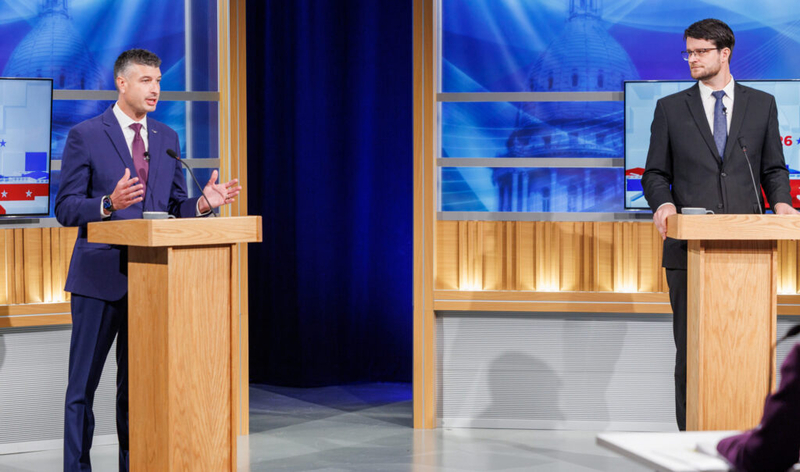
U.S. Rep. Tom Barrett, R-Charlotte, left, and Democratic nominee for U.S. House William Lawrence, right, face off in their first head-to-head debate at WKAR's studios in East Lansing, Mich., on Oct. 6, 2026. (Photo by Andrew Roth/WKAR-MSU)
The reelection campaign of Republican U.S. Rep. Tom Barrett and the progressive insurgency of Democratic nominee Will Lawerence came to a head Tuesday during the first — and potentially last — debate featuring the candidates in this year’s contest for Michigan 7th Congressional District.
Hosted by WKAR-TV, the debate between Barrett (R-Charlotte) and Lawrence, of Lansing, was at times heated as the candidates navigated questions including those on the Iran war and its associated costs, tariffs imposed by President Donald Trump and other price hikes, immigration and artificial intelligence data centers.
Although there was plenty of contrast between the two on some of the most pressing issues, there were a few moments of agreement over the most controversial topics in the forum, such as whether law enforcement should have unfettered access to surveillance data from Flock cameras, and on ending the Iran war in swift fashion.
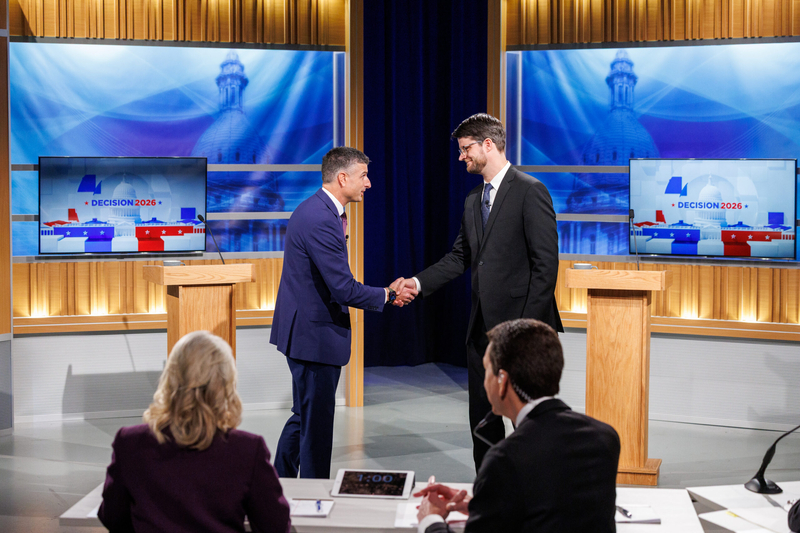
Barrett told viewers that he ran for Congress because he wasn’t happy with the status quo in America, and that he was dedicated and committed to solving those issues during his first term in the U.S. House. Barrett said he would continue that work in Washington, D.C. if voters reelect him.
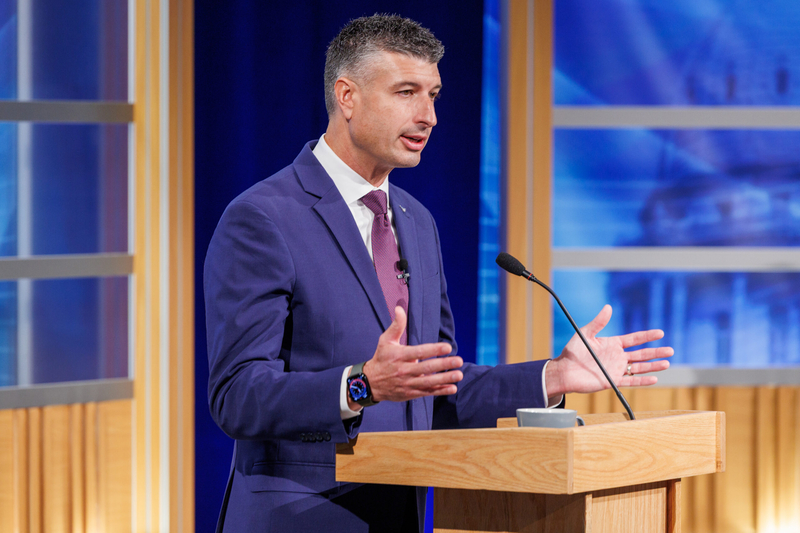
Lawrence said that he, too, was sick of the status quo on Capitol Hill and the work of the Republican-controlled Congress, which Lawrence said was dictated by President Donald Trump. Lawrence said voters could count on him to fight against the proliferation of the Iran war, and against the spread of hyperscale data centers, because he said he was not beholden to Democratic Party bosses or corporate influence.
Those comments set the stage for the back-and-forth in the battle for the 7th Congressional District, and for the kind of decision the district’s voters will have to make on Nov. 3.
Here’s how Barrett and Lawrence responded to each question, with answers edited for clarity and length.
How would you tackle high gas prices, mortgage rates and other increases in costs on goods?
Barrett said that gas prices were an important financial health measure because they ripple throughout the entire economy. He acknowledged that the current increase in gas prices was due to the continuation of the Iran war, which Barrett said he voted against.
“I saw friends that came home struggling after the effects of war, and I’m the only one on this stage who’s actually been to war to see these devastating effects” Barrett, a combat veteran, said of his opposition to Trump continuing to wage the conflict without authorization from Congress. “I take that responsibility very seriously. … As we wind down the war in Iran, we all know that fuel costs will come down, and the rest of the economy will recover, as well.”
Lawrence said Barrett was right about the war needing to end, but that he was wrong in the fact that his caucus’s haphazard support of Trump’s actions was to blame for much of it.
“On the first day of the war, I was out front opposing it, while he said that his president had earned the opportunity to start this disastrous war,” Lawrence said before turning to tariffs and Barrett’s support of Trump using the economic tool in ways that have been aggressive to trading partners and have damaged the economy with price increases.
“We’ve been impacted more than any state in the country, and whether you’re a worker, a business owner, an investor, or a consumer, you know that the business conditions have been so erratic because the president wakes up in the morning and he decides what the tariff rate ought to be based on his mood that morning,” Lawrence added.
Barrett, in response, said he has been consistently against Trump continuing to wage war without the approval of Congress and that he has been consistent in calling for legislative branch oversight.
Still, Lawrence said that Trump campaigned on ending expensive “forever wars,” but the nation, instead, is writing a new chapter for one “thanks to your president.”
Increases in health insurance premiums and deductibles have made health care less affordable. How would you rein those prices in for consumers?
For Lawrence, the undermining of the Affordable Care and Patient Protection Act impacted insurance prices most severely for people ages 50 to 65. He said that residents on the campaign trail have told him horror stories of their premiums going from $600 a month to $2,000.
Lawrence said he would champion a single-payer healthcare system that covers an individual throughout their lifetime.
Barrett accused Lawrence of just repackaging the progressive call for Medicare for All into his single-payer plan, and that it would amount to a $40 trillion expense for taxpayers and the nation.
“What I’ve done is actually push for reform within the health insurance industry, introduce the Care Over Profits Act, which affords health insurers to actually pay more in claims for the amount of premiums that they’re taking in, premiums are far too high today for families,” Barrett said, adding that he also paid nearly $20,000 in healthcare premiums and deductibles combined last year. “I’ve rejected contributions from the health insurance PACs, and I don’t support putting a government-run program for $40 trillion onto the books when we’re already struggling with so much financing.”
Lawrence responded by noting that the nation was already spending trillions of dollars on healthcare, and that under his plan, everyone would pay less “excepting the billionaires and the wealthiest in this country who are currently not paying their fair share.” He added that Barrett’s votes in Congress have cut more people off from the ACA and are now at risk of losing their Medicare coverage.
What guardrails would you put in place against unfettered surveillance of residents through equipment like Flock cameras?
On mass surveillance, Barrett said he supports “robust protections of individuals” and that is why he voted against the reauthorization of warrantless surveillance.
Barrett did say, however, that he supports tools for law enforcement to better do their jobs, even though he said he would continue to advocate against using federal funds for camera surveillance to balance the constitutional protections of citizens.
Lawrence said he was glad to see people fighting back against Flock cameras and other mass surveillance methods.
“Don’t tread on us and don’t spy on us either,” Lawrence said. “It’s a violation of the 4th Amendment. I support law enforcement and I believe in an all of the above approach to public safety, that includes police and community violence intervention, and stronger mental health services so police don’t have to be answering mental health calls and can be focused on solving violent crime.”
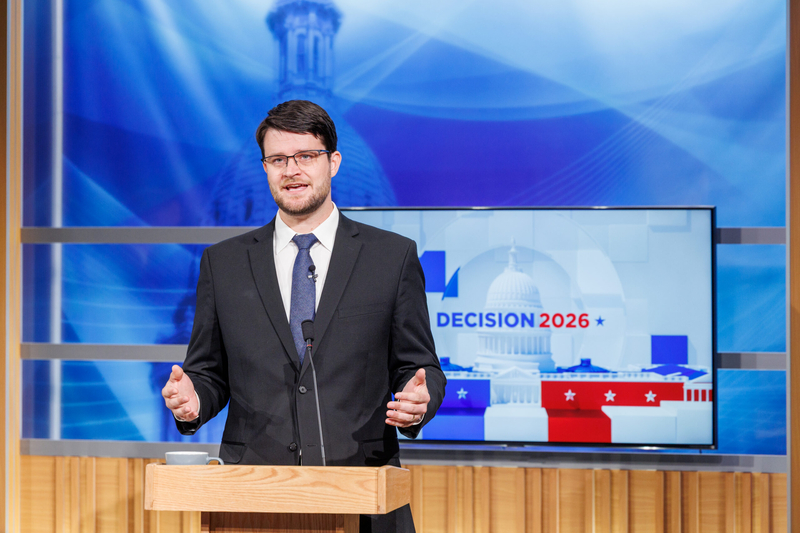
How would you manage trade woes with Canada and the Trump administration’s posturing against the nation or other allies?
The United States strained diplomatic and trade relations with Canada has taken center stage in many aspects of the 2026 cycle in Michigan, whether it’s Trump’s tariffs on that nation or posturing over the Gordie Howe International Bridge crossing.
On Trump leveling tariffs against trading partners, particularly Canada, Lawrence said it appears to him and others as if Trump was just throwing darts at a board to decide who and which country he wants to pick a fight with.
“Tom Barrett has voted to allow the president to continue changing the tariff policy each day of the week based on his mood or Lord knows what else,” Lawrence said.
Barrett said he supports tariff policies that bring investment back to the U.S. after a historic hollowing out of the nation’s manufacturing base — much of which is located in Michigan. He also said that the nation has seen Canada and other supposed trading partners disregard the needs of the U.S.
“I’ve called for predictability in our trade,” Barrett said.
Lawrence was quick to attack Barrett on his call for predictability.
“If Tom has been calling for common stability, he hasn’t been very effective at it because what we see from this president is chaos,” Lawrence said.
State law stripped away an element of local control on siting issues, and that includes decisions related to AI data centers. How would you ensure local communities can make their own decisions specifically related to data centers?
In terms of the state’s decision on local control, Barrett said it was the Democratic trifecta in Lansing that stripped away that control in the pursuit of a Michigan-based Green New Deal agenda, and that residents deserved the final say in those decisions. He said that he has introduced legislation that would prohibit federal agencies from overriding or influencing local control, as well as measures to prohibit non-disclosure agreements for those involved in the process.
“I’ve voted five times against that in 12 years,” Barrett said of this state legislative and congressional record.
With the question turning to Lawrence, the Democratic nominee said he was a nationally recognized leader in the fight against data centers, and that while he was out listening to residents’ concerns, Barrett gave $80 billion in tax breaks to corporations interested in building data centers.

America is stretched across supporting the Ukraine war effort, Israel’s own military actions and the front in Iran. How would you manage an end to those conflicts?
Lawrence has been against the waging of “endless wars” around the world, he said, as they have made the nation less safe and weaker over the last 25 years. He accused Barrett of supporting military aid to Israel, which Lawrence said was a factor in the U.S. decision to join their costly war with Iran.
Lawrence said firmly that Israel is committing a genocide in Gaza, where he said it has waged war against the Palestinian people since 2023 following the deadly Oct. 7 terrorist attacks perpetrated by Hamas against Israeli civilians. He called on the U.S. to “bring our money home” and stop funding Israel.
Barrett said he has separated himself from Trump on Iran and reiterated his call to not allow Trump to continue the war without authorization from Congress or basic congressional oversight.
“As I pointed out earlier, the War Powers Act delegates a limited amount of authority to the president for a specific period of time before Congress has to act to decide whether or not to continue that or not. That authorization has not happened,” Barrett said. “All the way back in May of this year, I was one of the very first Republicans to vote against the continuation of the war in Iran. Now, with that being said, we definitely have a national interest in preventing Iran from developing nuclear weapons. If they obtain them, it would be a disaster and one that we should prevent from happening. That doesn’t mean that we are endorsing an endless war or a furtherance of the war that we are in right now.”
A lively back and forth occurred between Barrett and Lawrence in their rebuttals on the issue of Iran and Gaza, with Barrett accusing Lawrence of agreeing with controversial Twitch streamer Hasan Piker’s comments that America deserved the Sept. 11, 2001 terrorist attack; and with Lawrence calling on Barrett to disavow comments by Trump that, in a continued war with Iran, both the nation could lose both Los Angeles and San Diego in an attack and still carry on.
Lawrence said Piker’s commentary was “despicable,” whereas Barrett went on record and said he didn’t agree with Trump’s wartime rhetoric on potential U.S. losses.
What is your position on border security and funding U.S. Immigration and Customs Enforcement?
Lawrence was adamant that border security and support for ICE were two different matters.
“We need a secure border. We need an orderly, efficient immigration court system, and we do need to remember the words on the Statue of Liberty, which call us to higher values and remind us that we should welcome immigrants because we are immigrants,” Lawrence said. “We can never forget what we saw on the streets of Minneapolis: American citizens being shot in the face and the back, families being separated from their children. That is what this president has brought. This is so un-American.”
Barrett said that he too believes that immigration policy should be fair, firm and humane. He said one of his proudest achievements in Congress was being part of a majority that secured the nation’s borders and, as a result, has seen smuggled fentanyl deaths decline because of that work.
He warned that if Lawrence was elected, those gains, particularly on curtailing fentanyl distribution, would be in vain.
Lawrence questioned Barrett on how he could view the events that occurred in Minneapolis in the later months of 2025 and early 2026 as fair or humane.
“Your president and your Congress have failed to deliver on your own stated immigration policy in order, and I think what you want is to punish people,” Lawrence said.
Lansing, MI