Passing HJR 4 would give Idaho Legislature sole authority to legalize marijuana, other drugs
Oct 06, 2026 | 6:15 am ET
Description
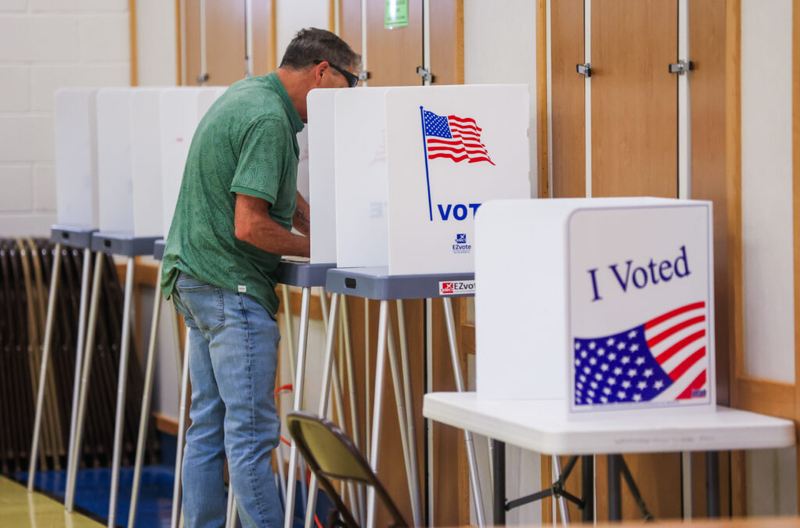
A voter casts his ballot in the May 19, 2026, primary election at Emerson High School in Idaho Falls. (Photo by Pat Sutphin for the Idaho Capital Sun)
Idahoans voting in November’s general election will decide whether to give the Idaho Legislature the sole power to regulate marijuana and other drugs — and eliminate their right to bring a citizen-led ballot initiative to do so.
Currently, there are two ways in Idaho that marijuana, medical cannabis or other drugs can be legalized and regulated.
First, the Idaho Legislature could pass a law to legalize it.
Second, Idaho voters could legalize it by passing a ballot initiative.
Who gets to decide is a big part of the debate over House Joint Resolution 4, or HJR 4 for short.
House Joint Resolution 4 is a proposed amendment to the Idaho Constitution that would give the Idaho Legislature the sole authority and power to legalize marijuana (including medical marijuana), narcotics and other psychoactive substances.
If a simple majority of voters vote “yes” for House Joint Resolution 4, Idahoans would not be allowed to bring a ballot initiative forward to legalize marijuana, medical cannabis, narcotics or other psychoactive substances.
If voters vote “no” and don’t approve HJR 4, there would be no changes to the Idaho Constitution. That means Idahoans would still be able to use the ballot initiative process to legalize marijuana, narcotics or other psychoactive substances.
Voters in several of Idaho’s neighboring states, including Washington, Oregon, Montana and Nevada, used ballot initiatives to legalize marijuana in those states.
People have tried to do the same in Idaho. But so far, each effort has failed to meet the signature-gathering requirements to qualify for an election, the Idaho Capital Sun previously reported.
Passing HJR 4 would mean Idahoans voluntarily give up rights to ballot initiative process, Idaho constitutional scholar says
David Adler, president of the nonprofit Alturas Institute in Idaho Falls, says passing HJR 4 would mean voters are agreeing to give up their own rights and freedoms.

Adler has taught courses on government and the Constitution at all three of Idaho’s public universities and has spoken about HJR 4 this fall.
“The more I speak on it, the more I realize people generally are of the belief that this is about regulating marijuana and they don’t understand that it has a far broader impact on their ability to resort to the initiative to exercise their rights,” Adler said.
“Really, HJR 4 asks Idahoans to surrender both their rights and their powers to shape their future,” Adler said.
He said a ballot initiative is a tool of democracy that the public has used to improve the state since the 1930s. Different ballot initiatives in Idaho have created the nonpartisan Idaho Fish and Game Commission, regulated dredge mining to protect clean water and created sunshine and transparency laws that provide for the disclosure of campaign finance reports and lobbying activity, Adler said
Idaho voters should not give that power up permanently when nobody knows what future medical discoveries could come from drugs or psychoactive substances, Adler said, adding that coffee and tea are considered psychoactive substances.
HJR 4 is also another example of the Idaho Legislature trying to restrict access to ballot initiatives or make the requirements to qualify a ballot initiative more difficult, Adler said.
Idaho legislators says HJR 4 protects Idaho from special interests trying to force legalization
Almost all Republicans in the Idaho Legislature support HJR 4 and oppose the legalization of recreational or medical marijuana.
Sen. Scott Grow, a Republican from Eagle who co-sponsored HJR 4, said the constitutional amendment is necessary to ensure that special interest groups don’t run expensive political campaigns designed to manipulate the public into legalizing drugs at the ballot box.

“When ballot initiatives run for marijuana or other psychoactive drugs like they did in Oregon, there is a lot of money that comes in on the pro side to legalize the drugs because special interests are trying to make money selling the drugs,” Grow said. “It is difficult to get money to fight it, and that’s the same thing we are seeing with HJR 4. It is difficult to get money to make the public aware of what it is because there is no money to be made by those of us pushing HJR 4. We’re just trying to help the citizens understand that the status quo is the Legislature has the power currently. We just want to prevent special interests from convincing people to pass legislation that would give money to those special interest groups.”
Grow said passing HJR 4 does not grant any additional power to the Idaho Legislature, which already has the ability to regulate and legalize drugs. Grow said the public has the opportunity to participate and make its voice heard through the committee and public hearing process in the Idaho House of Representatives and Idaho Senate.
“I would say the citizens have the full opportunity to be involved in the process,” Grow said.
Republicans in the Idaho Legislature introduced and adopted HJR 4 during the 2025 legislative session. With near unanimous Republican support and opposition from Democrats, HJR 4 passed 58-10 in the Idaho House of Representatives and 29-6 in the Idaho Senate.
Boise, ID