In new San Antonio district, law enforcement Democrat and GOP Air Force vet upend partisan script
Oct 06, 2026 | 6:00 am ET
Description
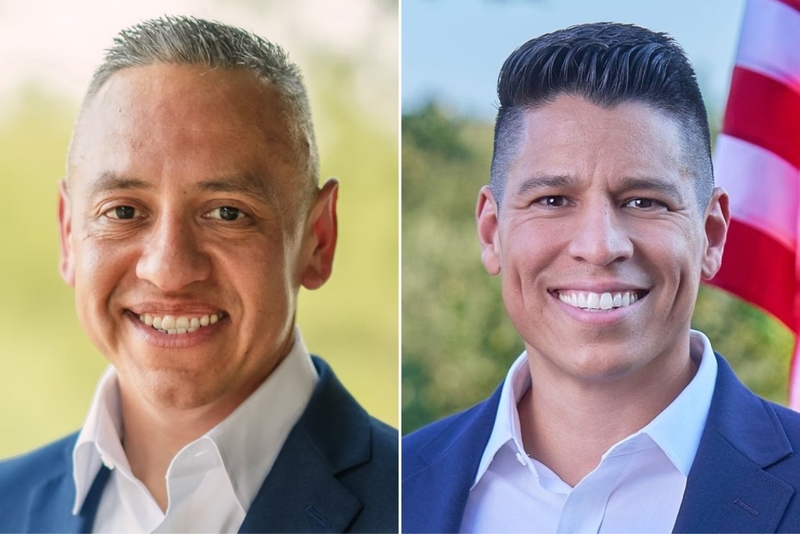
Democrat Johnny Garcia, left, and Republican Carlos De La Cruz will face off in November for Texas' 35th Congressional District. (Campaign photos)
SAN ANTONIO — As canvassers gathered near a golf course on San Antonio’s Southside, armed with bilingual campaign literature and a willingness to brave the September Texas heat, Carlos De La Cruz clarified the stakes for his campaign volunteers.
“God willing, we will maintain the House majority this year,” the Republican congressional nominee said. “But that’s only going to happen through items like this. Let’s get out there! Let’s knock as many doors as humanly possible!”
After introductions and a group prayer led by a local pastor lamenting the separation of church and state, the block-walkers dispersed to sing De La Cruz’s praises at front doors around the neighborhood.
De La Cruz is a first-time Republican candidate running for a U.S. House district his party redrew last summer to pick up seats in the Congress’ lower chamber. An Air Force veteran who served overseas and at San Antonio’s Lackland Air Force base, De La Cruz — the brother of Edinburg Rep. Monica De La Cruz — is essential to House Republicans’ hopes in a cycle where Democrats are favored to take the House.
Six miles up the road, Johnny Garcia, a Bexar County sheriff’s deputy and self-described “old school Democrat” from San Antonio’s Westside, had spent his morning at New Creation Christian Fellowship, a Black church just outside the city’s northeast boundary. There, he shared his economic message to voters — providing some San Antonio flair on an issue Democrats are hammering around the country.
“I say on the campaign trail — speaking to Latinos, because it means that much to us — we’re just trying to make it to Sunday to afford our barbacoa and Big Red,” Garcia said. “This morning, my message to the church was, we’re just trying to make it to Sunday with enough gas in our vehicles to get here to church and still have enough to go to brunch afterwards.”
The race, between two Latino men with respective backgrounds in law enforcement and the military, defies traditional partisan narratives. De La Cruz, who has never held elected office, has no record of tough votes to answer for. Parts of his TV ads, such as his vow to “clean up corruption and lower costs,” are interchangeable with messaging coming from Democrats. And Garcia, a Blue Dog Democrat with nearly two decades in law enforcement, is hard to tag as a socialist or extremist, and is willing to criticize his party on the border and social issues.
“I find it fascinating, because I would argue this is not your normal race when it comes to a Democrat,” said Jon Taylor, a political science professor at UT-San Antonio. “Johnny Garcia is much closer to Vicente Gonzalez and Henry Cuellar, when it comes to being a moderate Democrat … so I think it makes it a much more daunting task for Republicans.”
Compared to the U.S. House battlegrounds in the Rio Grande Valley, where Cuellar and Gonzalez are up for reelection, the race for the 35th Congressional District has flown under the radar. But like in the Valley, the outcome in the 35th could turn on some of the biggest questions in Texas politics this cycle, from whether Latino voters swing back toward Democrats to the success of Republicans’ mid-decade gerrymander.
Of the five Democratic seats the GOP redrew to favor a Republican candidate, analysts rate the 35th as the third most likely to flip — making the race the pivot point for the entire redraw. (The redraw prompted incumbent Democratic Rep. Greg Casar to run in a different district, leaving the 35th as an open seat.)
“I think this is going to come down to a two or three point race [on] either side,” Taylor said, predicting Garcia would win if Bexar County sees high voter turnout.
And as De La Cruz suggested ahead of the recent block walk, the race could be critical for the even bigger question of which party controls the House.
Republicans in Washington are certainly treating it that way. House Speaker Mike Johnson told GOP voters at a gathering for De La Cruz over the summer that “this district is the whole enchilada.” President Donald Trump is set to rally with De La Cruz alongside Senate GOP nominee Ken Paxton in San Antonio this week. And Trump’s political network has spent some $4 million on the race.
The district includes the heavily Mexican American, working-class Southside and the southern portion of Bexar County; the county’s northeast suburbs near Randolph Air Force Base; and three heavily Republican and mostly rural counties east of the city. About 60 percent of the 2024 vote would have come from the Bexar County portion.
As drawn, no statewide Democratic candidate has won the district in recent elections, though Sen. Ted Cruz would have carried it by just 1 percentage point in 2018 and by 4 points in 2024. Trump carried it by a 10-point margin last election.
The seat’s eligible voter population is 51.8% Hispanic. But Hispanic voters typically turn out at lower rates than other groups, making them a smaller share of the electorate; in 2024, for example, voters with Spanish surnames made up just 37% of those that voted in the new 35th District.
De La Cruz’s campaign believes the Southside is the key swing area of the district and is knocking on doors of voters they believe are truly up for grabs. Their pitch leads with an overview of the candidate’s background as a veteran and small-business owner, having opened a kickboxing gym with his wife several years ago.
The Republican, who said in an interview that his mom and grandparents were Democrats, believes swing voters care about candidates’ vision and values above their party affiliation — and that he has a compelling story and economic gameplan to offer them.
“I’m talking about the issues voters care about,” De La Cruz said. “They see my 20 years in the United States Air Force, and that’s the story of this community, being Military City, USA.”
As Election Day has crept closer, the race has gotten more expensive. Republicans have spent or booked $4.4 million on ads in the general election, with $4 million coming from No Going Back PAC, which is affiliated with Trump’s political operation. Democrats, meanwhile, have spent $5.1 million, mostly from House Majority PAC, the main outside group supporting House Democrats.
The Trump-affiliated group has gone after Garcia over a 2019 case in which a teenage inmate of the Bexar County Jail attempted suicide. Garcia, who was the public information officer for the sheriff’s office, which oversees the lockup, called the incident “tragic” and accused Republicans at the state level of providing inadequate support for mental health treatment in local jails.
In their attack ads and on the stump, each candidate has tried to tie his opponent to his party’s unpopular elements. De La Cruz, according to Garcia, is little more than “Donald Trump’s wingman,” a nod to the president’s underwater approval among Latino voters and Texans overall. And Garcia, per De La Cruz, is a “PR guy” who would “make excuses for his party’s open border policies” in Congress.
Despite all the money, the presence of two first-time candidates in a completely new district means that each candidate’s ground game will be doubly important, said Henry Bonilla, a Republican who represented parts of San Antonio in Congress from 1993 to 2007.
Bonilla, who is a finance chair of Associated Republicans of Texas, said 2024 was a watershed moment for Republicans who had long invested in making gains with Hispanic voters. But he worries that the administration’s aggressive immigration enforcement could imperil those gains in districts with significant Latino populations.
“I was surprised back then, where even on the Southside, which is overwhelmingly Hispanic, I’d see pickup trucks with Trump signs,” Bonilla said. “However, a lot of the policies now that have been implemented are driving them away, and that’s extremely concerning to a lot of us who have worked so hard over many years to build that support.”
Garcia
Garcia has spent nearly two decades at the Bexar County Sheriff’s Office, a job he began at age 21 working in the county jail. He went on to be a SWAT crisis negotiator and eventually became the agency’s public information officer.
The Democrat has drawn on that experience on the campaign trail, frequently quipping — including in his television ad over clips of him in uniform — that when law enforcement officers get a dispatch, they don’t ask if the house they’re going to is Democrat or Republican. Part of his pitch to independent voters and even Republicans is what he describes as a willingness to stand up to his party.
The Biden administration, Garcia said, committed “failures” on the border — describing an incident where dozens of dead migrants were found in a truck in San Antonio in 2022 to the emergence of stash houses and the fentanyl trade. And he said he does not agree that trans women should be playing in women’s sports.
“We know we got it wrong on the border here in Texas,” Garcia said, explaining his pitch to voters. “But at the same time, I bring it back to the economy, and just how much things have changed under this administration, with the tariffs that are hurting working class families, with the healthcare cuts. And that’s where folks see, okay — this guy is able to call it like it is.”
Garcia has the backing of local union chapters in the race, including the Communications Workers of America, which conducts weekly phone and text banks and is gearing up for a major get-out-the-vote push. Charles Fuentes, the CWA legislative director, thinks Garcia is a good fit for the district.
“Man, that I-35 corridor down to Southside San Antonio — that’s working class to the bone,” Fuentes said, adding that rank-and-file union members this cycle are more energized and eager to get involved in helping CWA’s candidates.
Garcia’s allies also believe there’s stronger Democratic organizing on the Southside this cycle and that the candidate has been shrewd to lean in on visiting churches.
“I think Johnny has made a good platform for himself,” said Peter Vallecillo, the longtime president of the Bexar County Tejano Democrats, over chips and salsas at a northeast San Antonio restaurant where he has lined the windows with Democratic candidate signs. “I think he’s coming out very energetic. He’s speaking to the crowds. These are all tangibles that make Johnny a very good candidate, especially with [the] Southside. Because they haven’t seen a candidate like Johnny Garcia in a little while.”
To win, Garcia will need to win over Latino voters who pulled the lever for Trump in 2024. VoteHub estimates that Trump captured 44% of the Hispanic vote in Texas House District 118, which encompasses much of the Bexar County portion of the 35th Congressional District.
He believes his laser focus on the economy — and tying high everyday costs back to Republicans — is the winning blueprint.
“Latinos, we just want our fancy troquita — our nice truck — that has 30-inch tires jacked up and our loud mufflers,” Garcia said. “And these days, Latinos are having to park that fancy troquita and now drive their wives’ minivans. That pisses people off, because that isn’t what they voted for.”
De La Cruz
In his ads and on the campaign trail, De La Cruz follows a disciplined message, frequently acknowledging that Texans feel squeezed by high grocery and gas prices. His prescription for bringing costs down, he says, is cutting red tape, particularly for energy production and small businesses.
In a tight race, the outcome could come down to whose vision for the economy appeals to more voters — and who shoulders the blame for its problems. Democrats have especially hammered the Iran War, and the subsequent rise in gas prices it caused, as a key way to pin the blame on the GOP.
De La Cruz, meanwhile, emphasizes his own military service — a biographical detail his campaign sees as a strong fit in a district with a large military and veteran population.
“I stand with our troops and with their families,” he said when asked if it was time to wind down U.S. military engagement in and around Iran. “But I’ll be crystal clear: No one wants Iran to have a nuclear weapon, and our troops are doing some very important work to protect our country. And nobody wants a forever war in the Middle East. I absolutely want it to be resolved peacefully, but at the end of the day, it has to be resolved responsibly as well.”
Armed with Trump’s endorsement in the primary, De La Cruz defeated state Rep. John Lujan, a perennial Republican overperformer in House District 118, a swing seat routinely targeted by Democrats. The veteran spoke at the GOP midterm convention in Dallas in September, dismissing as “hogwash” the idea that he should keep the unpopular president at arm’s length.
More recently, he explained why he sees his support of Trump as a winning political play.
“I won’t manufacture something to disagree with the president on just to make a headline,” De La Cruz said. “I want to make it clear that I’m going to go there and actually work with this administration to bring resources back to our community, whereas my opponent, he would go there to set up shop at MSNBC.”
Janie Fonseca, who runs a local GOP group called Heart de San Antonio Republicans, said De La Cruz is able to connect with Hispanic voters, who she described as more culturally conservative even if they identify as Democrats. And she thinks Republicans, contrary to most polling, can actually improve with Hispanic voters locally due to the rising tide of democratic socialism in other states.
“He can make inroads — as long as people know of him and know what he stands for,” Fonseca said. “He’s a personable individual. And he also has values that Hispanics can relate to.”
Austin, TX