Baltimore can show how to prevent youth homelessness before it begins
Oct 05, 2026 | 11:33 pm ET
Description
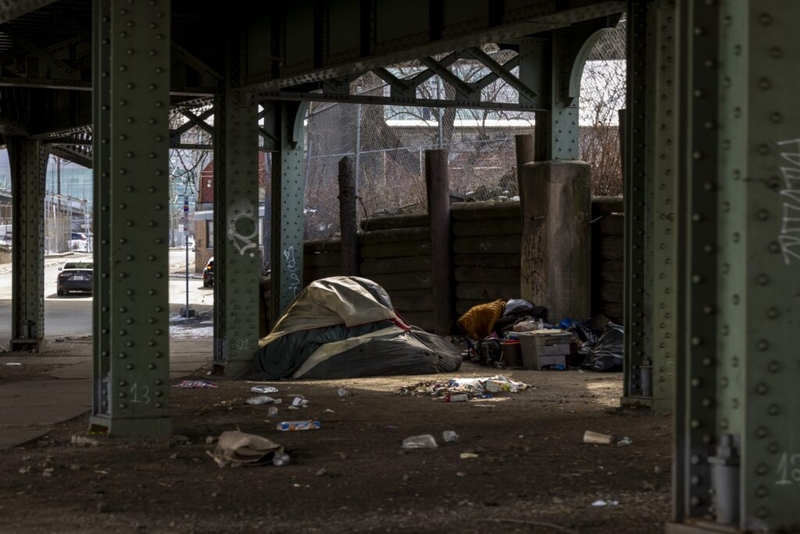
A homeless encampment is seen in Paterson, New Jersey. (Photo by Anne-Marie Caruso/New Jersey Monitor)
Until very recently, Maryland’s response to youth homelessness kicked into gear only after a young person had already lost a place to live, at the most difficult and expensive point in a housing crisis. But Baltimore is bringing a logical, practical and scalable approach to addressing housing insecurity among young people with a simple proposition: Identifying what would keep a young person housed and providing it before a temporary crisis becomes lasting homelessness.
For many young people, homelessness begins with a specific financial emergency. A family conflict leaves someone without a place to stay. An unexpected expense consumes the money needed for rent. A young parent needs a security deposit. A student loses campus housing or lacks transportation to keep a job.
The amount required to stabilize the situation may be modest compared with the cost and disruption that follow. Yet available assistance is frequently too small, arrives too late or can be used only for an expense that does not match the actual problem.
Point Source Youth’s Targeted Housing Assistance Program was designed around that mismatch. A young person facing an imminent housing crisis works with a trained community provider to develop an individualized housing action plan. The program then supplies a one-time, flexible payment large enough to carry out that plan, whether the need involves rent, utilities, transportation, moving expenses or another immediate barrier to stable housing.
The model has now produced encouraging evidence. In a seven-state pilot evaluated by researchers at the Johns Hopkins Bloomberg School of Public Health, 345 young people ages 16 to 27 received an average of approximately $3,700, generally within 48 hours, and those funds ended their crisis and slide into homelessness. Including dependents and other household members, the program affected 623 people. Administrative homelessness system records showed that 92.8% of participants had not accessed homelessness services six months after receiving assistance.
Those findings show that rapid, adequately funded assistance delivered before shelter entry merits expansion, and merits investment.
That next phase is underway in Baltimore through Point Source Youth’s partnership with Thread, a local organization with the relationships and community knowledge needed to reach young people before a housing crisis becomes visible to the formal homelessness system. The results in Baltimore will help determine whether the national pilot’s results can be reproduced locally, and what infrastructure is required to sustain the model.
Private funding has made that work possible, but it cannot be the endpoint.
Baltimore City and the state of Maryland should help finance future cohorts and the local capacity required to serve them. That means supporting the payments themselves, along with the outreach, staffing, housing planning and follow-up that make the intervention work. Public partners can also help establish efficient disbursement procedures, strengthen responsible data sharing and support independent evaluation of Baltimore’s results.
Such an investment would be disciplined rather than open-ended. Public officials could examine who the program reaches, how assistance is used, whether participants remain outside the homelessness system and which elements must be preserved as the model grows. Local evidence would then determine the appropriate scale and funding structure.
Maryland is particularly well positioned to do this work. Baltimore has experienced community organizations capable of delivering the program, Johns Hopkins researchers who can continue evaluating it and public leaders who understand that housing instability affects education, employment, health and family stability. This October, Point Source Youth’s national symposium in Baltimore can bring those groups together around a concrete question: What would it take to make prevention a durable part of Maryland’s homelessness response?
The national implications are significant. Communities across the country are searching for ways to reduce homelessness while controlling the cost of crisis systems. A successful Baltimore implementation, backed by credible local evidence and a serious public-sector partnership, could give other jurisdictions a model they can adapt.
Maryland does not need to wait until every question has been resolved. It should invest enough to learn what works while young people still have housing within reach.
Annapolis, MD