Tom Tiffany’s dam lies
Oct 06, 2026 | 4:30 am ET
Description
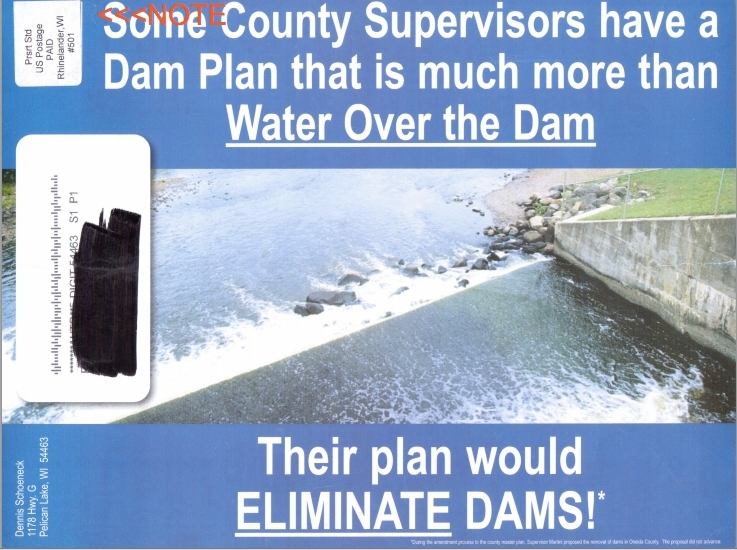
This is one of the flyers sent to Oneida County residents in 2014
The flyers that arrived in mailboxes in Oneida County, Wisconsin, just days before the April 1, 2014, county board elections, were nothing if not alarming. “Some County Supervisors have a Dam Plan which is much more than Water Over the Dam,” they warned. “Their plan would ELIMINATE DAMS!*”

Underneath this incendiary accusation, in tiny type, was this asterisked elaboration: “*During the amendment process to the county master plan, Supervisor Martini proposed the removal of dams in Oneida County. The proposal did not advance.” The flyers, otherwise identical, each bore the names and photos of one of the four county board candidates who would heroically “Stop Their Dam Plan!”
Dams are critical infrastructure in northern Wisconsin, essential for lakefront homes and resorts, boating, fishing and other outdoor recreation. To seek their wholesale eradication, as Oneida County Board Supervisor Bob Martini allegedly did, is akin to proposing the expulsion of the Green Bay Packers. A 2013 report counted 42 dams in Oneida County, about half described as large, and half as small, some privately owned and some owned by utility companies, towns, the Wisconsin Department of Natural Resources, and the county itself.
In the April 1 election, two targeted incumbents were defeated. Martini lost badly to challenger Robb Jensen, 213 to 128 votes, and Supervisor Candy Sorensen lost to challenger Lance Krolczyk by fewer than a dozen votes. A third incumbent, Bob Mott, beat a challenger by a narrow margin, while a fourth targeted candidate, Alan VanRaalte, won election to an open seat.

In February 2015, I wrote a two–part report on this matter for the Wisconsin Center for Investigative Journalism, now Wisconsin Watch, where I worked as a writer and editor. I noted that both Martini and Sorensen blamed the flyers for their defeats, and all four targeted contenders said the representations in the flyers were false.
Martini, a former rivers protection coordinator for the state DNR, told me he had “never made an amendment or proposal to remove dams in Oneida County” and does not support a policy of doing so. He noted that counties don’t even have this authority, adding “It’s just wrong to lie to try to get elected.” Sorensen said that, during her time as a county board member, “there has never been any discussion or plan on removing Oneida County dams.” Mott and VanRaalte likewise denied any knowledge of a dam-removal plan, with VanRaalte exclaiming, “I live on a lake that’s created by a dam!”
What makes this story significant 12 years after the fact is that the flyers were produced with input from a Republican state senator who went on to become a member of the U.S. House of Representatives and is now his party’s nominee in the race for Wisconsin governor. His name is Tom Tiffany.
Tiffany’s explanation
When I interviewed Tiffany in 2015, he admitted to me that he helped craft the wording of this flyer, as well as another flyer aimed at boosting the candidacies of the same four candidates by accusing the county board of wanting to sell a county building at a substantial loss. He told me he was acting not in his capacity as a state senator but as a resident of Oneida County: “I care about my county. It’s important to be engaged.”
Tiffany provided a convoluted explanation for why the mailing, disclaimed by all four targeted candidates, was somehow still true. He argued that besides playing an “instrumental” role in past DNR dam removal projects, Martini served on the board on the River Alliance of Wisconsin, which Tiffany said is “associated with” a national group called American Rivers, which has “a bias toward removing dams.” The folks at the River Alliance said the two groups had no formal ties.
Tiffany also claimed that, during discussions on a county land-use plan, Martini had offered “some wording that was favorable to dam removal when possible.” Jensen, the challenger who beat Martini, also latched onto this thin reed for alleging that some board members had a plan to eliminate the county’s dams, saying a draft land-use plan favored by Martini included this language: “Support dam/drainage way repair and removal where appropriate.” Martini said he had no role in crafting this language, which was removed when some towns objected.
In a recent email exchange, Martini elaborated on the allegation that precipitated his electoral defeat: “The flyer said there was a plan to remove all the dams in Oneida County. There was no such plan. Even if there was a plan I would have opposed it on several grounds.” He went on to list some examples of dam-removal efforts he opposed during his time at the DNR.
DOJ investigation
In August 2014, a group formed in response to the flyers, Citizens for Democracy in Oneida County, filed a complaint against Tiffany and others with the state Government Accountability Board, an entity which at that time oversaw state election laws. The complaint alleged more than 70 violations of state elections laws, most dealing with whether the mailings met requisite disclosure rules and reporting requirements. It also accused Sen. Tiffany of causing “the dissemination of improper campaign information.”
The GAB declined to investigate, saying it defers to county district attorneys to investigate and prosecute such matters. And so the group sent its complaint to then-Oneida County DA Michael Schiek, who forwarded it to the state Justice Department, then headed by Republican Attorney General Brad Schimel. “We have received the information and it is under review,” DOJ spokeswoman Anne Schwartz told me in January 2015.
Recently, in response to an open records request and some prodding, the DOJ released to me its 91-page file on the case and associated documents. These records show that Special Agent Loreen Glaman was assigned in April 2015 to investigate the allegations, She interviewed at least a half-dozen people, including all four of the candidates the flyers were meant to assist. Tiffany himself does not appear to have been interviewed, but his role was described by Jensen, who “explained that Tom Tiffany approached him and suggested a mailing” and “assisted in designing the flyer.”
On July 15, 2015, Assistant Attorney General Jeffrey M. Gabrysiak wrote a “closeout of investigation” memorandum to Assistant Attorney General Roy Korte. The memo says the investigation found that while “some of the conduct in question appeared to constitute technical violations of the state’s election laws,” none appeared to be deliberate. Specifically, Gabrysiak concluded the flyers’ almost microscopic and bizarrely misspelled disclosure — “Authoized and pad for by candidate” — fell short of what the law requires, which is to include the name of the candidate or committee in this wording.
But Gabrysiak said the more significant allegations reported by Citizens for Democracy in Oneida County “lacked merit,” calling the one exception regarding requisite disclosure “minor” and “likely attributable to a lack of knowledge regarding campaign law or simple inadvertence.” He shrugged off the complaint’s allegations of untruthfulness, saying “Whether false statements have been made in campaign fliers is a subject of debate.”

Nonetheless, Gabrysiak recommended and ultimately sent warning letters to the four candidates, saying they “failed to properly name the sponsoring candidate or committee as required by law.” The letters said that while this failure was likely not intentional, the candidates would not be given “the benefit of the doubt as you were in this situation” should they again run for office. “This letter is meant to put you on notice that you will be expected [to] make yourself familiar with, and comply with, all applicable campaign laws and that failure to do so will subject you to criminal prosecution.”
Far from the truth
What is most remarkable about this episode is the vastness of the gulf between the truth and what was stated in the flyers that Tiffany instigated and helped craft. While it may not rival other concerns about Tiffany, including his efforts to overturn the 2020 presidential election results, Tiffany’s actions in connection with these flyers raise serious concerns about his honesty and integrity.
The record shows that Tiffany set out, with some success, to kneecap candidates for local office with the blatantly untrue accusation that they had a “plan … to ELIMINATE DAMS” in Oneida County. And he stuck to this fabrication even after it was pointed out that none of the targeted candidates favored any such thing.
At the time I wrote about this episode, I remember being shocked by Tiffany’s apparent disregard for the truth, which I considered extraordinary. It was my impression, based on decades of reporting, that people in public office rarely say things that are flat-out and demonstrably untrue, as Tiffany did in this case. There is — or at least there was, back in the days before Donald Trump — too much danger that outright lies will be exposed and consequences will ensue. And indeed, the wounds opened by Tiffany’s conduct prompted some members of Oneida County to file a complaint that led to official investigation, however unsuccessful it proved to be.
In his current campaign for governor, Tiffany has also displayed a predilection for dishonesty. For instance, Tiffany has sought to distance himself from Trump’s wildly unpopular war in Iraq, saying it’s time to wrap things up, when in fact Tiffany has voted five times against resolutions to end the war.
Tiffany, to his discredit, has recently been airing an ads blaming Crowley for allowing a county jail inmate to download child pornography. It features Crowley’s face alongside text that proclaims “Used the tablet to access child pornography,” as though it were Crowley who was doing the accessing.
But even this ad is arguably more defensible than the flyers that Tiffany devised in 2014; the county jail does have a program to provide tablets to inmates, some of whom got busted for misusing the privilege. The fairness of blaming Crowley for this is debatable, but at least the criticism is based on something that actually happened, unlike the plan to eliminate dams.
I suspect the current ads were created with input from campaign professionals who are mindful of just how far they can push the boundaries of campaign speech, while the 2014 flyers reflected Tiffany’s own unchecked inclination to deceit. Maybe that’s why he is no longer interested in trying to defend them. Tiffany’s campaign did not respond to requests for comment.
Madison, WI