Judge dismisses Lutheran church challenge to Tennessee law making it a crime to harbor immigrants
Oct 05, 2026 | 2:25 pm ET
Description
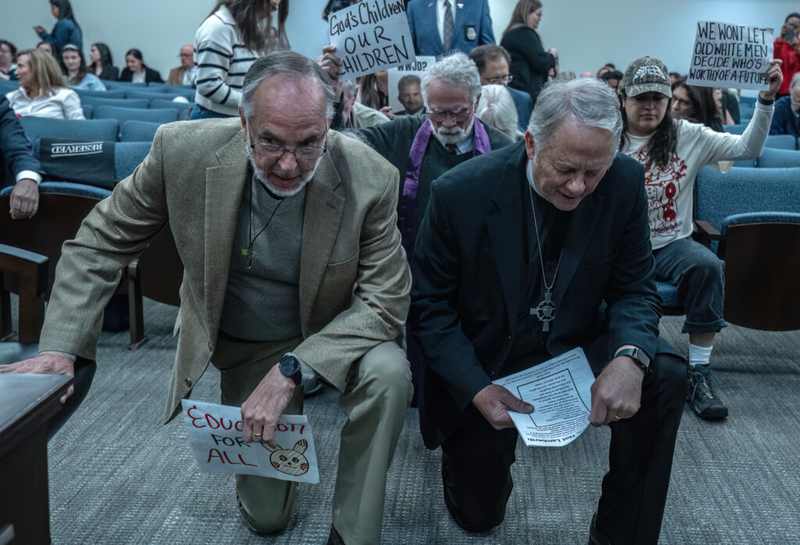
A federal judge on Sept. 20. 2026 dismissed a challenge to Tennessee's human smuggling law brought by Lutheran churches. Rev. Rick Roberts, pastor of St. John’s Lutheran Church in Donelson and Rev. Matt Steinhauer, interim pastor of St. Andrews Lutheran Church in Franklin, knelt in front of lawmakers debating a bill to deny an education to some immigrant children during the spring 2025 session of the Tennessee Legislature. (Photo: John Partipilo/Tennessee Lookout)
A Tennessee law that makes it a felony to “harbor” immigrants without legal status remains enforceable after a federal judge last week dismissed a legal challenge brought by Lutheran churches.
The law defines human smuggling as intentionally concealing, harboring or shielding from detection, for financial gain, any individual known to have illegally entered or remained in the United States.
It includes in the definition of human smuggling — a felony punishable by up to six years in prison — any attempt to transport an individual without legal status in an effort to conceal them from law enforcement, including immigration agents.
Days before the law took effect in July 2025, the Southeastern Synod of the Evangelical Lutheran Church in America, along with a Nashville landlord and a father whose son-in-law is an asylum seeker living in his household, filed suit.
They contended the law was an unconstitutional usurpation of federal powers to exclusively enforce immigration law and violated the First Amendment’s rights of the Synod congregations, which provide shelter and services to immigrants regardless of immigration status, often paid for by charitable contributions. The plaintiffs also argued the law was overly vague.
Suit seeks to block Tennessee law that makes it a crime to “harbor” certain immigrants
In dismissing the lawsuit last week, Chief District Judge William Campbell, Jr. ruled the churches, landlord and father-in-law lacked legal standing to challenge the law, because they could not show an immediate threat they would be prosecuted under its language.
Campbell, nominated to the bench by President Donald Trump in 2017, cited state attorneys’ assurances that the law applies only to “for-profit” operations that knowingly harbor or transport immigrants without legal status, not churches that accept charitable contributions to provide services that align with their faith.
State attorneys also said that a violation of the law occurs not only by providing shelter but to do so with an “intent to conceal.”
The judge conceded that the state’s interpretation of the law presented in court is not explicitly stated in the law’s language.
“The court has serious misgivings that the defendant’s interpretation is not supported by the statutory language, particularly with regard to the purported ‘intent to conceal’ requirement and whether the statute requires knowledge of illegal status or knowledge of an ICE determination of illegal status,” Campbell wrote.
Even so, he concluded the plaintiffs had not met their legal hurdle to demonstrate they had the right to challenge the law, because they could not demonstrate they were likely to be prosecuted under it.
The decision

Nashville, TN