Removing federal protections for wolves would be catastrophic
Oct 05, 2026 | 8:53 am ET
Description
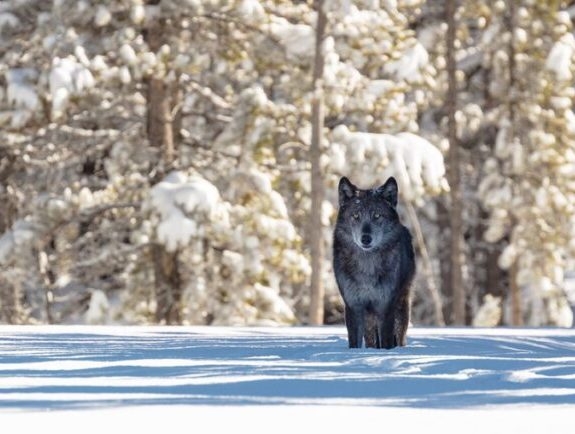
A gray wolf prowls the winter forest (Photo courtesy of National Park Service)
President Donald Trump recently issued an executive order that seeks to sacrifice wolves to placate farmers and ranchers for his tariff policy. This order is nothing more than smoke and mirrors, and it’s obvious that it won’t make a real difference for ranchers and farmers who are struggling.
The executive order gives the U.S. interior secretary 90 days to decide whether to remove Endangered Species Act protections for gray wolves and Mexican wolves in the United States. The order also calls for Interior Secretary Doug Burgum to prepare a legislative recommendation for Trump to fully delist or downlist wolves and, upon determination that recovery criteria have been met, encourage states to delist wolves and revise state standards for the killing of wolves in order to help ranchers.
In other words, though it does not immediately remove federal protections for wolves, it’s clearly intended to provide momentum for either Congress or the U.S. Fish and Wildlife Service to do so.
Delisting would be catastrophic for Minnesota’s wolves, which would almost certainly face trophy hunting and recreational trapping seasons. Such killing rips wolf families apart, as studies show that killing just one wolf can lead to the dissolution of the pack and the deaths of other members.
When Minnesota’s wolves were delisted in 2011, more than 900 were killed in just three seasons. Nearly half of the wolves were killed using steel-jawed leghold traps or strangling snares. When wolves were delisted again in 2020, Minnesota held off on a hunt until the state could update its wolf management plan. Prior to the finalization of that plan, a federal judge overturned the delisting decision, and wolves were again federally protected as “threatened” in Minnesota.
If wolves are delisted again, however, the Minnesota Department of Natural Resources would very likely propose a hunting and trapping season. There have also been attempts in the Legislature to require the state to hold a wolf season if they are delisted.
To be clear, Minnesota farmers experience very few conflicts with wolves. According to the state Department of Natural Resources, only 2% of livestock farms in parts of the state where wolves live experience confirmed conflicts each year. For those who do experience conflict, nonlethal tools like fencing, guardian dogs and removing attractants are the best way to prevent conflicts and reduce the vulnerability of farmed animals.
A cattle ranch near Voyageurs National Park is a perfect example of the efficacy of nonlethal tools. There, the Voyageurs Wolf Project with the University of Minnesota has documented that a 7.5-mile fence has effectively prevented any conflicts since 2023 on a ranch that is at the center of multiple wolf pack territories.
Wolves aren’t to blame for a disappointing deer hunt, data show
The state provides grants and expertise to help farmers implement nonlethal tools, and USDA Wildlife Services staff have also found success in Minnesota with those deterrence methods. Although studies demonstrate that killing wolves does not solve conflicts, the fact that they are listed in Minnesota as “threatened” under the federal Endangered Species Act means that officials already can — and do — kill wolves in response to conflicts.
According to the USDA, most livestock losses are caused by bad weather, respiratory issues and disease, or birthing problems. But you can’t kill the weather, so it is easier to blame wolves.
It is likewise easier to pin culpability on wolves for perceived reductions in the deer and moose populations. Yet, as researchers with Voyageurs Wolf Project pointed out in 2023, “Hunting wolves won’t save Bambi.” Deer fawn survival rates in Minnesota are on par with rates elsewhere, including places without wolves. The scientific consensus is that wolves are not a main factor limiting deer populations and that killing them won’t increase deer abundance.
The same facts pertain when it comes to Minnesota’s moose population, which has been stable for more than a decade; studies have indicated that parasites, climate change and other factors pose the biggest threats.
Wolves keep deer and moose herds healthy by preying on weak or otherwise compromised animals who would likely die from other natural causes. Wolves also play a critical role in mitigating the spread of disease in prey species. Recent studies also show that wolves can reduce deer-vehicle collisions by altering deer movements, saving lives and dollars.
Delisting a species is not just about numbers. Wolves face many threats to recovery, including poaching, habitat loss and state agencies bowing to pressure from trophy hunters and recreational trappers.
Minnesota needs wolves, and Minnesotans value them. Polls conducted by both chambers of the Legislature at the 2023 Minnesota State Fair found that more people oppose wolf hunting than support it. A 2019 study by the state in partnership with the University of Minnesota found that 86% of Minnesotans want to maintain the wolf population at its current level or higher.
Keeping federal protections in place is our first line of defense against trophy hunting and recreational trapping, and our members of Congress and officials at the U.S. Fish and Wildlife Service must hear that message from us. At the same time, we must remain vigilant here in Minnesota to ensure that if wolves do lose their federal protections, we keep them out of the crosshairs of those who view these highly intelligent, family-oriented animals solely as trophies or pelts or the objects of misplaced fears and irrational hatred who deserve to be killed.

Saint Paul, MN