An Essex County officials’ parking fight puts taxpayers in a tight spot
Oct 04, 2026 | 6:58 am ET
Description
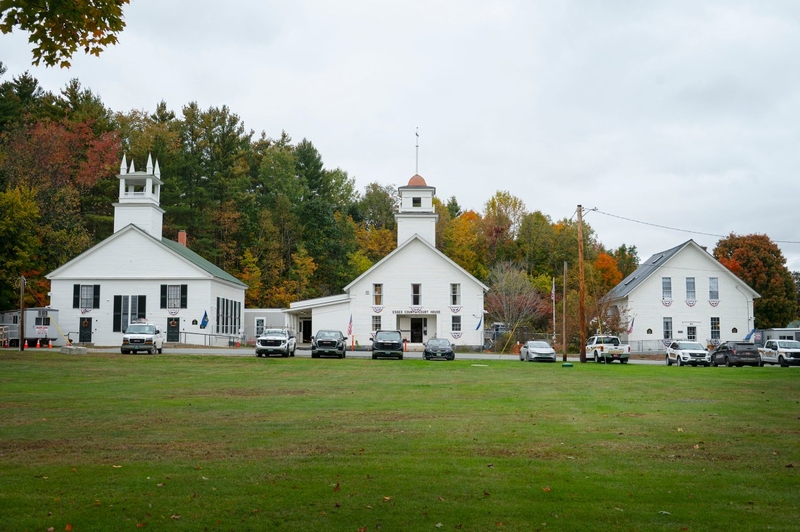
The Essex County Courthouse in Guildhall, center, sits between the Meeting House (left) and the Essex County Sheriff’s Department on Wednesday, September 30, 2026. . Photo by Glenn Russell/VTDigger
Essex County’s sheriff and assistant judges have taken a simmering parking fight to court, leaving taxpayers caught between the cost of stopping construction and the risk of paying to redo it.
“Would it cost more to delay the project and design it correctly,” said Brice Simon, the sheriff’s attorney, “or would it cost more to do the project, find out later it wasn’t done quite right, and then have to deconstruct things and redo it?”
The dispute concerns changes to renovation plans for the Eben Judd Justice Center in Guildhall, a project that is projected to cost $4 million. The amended plan was approved by the Town Of Guildhall Planning Board on Aug. 27. Sheriff Trevor Colby argued that the revised plans for the parking area violate zoning laws and would hinder his department’s operations.
Meanwhile, Evan Hammond and Kenn Stransky, two of the county’s assistant judges who lobbied for state approval and funding for the construction project, said that Colby lacks sufficient legal grounds for an appeal, while the project manager warns that delaying construction would drive up costs.
The outcome could determine both how the sheriff’s department operates at the renovated center and how much taxpayers ultimately pay for the work.
Colby filed his appeal of the permit on Sept. 4 with the Vermont Superior Court Environmental Division, which handles local zoning disputes. At the initial Sept. 21 hearing, Judge Joseph McLean asked the parties to try to resolve the dispute through discussions before proceeding in court.
“It’s important for these different components of county government to be talking to each other and working with each other for any number of reasons, but not the least of which is the public perception,” McLean said in the Sept. 21 hearing.
Simon said he understood the judge’s concerns, but also saw a benefit in creating space for civil disagreements.
“On the one hand, ” Simon said, “it shows a healthy dialog between different branches of government that’s being conducted in a manner that, although has certain procedural formalities, it affords each side due process and a chance to be heard.”
Nicholas Low and Sarah Buxton are the attorneys representing the judges in the case, Hammond and Stransky. Low declined to comment on the record when asked about public perception of disputes between components of county government.
Colby argued in the initial appeal that the amended zoning permit for the renovation project violated the Guildhall Zoning Bylaw. The amended plan would affect a parcel of land not identified in the application or public notifications, Colby wrote.
The sheriff’s department is adjacent to that parcel of land, Colby wrote, and the changes would significantly impact the department’s ability to safely transport defendants into the building by reducing their parking capacity.
Along with the reduced parking, the revised plan includes a retaining wall, which blocks the sheriff’s department’s access to the building from the private parking lot, Colby said in an interview. Deputies instead must walk around the wall and up a flight of stairs to access the office, he said.
“The further you have to walk somebody who’s intoxicated in handcuffs, or anybody we’re bringing in for processing … the more public safety risk is increased,” Colby said.
Colby is appealing on behalf of the sheriff’s department, Simon said in the initial hearing on Sept. 21.
Colby also asked to expedite the case and sought an immediate pause in construction on the parking element of the project to prevent work from being completed that might later need to be undone.
McLean, the judge in the case, denied the stay request on Sept. 11 but agreed to expedite the case overall. To meet the requirements for a stay, the person must prove that “immediate and irreparable” harm will happen to them before the other side can be heard, according to his written statement.
Colby’s appeal did not meet those standards, McLean wrote.
Stransky and Hammond, the county judges, lobbied for two years to get the project approved and funded by the state. Low filed a motion to dismiss the appeal Sept. 18.
The original plan would have expanded the sheriff’s department’s parking lot from 11 current spaces to 22, Colby said. But revisions made because of a design error raised the parking lot’s elevation, reduced the number of spaces and added a retaining wall, he said. The wall was installed before the appeal, Colby said.
The redesign was necessary for safety reasons because designers found a steeper elevation drop than originally anticipated between building the entrance and the parking area, Buxton said at a July 17 town board meeting, according to past reporting from the Caledonian Record.
The revised plan changed the number of parking spots from 22 spots to nine, according to Colby’s motion for immediate stay and expedited consideration.
In his appeal, Colby claimed that he qualified for “interested-person status” under Vermont state law, because he continuously occupies the property adjoined to the construction site.
However, Low argued in his motion to dismiss that Colby did not have sufficient standing because the Vermont state law cited by Colby requires a “legal title or right to a property in the immediate neighborhood.”
“Reconfigured parking, altered pedestrian routes, and access changes to this public building will affect all members of the public equally,” Low wrote.
Project manager Zoltan Horvath wrote in a court document that a delay would increase costs because materials might need to be stored, the construction manager would need to be paid for extended time, and winter tends to add costs to construction projects.
The dispute requires balancing those expenses against the potential cost of undoing construction of the parking area if Colby’s appeal succeeds, Simon said.
“If while you’re disputing that the person goes ahead and builds what they got a permit for, the horse’s left the barn,” Simon said. “And so the whole idea of a stay is to try to get the permit holder to have to stop the work so that you can then have your due process.”
Before the appeal can proceed further, Colby must establish standing, or show that he is sufficiently affected to bring the appeal, Low said.
“We think it’s enough of a question that, obviously, we brought it to the court,” Low said.
The court has not yet scheduled a date for the next hearing. Construction continues in the meantime, Colby said.
Low and Simon said they hope negotiations will resolve the dispute.
“Odds are we should be able to work something out,” Simon said. “If we can’t, the courts are there to make final decisions.”
Correction: An earlier version misidentified the Vermont Superior Court Environmental Division.
Read the story on VTDigger here: An Essex County officials’ parking fight puts taxpayers in a tight spot.

Montpelier, VT