Immigration insights: Tears and action follow ICE raids in southwest Kansas
Oct 03, 2026 | 9:00 am ET
Description
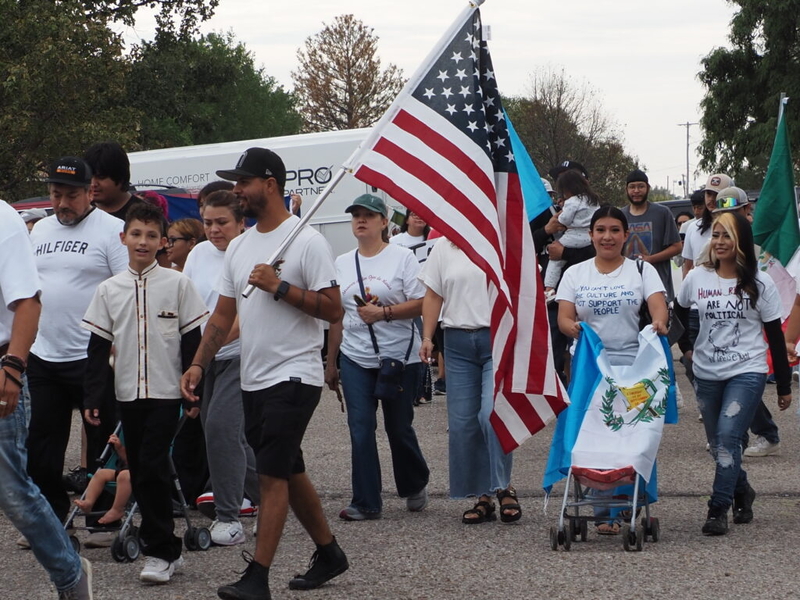
Dodge City protesters gather at Wright Park on Sept. 25, 2026, to march to U.S. Rep. Tracey Mann's office. They were protesting U.S. Immigration and Customs Enforcement actions in the community. (Photo by Morgan Chilson/Kansas Reflector)
DODGE CITY — U.S. Immigration and Customs Enforcement agents arrived in southwest Kansas on Sept. 22 and departed three days later, leaving fear, uncertainty and anger.
Many in the Hispanic and Latino communities in Dodge City, Garden City and Liberal, where most ICE activity was located, returned to work this week. But their fear persists and they aren’t yet leaving their homes or returning to regular activities, multiple immigrants said.
The fear was contagious. In Manhattan, about 225 miles east of Dodge City, social media posts blasted warnings of possible ICE agents on Thursday because of a large presence of law enforcement vehicles in a store parking lot. It turned out to be a training session for local police, according to a store employee.
Here are a handful of glimpses into the lives of Kansans affected by the raids.
Viridiana Boron, volunteer
Viridiana Boron spent several days last week delivering meals to Dodge City families whose members were scared to leave home because ICE was in the area.
Her mother and sister cooked meals for about 200 people, and Boron delivered them, she said.
“I was the one that was on the street and watching everything, watching all the suffer the families was having,” she said, pausing to apologize for her English. “I saw the reality, the truth. They were scared. They were sad. They were worried. I saw families with no water.”
Boron started crying.
“It was something that I’ve never seen in my life,” she said. “How can people not have heart and just do things like that? Because I mean, there I know could be a lot of immigrants over here that are like criminals, but a lot of people that I saw, they were not criminals. They were people working hard for their kids.”
This week, many people she knows have returned to work, but they aren’t eating out or shopping as the fear lingers, Boron said.
Boron came to the United States at age 24, receiving a visa because she and her family were threatened in Mexico. She has since married and is a legal permanent resident. Despite knowing she had the correct documentation, she was scared during the ICE operation.
Others who stayed home also had documentation, she said. But they have seen instances where it didn’t matter, and ICE agents stopped cars to check paperwork just because someone looked Hispanic or Latina, Boron said.
The affect on the community was “huge,” she said. It was difficult explaining to her 11-year-old son why people were scared because he didn’t understand the difference a paper could make, Boron said.
“We are all the same,” she said.
Julie Barraza, volunteer and activist
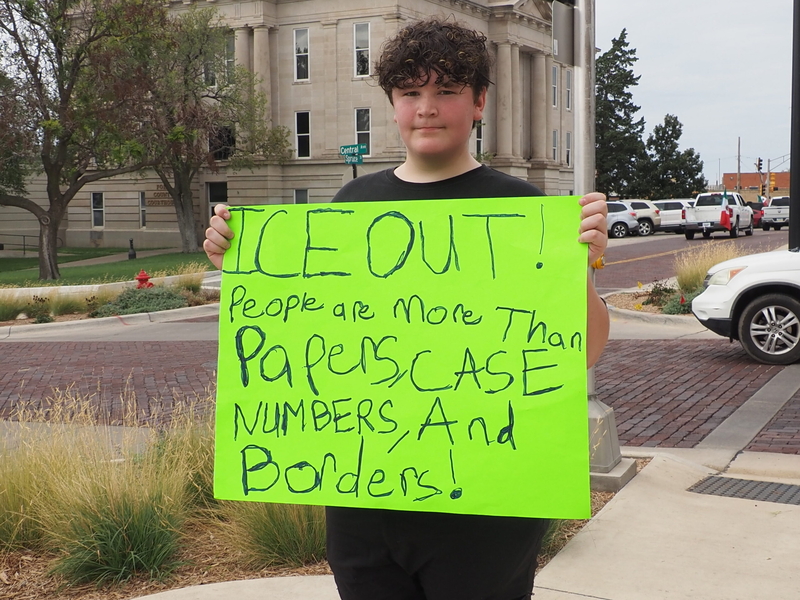
Julie Barraza smiled at everyone approaching the table she set up at a downtown Dodge City protest on Sept. 24. She patiently answered questions about a petition to reform the country’s immigration system.
“I was born and raised here, and I’ve never seen such a cloud over the town,” she said during a break. “The first morning, they (ICE) were waiting for me to get out of my car, and I didn’t know what was going on. I didn’t get out of my car.”
Barraza drove on to work at Rattlesnake Grill. She said ICE agents came in to eat but employees didn’t realize they were with ICE because they wore regular clothing.
“Once we figured out they were ICE agents, because a customer had alerted us, I stepped out and decided to tell them to leave, and they refused,” she recalled. “I was scared, but I still did it.”
The agents did get up and leave, Barraza said, adding that several restaurants in town refused to serve agents and others closed because there weren’t employees to work.
Patrick Lopez, immigrant and educator
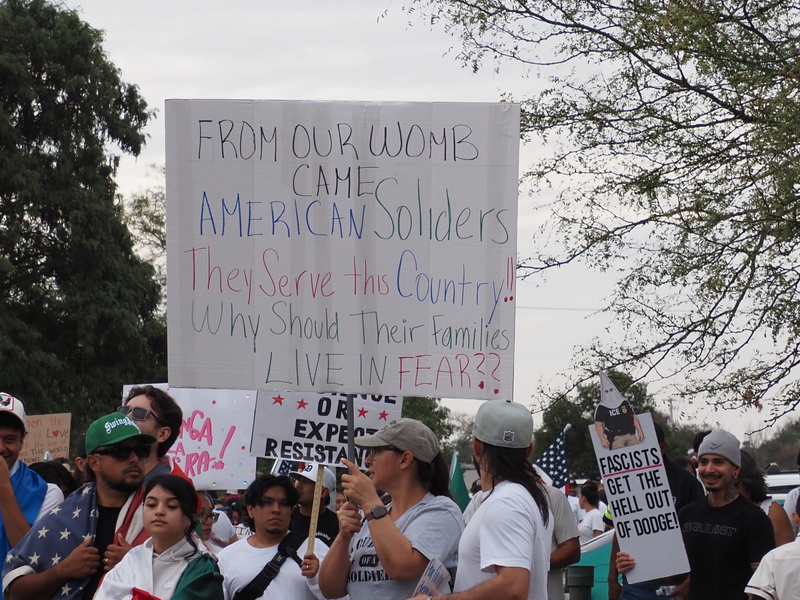
Patrick Lopez stood in the midst of a Dodge City protest on Sept. 24, holding a sign and nodding to people he knew. He was there, he said, to “show solidarity with people who are being persecuted by ICE.”
“I’m here to defend my immigrant brothers and sisters. I’m here to stand up for them, and I hate that they have to live in fear right now,” Lopez said. “I can’t sleep last night. I’m offended as an American. I’m embarrassed as an American. I’m indignant. I can’t believe that this is happening right now.”
While acknowledging the economic costs to town — restaurants closed, businesses slowing or stopping work — Lopez said they weren’t what made him toss and turn at night.
“I also wish that people remembered the human rights effect,” he said. “People’s families should be protected. I don’t care what the issue is. You can’t destroy people’s families like that and hopefully get away with it.”
He tried unsuccessfully to reach a friend who drives a cab and worried that he was detained.
“He works every day, and that’s the thing. The people that ICE is after are hardworking people around town,” Lopez said. “Many of them are putting their kids through school. They’re just trying to make a living.”
Sarahí Aguilera, therapist and immigrant
Sarahí Aguilera is a licensed social worker, and she works as a mental health therapist. Advocating for the immigrant community, she said, is at the foundation of her personal and professional life.
She knows the challenges well. Aguilera is part of the Deferred Action for Childhood Arrivals program, which allows young people who arrived during specific time periods to apply and work in the country.
DACA has been under fire during President Donald Trump’s administration, she said, but she was fortunate that her permit didn’t expire when the program was temporarily halted. Since then, it has been a “consistent uphill battle” to keep the program active, Aguilera said.
Other family members weren’t so lucky. Aguilera’s sister had just been to an immigration appointment after turning 15, which is the age that people can apply for the DACA program, Aguilera said.
“We had started her paperwork. She had been approved. She had gone to her biometrics. I lived at Wichita at the time because that’s where I was getting my education,” she said. “And she got approved. She just never received her work permit.”
It was frustrating because when the family looked her up in the system, it said she was approved, Aguilera said. But she never physically received the approval that would allow her to receive her driver’s license or continue her education.
Her sister eventually married and is in the process of acquiring her documentation, Aguilera said. The experience reminds her how difficult it is to go through the immigration process and how different it is for each person, she said.
“Especially seeing me and believing she was going to have the same opportunity,” Aguilera said. “It really impacted her mental health and her motivation to further her education and just work on herself.”
Aguilera volunteers with New Frontiers, a nonprofit organization that works with young people in southwest Kansas to create a grassroots movement focused on political, social and economic power.
The group has a rapid response team that becomes active when events like ICE raids in the area occur, she said. Volunteers watch for ICE agents and try to verify information before releasing it to the community.
“Fear already does a lot to someone,” Aguilera said. “So fear and the wrong information — we want to make sure that we’re just prepared and grounded with what information we’re trying to share.”
Fear of the unknown is a problem for southwest Kansas immigrants, Aguilera said, along with how overwhelming information coming out could be.
While ICE was in the area, she saw about four clients because most were afraid to go out. Typically, her schedule is full every day.
Aguilera said she understands why some people are critical of immigrants who don’t have documentation.
“There is so much misinformation. I believe as a society we need to do a better job of understanding what the immigration process looks like,” she said. “Of understanding what are the barriers, what are the circumstances? Because there is not a system that is going to work for all of us.”
DACA recipients, for instance, don’t have a pathway to citizenship unless they marry or their jobs petition for them, Aguilera said.
Whatever a person’s belief system, she said, she hopes people are careful with their words.
“I do think it’s important to be mindful of the comments and what they can do to the mental health of someone overall,” she said, adding that people are easily influenced by social media and political figures, who she believes often don’t understand the process either.
Does she think significant immigration reform is likely?
“My heart wants to say that it’s hopeful. My uncertainty and anxiety that I’ve experienced for the past 10 years wants me to have a different answer,” Aguilera said. “I do believe people are opening their eyes. I believe we are getting a lot more information and more attention. Although I think we are creating great awareness and sharing information and education, I don’t believe we will see the impact and the change we want to see until people get out and vote.”

Topeka, KS