No single failure caused LA fires, report finds. Who fixes the system?
Oct 02, 2026 | 12:00 pm ET
Description
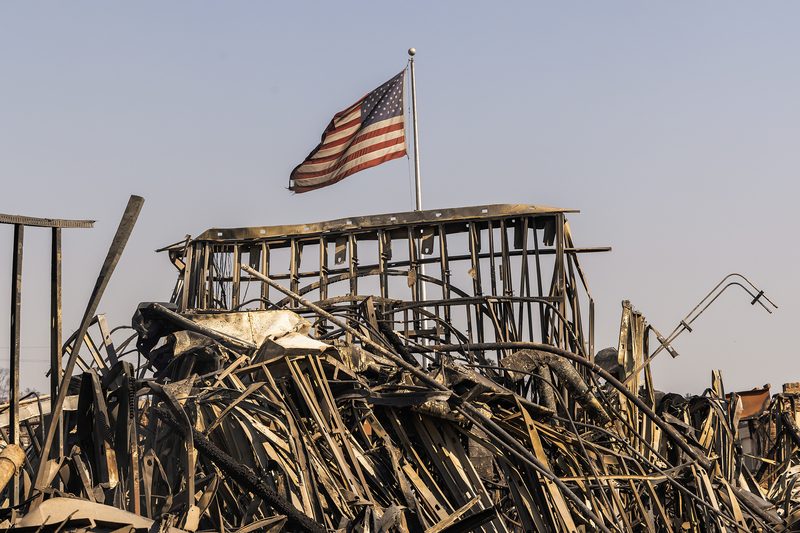
No single failure explains the devastation of the Palisades and Eaton fires that burned through Los Angeles County in January 2025, a new report concludes. Instead, the blazes exposed weaknesses across a system never designed to combat a wind-driven conflagration that spread from structure to structure at sweeping scale.
The 723-page report dropped Friday morning. Commissioned by Gov. Gavin Newsom, it lands during his last months in office and just days after California’s Legislative session concluded. The report doesn’t pin the disaster on a single agency or decision. Its authors caution against seeking one culprit or one magic fix.
As a result, the report, which completes an analysis of some of the most deadly, destructive and costly fires in state history, raises a harder question: If responsibility is spread across an entire system, who is responsible for fixing it?
A governor-ordered review
The Fire Safety Research Institute’s first report, published last November, offered a detailed timeline beginning Jan. 7, the day the Palisades and Eaton fires ignited less than eight hours and roughly 30 miles apart. The institute’s final report takes a closer look at the policy gaps the fires exposed.
“While the state continues to advance building codes, hazard mapping, fuels treatment programs and insurance-related reforms, these efforts are not consistently translating into reduced risk at the parcel, neighborhood, or landscape level,” the authors wrote.
Informed by interviews with nearly 300 people from 22 different agencies, another 200 conversations with residents within or near the fires footprints, and detailed analyses or alerts, communications and other information, the institute’s authors acknowledge gaps. Some agencies didn’t provide complete information, and some operational records were sparse, limiting parts of the analysis.
Taken together the recommendations from the state-funded consultants call for a systemic shift, including a realignment of government responsibilities at multiple levels.
“The problem is implementation and funding,” said Michael Wara, director of the Climate and Energy Policy Program and a senior research scholar at the Stanford Woods Institute for the Environment. “We can have the best plans in the world, but if we do not actually implement those plans, it will not matter.”
What the report found
Homes, structures and the built environment in general played a “substantial role” in spreading the fire. Embers and flames and heat radiated from building to building.
But the report concludes that no one resident’s fire hardening could have guaranteed their home’s survival; it’s community efforts that matter.
Though wildfire-resistant building features helped in some areas, whether homes survived “was also strongly influenced by surrounding conditions, neighborhood-scale exposure pathways, and defensive actions.”
Even before the fire started, the institute concludes that the state’s wildfire response system was already stressed and failing — particularly in communicating about risk and preparedness to residents. In interviews, fire survivors said they didn’t know whose information to listen to or act upon, or how to track evolving recommendations.
The analysis reinforces earlier reporting about chaotic communications among agencies, moving incident command posts, poor evacuation planning especially for senior care homes and vulnerable populations, and delayed warnings on multiple systems.
Who bore the cost
Systemic failures especially harmed people who were renters, those with limited mobility, vision or hearing, and people who didn’t speak English.
The consequences are clear in the deaths of the 31 people killed in the Eaton and Palisades fires.
“The circumstances of several,” the report says, “suggests that some individuals may not have been aware of the fire’s proximity or their evacuation status.”
One victim collapsed in front of paramedics with severe burns. One was found on the front steps of their home. Another died with a garden hose in their hand.
“Behind every statistic in these fires is a person,” Derek Alkonis, one of the report’s authors, said during a briefing. “Understanding who we lost is not a footnote to this story. It’s the heart of it, because these fires are selective in who they impact most.”
Sacramento