Trump’s immigration sweeps leave southwest Kansas communities looking for way forward
Oct 02, 2026 | 9:00 am ET

Description
Dodge City protesters gather on Sept. 25, 2026, outside U.S. Rep. Tracey Mann's office, chanting "Tracey Mann, where are you? We need you?" They were protesting U.S. Immigration and Customs Enforcement actions in the community. (Photo by Morgan Chilson/Kansas Reflector)
DODGE CITY — Southwest Kansas communities reeling from President Donald Trump’s immigration crackdown — which included random stops to check status — are looking for ways to recover as fear continues to grip the area’s large Hispanic population.
Restaurants closed, motel managers cancelled reservations and the area’s large beef processing facilities shortened or called off shifts last week as U.S. Immigration and Customs Enforcement officers rushed in and immigrant employees didn’t show up for work.
Breanna Rutschman, a Dodge City second grade teacher, said seven of her 20 students were absent the day the agents arrived. The next day, just eight students showed up. Other classrooms in the school were largely empty.
“They’re here to better their situation and improve the lives of their children, and they’re just hardworking and they’re caring and they’re human,” she said. “What’s happening is so inhumane and so cruel, and it’s unnecessary. It’s absolutely unnecessary.”
ICE agents arrived in the area Sept. 22, focusing immigration checks in Dodge City, Liberal and Garden City. The federal government reported making more than 100 arrests. Trump’s Department of Homeland Security Sec. Markwayne Mullin said through news releases that agents were arresting only “heinous criminals”
But on a list including murderers, rapists, and drug traffickers he added “illegal aliens with final orders of removal.” Mullin also said ICE agents, who work for Homeland Security, are not arresting people at worksites.
Local officials and advocates say that’s not what happened.
“It wasn’t just criminals, because I’ve been in contact with several schools, and I’ve been in contact with the families directly,” said Janeth Vazquez, vice mayor of Liberal. “The majority of these families did not have any criminal history. These were hardworking, humble, genuine, good people in our communities.”
Census data shows that Liberal, Dodge City and Garden City have populations ranging from 55% to 69% Hispanic or Latino.
As word of ICE’s presence spread, Vazquez said, Liberal became a “ghost town,” as people hid.
Federal officers arrested people after demanding proof of immigration status during traffic stops and from employees entering beef processing plants, and based on outstanding warrants, Vazaquez said.
“I’m not just talking about undocumented people. I’m talking about U.S. citizens as well,” she said. “They were racially profiling people and targeting people of color, and so all of those stories were shared across social media. People were terrified to leave their homes.”

Helping out
Amy Soberanes owns a small Dodge City shop selling juices and lattes. But since the ICE arrests she has another job: organizing a relief network to deliver food and other essentials to immigrants in hiding.
The front porch of Soberanes’ business was covered with donations in the days after the immigration searches. She gathered a team of driver-volunteers who go to homes to drop off diapers, baby formula, toilet paper and groceries, a community practice employed in Minneapolis, Los Angeles and other cities when ICE arrived.
The volunteers are careful, Soberanes said. Drivers switch routes and cars to avoid detection, and they write addresses on notebook paper and carry a water bottle so they can drop the paper in the water and obscure the addresses should they be stopped by authorities.
Last week, her phone rang constantly as she juggled boxes of diapers, bags of fruit and rolls of toilet paper.
“I have not slept the past three days,” she said Friday. “We have been out delivering food until midnight, and then getting up in the morning at 4 a.m. and delivering food before (ICE is) active from 8 a.m. to probably 6 p.m.”
Soberanes nonetheless said she was heartened by everyone who volunteered to help. Even cancellation of a long-planned Hispanic community event, the Pachanga en la Plaza, had a bright side, she said.
“What we are doing now is we have turned all the free food we were going to give out for the event, all the money we had gotten for it, and we are now donating it to the families,” Soberanes said.
Hurting, in hiding
In a small house, a family of seven crowded the living room last week, scared to leave and relying on donations dropped off by Soberanes.
A young woman, whom Kansas Reflector is not identifying because of her fear that ICE may retaliate against her and her family, cuddled her newborn son as she talked about her husband’s detention by ICE days earlier.
On Sept. 23, the woman and her husband were on the way home from the hospital with their newborn baby, she said in Spanish, speaking with help of a translator. Their doctor warned the couple to be careful as they traveled home because it was “dangerous” out there.
Despite precautions, they were stopped by ICE, and her husband was detained.
“The agents did have some mercy, but it was very little,” the woman said. “He let my kid and me go. One thing I am incredibly grateful for is that I am with my three kids here at home.”
The arrest happened near the couple’s house, she said, where her 4-year-old son came outside and saw her husband taken away.
“They didn’t care about my husband, and they just took him. I’m incredibly sad,” she said. Her husband immigrated to the United States with a work permit, but it wasn’t renewed.
“He appealed his case,” the woman said. “He did everything that was required of him. He came here legally. He did everything. They just didn’t renew it.”
An appeals court upheld a lower court’s decision that asylum and an application for protection under the Convention Against Torture were not appropriate for him, court records confirm. The court decided that the man’s refusal to join criminal gangs in Guatemala was not sufficient to show his life was endangered, and that his race didn’t play a role in his fear of specific “actors” in his birth country.
“His lawyer at the time told him just stay where you’re at and just don’t do anything,” the woman said. “So he didn’t know what to do. We feel like that lawyer didn’t help us at all that time, but we didn’t know much at the moment, so we just let it go.”
The woman said she spoke on the phone to her husband days after agents took him. He said he was being held in San Diego but expected to be deported to Guatemala.
She said she doesn’t see how she can return to Guatemala.
“I can’t because of my kids. I need to take care of my kids. They have a future here,” she said. “In Guatemala, there is no future. We don’t have a house there. We don’t have anything.”
The couple’s current attorney said she can’t help anymore because she can’t get in contact with the husband, the woman said.
The young woman dissolved into quiet tears when she talked about her husband. “He hasn’t done anything. He doesn’t drink. He plays in the church band. These were the last words that he told me: ‘Take care of yourself. Take care of our kids.’”
Volunteers, including three attorneys who are working pro bono with southwest Kansas immigrants, will coordinate with the man to help him apply to return, Soberanes said. The family was unsure if he signed a stipulation agreement while in detention, a form commonly used with immigrant detainees in which they agree to be deported without going through immigration court, according to the National Immigration Project.
The man was the breadwinner for his family of seven, which includes his wife and their three children, his own mother, and his younger brother, who is deaf.
Protesting ICE
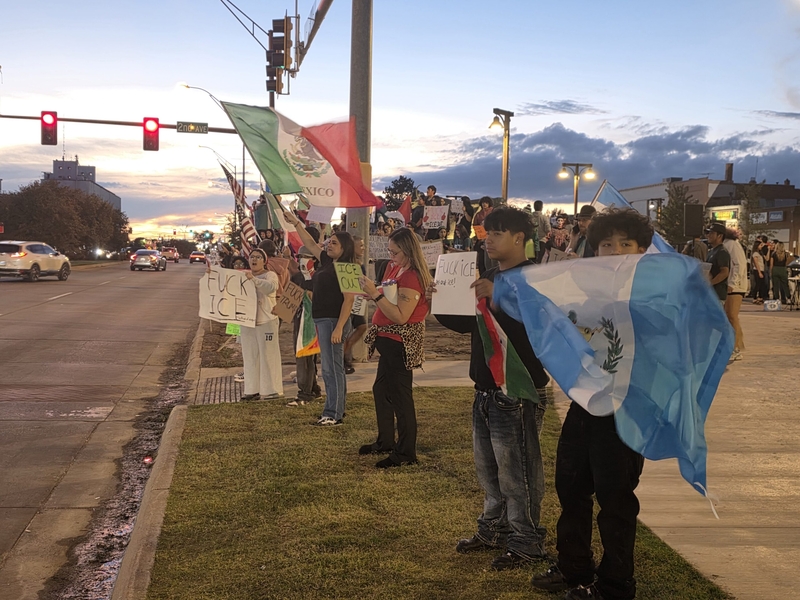
In response to ICE’s presence, hundreds of people lined Dodge City’s signature downtown plaza with its life-sized bronze Texas longhorn steer on Sept. 24, waving flags from Mexico, Guatemala and the United States.
They carried signs urging kindness and cursing ICE.
The following day, protesters marched from Wright Park to U.S. Republican Rep. Tracey Mann’s Dodge City office, where the doors were locked before the demonstrators arrived. Mann represents Kansas’ vast 1st Congressional District, which stretches some 400 miles east to west, from Lawrence to the border with Colorado.
Mann did not answer Kansas Reflector questions submitted by email about why the office was closed or whether he was concerned by disruptions to Kansas businesses.
“Federal law enforcement has a responsibility to enforce our immigration laws and help keep our communities safe,” Mann said in an emailed statement. “I also recognize the disruption the operation caused for communities across the Big First. When possible, federal authorities should coordinate with local law enforcement so operations can be carried out safely.”
Complications of gaining citizenship
Not all iof those n southwest Kansas are sympathetic about the ICE raids.
Residents commented under social media posts telling immigrants to simply file paperwork to gain legal status or leave, and thanking ICE for their work, even as others mourned families torn apart.
But attaining citizenship isn’t as easy as it may sound.
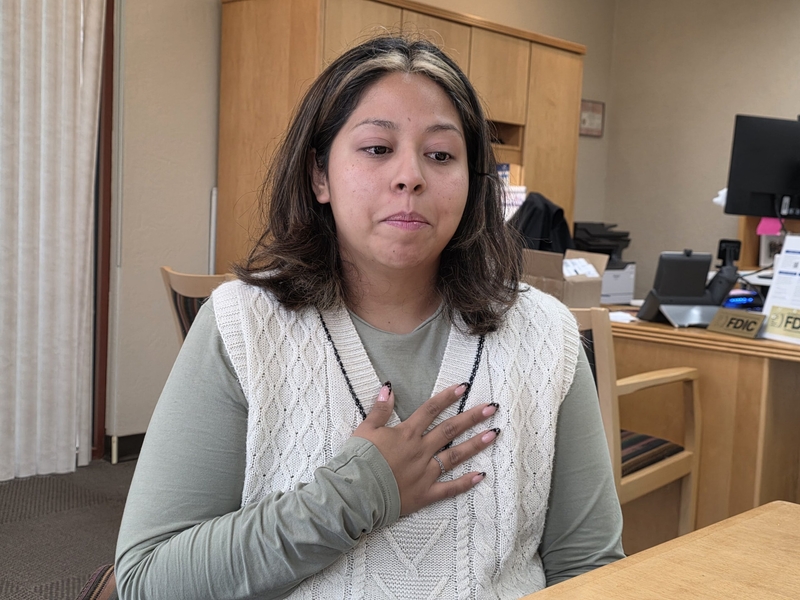
In 2011, Ana Sanchez Ortiz’s stepfather petitioned for her, along with her siblings and mother, to become U.S. citizens.
Fifteen years later, Sanchez Ortiz’s mother still isn’t a citizen, and on Sept. 23, she was detained. That was despite checking in for years with ICE, holding a job at National Beef Packing Co. and staying out of trouble, Sanchez Ortiz said.
Sanchez Ortiz, a senior branch manager at a Dodge City bank, hesitated at first to speak out, fearful of drawing attention.
But frantic family members couldn’t find her mother in the federal detention system for several days, she said. Her mother is diabetic and has high blood pressure, and although Sanchez Ortiz’s sister rushed her medications to the local jail, ICE agents wouldn’t give it to her mother.
The family now know their mother is being detained in California, and they have traveled there to try to help her, Sanchez Ortiz said.
“We have done everything the right way. She’s been here since she was 16 years old,” Sanchez Ortiz said. “She went to high school here. She started her family here.”
Because she came to the country when she was 4 years old, Sanchez Ortiz became a citizen through the DACA, or Deferred Action for Childhood Arrivals, program. This Obama-era immigration policy allows certain immigrants who were brought to the United States as children to receive renewable two-year work permits
She renewed her DACA application six times before she could apply for the separate status of legal residency, which she received when she was a freshman in high school. But it wasn’t until she was 31 years old that she became a citizen, Sanchez Ortiz said.
Looking for a solution
Zac Carlton owns a construction company in Dodge City, and he said friends were “gutted” by ICE activities last week. Everyone in the area knows someone who is not here legally, he said.
“I’ve talked to multiple contractors and subcontractors, and everybody was laying low last week, and no work was getting done,” he said. “Now this week, people are trying to figure out how to recover. It has put a strain on, obviously, the families that were affected by the sweep, and then the employers.”
Western Kansas needs immigrants to support construction, agriculture and other businesses, Carlton said. Finding workers is already an issue in those industries, he said, and will continue to be so.
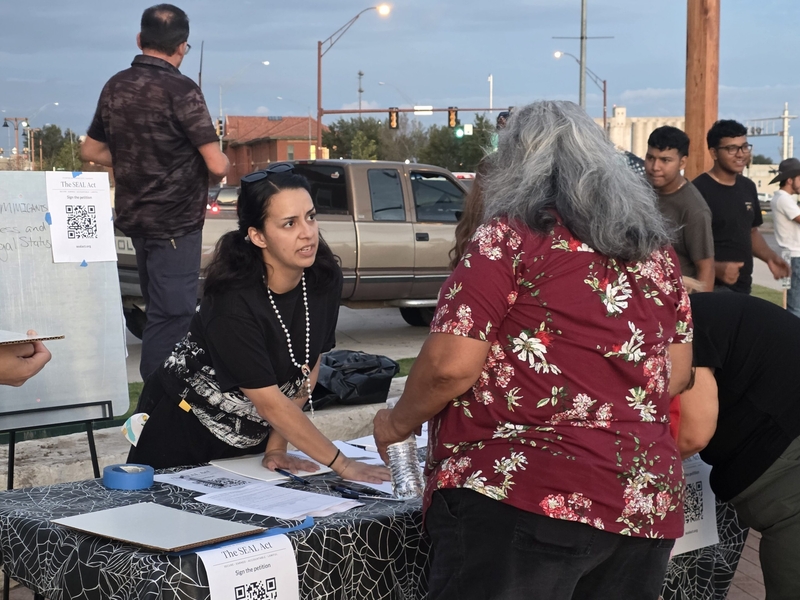
Carlton looked at past immigration laws and policies and is circulating a petition to promote the SEAL Act, which stands for secure, earned, accountable and lawful, he said.
Immigration reform bills have failed multiple times in the past, he said, but he’s hopeful politicians will pay attention after what happened in Kansas.
Vazquez has been fighting the battle Carlton is attempting for about 15 years, traveling to Washington, D.C., to advocate for immigration changes. She began when her father was deported right as she started college as a teenager. Five years ago, she became a Liberal city commissioner, the first Latina in the position.
What happened in Southwest Kansas last week will reverberate across the nation because of the effects on the beef supply, she said. Industry groups raised concerns that employees who skipped work at beef processing facilities for fear of encountering ICE could contribute to slowed production and higher prices.
“This whole operation just truly put an impact on our economy, and everybody in Southwest Kansas is going to suffer,” Vazquez said, “not just the undocumented population.”

Topeka, KS