In first debate, LePage and Dunlap clash over healthcare, affordability, immigration
Oct 01, 2026 | 11:00 pm ET

Description
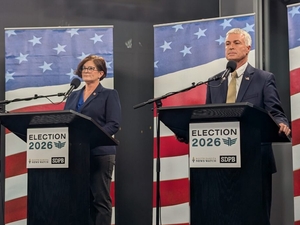
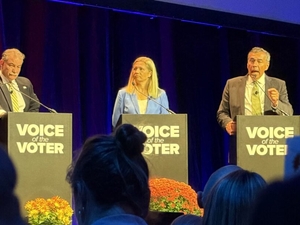
U.S. House candidates Democrat Matt Dunlap (left) and Republican Paul LePage (right) met for the first time on the debate stage on Oct. 1. (Photos by Jim Neuger and Andrew Clark/ Maine Morning Star)
Democrat Matt Dunlap and Republican Paul LePage met for the first time on the debate stage Thursday night, where they continued their clash over healthcare and traded barbs over each other’s records in state government.
The state auditor and former governor are vying to replace outgoing Rep. Jared Golden in the U.S. House of Representatives for Maine’s 2nd Congressional District.The WMTW debate quickly settled on a familiar theme: the candidates’ opposing stances on healthcare and how to reduce rising costs.
Throughout the Democratic primary, Dunlap campaigned on his support for Medicare For All, placing him in stark opposition to LePage, who oversaw dramatic cuts to Maine’s healthcare programs as governor and vetoed several bills to expand MaineCare, the state’s Medicaid program.
And while Dunlap acknowledged that universal healthcare would take time to implement, a more immediate solution he said he would advocate for in Congress is reestablishing marketplace insurance subsidies that congressional Republicans allowed to expire at the beginning of 2026.
Of the 61,000 Maine people who enroll through CoverME.gov, the state’s online marketplace, 85% relied on those premium tax credits to reduce their monthly costs. The lapse of the subsidies are contributing to spiking insurance costs in Maine and across the country.
“If you restore the subsidies to the Affordable Care Act, they’d see it immediately in January, as soon as we could enact it, and the president would sign it into law,” Dunlap said. “So I think that would be an immediate relief.”
In contrast, LePage said he would not support expanding Medicaid — even if it lowered the number of uninsured Mainers — and underscored his opposition to a universal healthcare system.
“The reason I have a problem with Medicare For All is they’re not telling you the truth,” LePage said. “If you’ve not lived in Canada, you don’t understand socialized medicine. What happens is your insurance coverage that you have now at work goes away. Bureaucrats make decisions on your healthcare, not your doctor.”
When Dunlap pushed back, LePage repeatedly questioned if he had lived in Canada and experienced the system to understand how it works. Dunlap said he had lived in Maine his whole life.
“I do understand how it works, and people in Canada are not flocking to Maine to get less insurance,” Dunlap said.
“No, they’re flocking to Maine to get cancer treatments and heart treatments,” LePage responded.
Fate of Medicare, Medicaid emerge as key issue in 2nd District race
Dunlap also criticized cuts to federal healthcare programs under President Donald Trump, and said they would only make things more expensive for Mainers. But LePage defended the president’s policies, specifically the $50 billion Rural Health Transformation Program, which was passed to partially offset the dramatic cuts to Medicaid, though experts say it remains to be seen how those funds will be distributed.
“[Dunlap] says we’re going to lose Medicaid after the election,” LePage said. “No, you’re not. There’s $50 billion that’s going to be spent across the nation in rural communities to help sustain and have healthcare provided to those in need.”
“Which won’t replace the trillion dollars worth of cuts,” Dunlap interjected.
LePage also repeated the claim that there is extensive fraud in Maine’s benefit programs, which are currently being investigated by the state Department of Health and Human Services.
“I’m sorry to say that there’s fraud in Maine, fraud across the country in Social Security, and in our Medicaid and in our welfare programs and I experienced it,” LePage said. “I’ve been fighting this battle since 2015 and it’s only now coming to the surface.”
In the most recent federal review, Maine’s Medicaid payment error rate was 2.4%, lower than the national average of 3.2%. And only about 0.1% of total program spending was confirmed by federal reviewers to be definitively incorrect.
Dunlap pushed back on the claim, arguing that Republicans’ focus on fraud is a cover for cutting program funding.
“When J.D. Vance, however, talks about Medicaid fraud, I want to be clear: he’s not interested in rooting out Medicaid fraud,” Dunlap said. “They’re interested in rooting out Medicaid, and I think that’s something we should be very wary of in the Congress.”
Tackling affordability challenges
Healthcare wasn’t the only divisive issue on the debate stage. The candidates clashed over housing, affordability issues, foreign conflicts and even what has been said on the campaign trail.
“You said that just last week that if you’re elected, you’re not going to do anything for two years because you’re going to be impeaching the president,” LePage said to Dunlap.
“I did not say that,” Dunlap answered. “What I said was that people should have the expectation that even if the Democrats take control of both chambers, President Trump probably won’t be signing very much that comes out. But however, we can still maintain our constitutional role of oversight of the executive branch, and that’s what we should be doing.”
Along with emphasizing his record as Maine governor, LePage pointed to his relationship with Trump and his access to the president.
“I know him personally, and I will say right now, I will be able to get into the Oval Office,” LePage said. “My opponent will not.”
Dunlap countered that Congress is meant to hold the president accountable, not maintain close ties.
On the issue of affordability, LePage said one of his top priorities if elected is to ask the president to put restrictions on diesel exports, echoing a call from top congressional Republicans, and would advocate for the state and federal government to suspend taxes on fuel.
Dunlap said he had heard from many people in the district that rising fuel and heating oil prices were already straining their budgets.
“One thing that we could do to help lower the cost of energy very quickly is to pass a war powers resolution and stop this war in Iran, which my opponent won’t say whether or not he supports,” Dunlap said. “So if we stop the war in Iran, we’ll see the price of oil start to come down, and that’s something that will provide almost immediate relief.”
LePage said he did not believe in the War Powers Act and that the president has constitutional authority over the military.
“I do not support the war in Iran,” LePage said. “I do support not allowing Iran to get the nuclear power, nuclear bomb, and so I’m urging the president to work as fast, as vigilant, as possible to get this done quickly. Let’s get out of it.”
The lack of access to affordable housing was also something the candidates were asked about.
Dunlap said he has spoken to people in construction and development, and said a key way Congress can help Maine’s housing crisis is by making more financing available.
“When you talk to people who work in the field of affordable housing and construction of it, they have a hard time accessing capital and financing,” Dunlap said. “And this is something that Congress can do and has done in the past: make funding available on a rotating basis, a revolving loan fund, so that it’d be easier for some of these developers to do.”
LePage agreed that Congress should provide funding, but he said that it should be focused on housing for the elderly. He then quickly pivoted to immigration.
“Housing costs remain out of control, first and foremost, stopping the illegal aliens from coming into our state and taking what housing is available should be stopped,” LePage said.
LePage said that he believes President Joe Biden let “millions and millions” of people enter the country illegally. And while he said he doesn’t disagree that U.S. Immigration and Customs Enforcement has “run roughshod” over communities, he believes the agency can be improved with proper training.
“I think we need to have a robust law enforcement division of our country that deals with it,” LePage said. “However, we should be able to have transparency, and if there are robust investigations, and if there’s a problem, then we need to account and make them accountable.”
The federal government has so far declined to investigate or reveal any information about the fatal shooting of Johan Sebastian Duran Guerrero, the Biddeford man who was killed by federal agents in July, a pattern seen across the country in response to violence and wrongful detentions by ICE.
Dunlap said that while ICE should exist in some capacity, it shouldn’t be in the way the agency is functioning today.
“Gov. LePage has talked very strongly about being tough on illegal immigration, being tough on the border, until of course somebody he knew very well ran into some immigration trouble,” Dunlap said, referring to LePage’s recent comments that his daughter-in-law’s father had immigrated legally but was deported.
“Then he kind of changed his tune a little bit,” Dunlap continued.
LePage said that was a personal situation, and has nothing to do with illegal immigration or ICE.
On the issue of trade, LePage said he does not support the tariffs as they are currently structured, but that the country has gotten a “bad deal” for many years with many countries.
“These issues are real, and they and they need to be addressed,” LePage said. “We need to de-escalate the rhetoric, and we need to get the president and the prime minister of Canada back to the negotiating table.”
The Canadian tariffs that went into effect Sept. 8, are expected to impact $170 million of Maine exports.
Dunlap said it’s Maine residents who are paying for the tariffs, and Congress should exercise more authority over the issue.
“Tariffs are a tool, they should not be used as a blanket policy,” Dunlap said. “And my opponent said that he was all for the tariffs when they first started being applied, and now apparently, now apparently he’s changing his tune a little bit.”
Augusta, ME