How a Tennessee execution gone wrong connects to Arizona’s capital punishment troubles
Oct 01, 2026 | 9:02 pm ET
Description
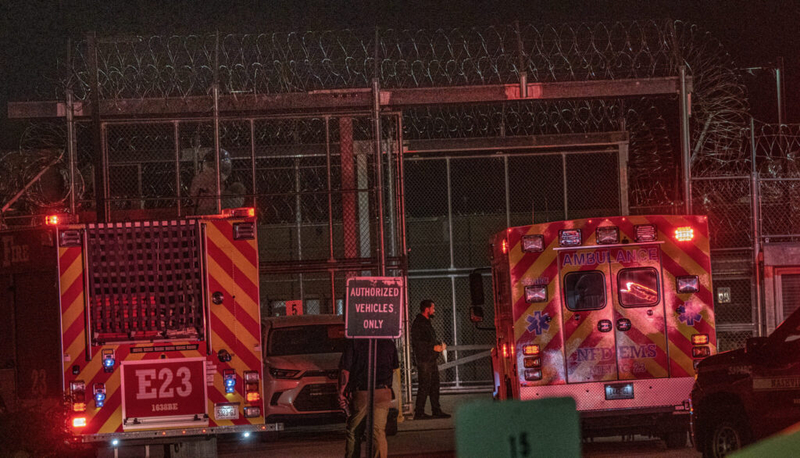
Emergency vehicles at Riverbend Maximum Security Prison in Nashville on Wednesday, Sept. 30, 2026. The execution of death row inmate Christa Pike was halted nearly two hours after the state of Tennessee began the lethal injection protocol. (Photo by John Partipilo/Tennessee Lookout)
Christa Pike, the Tennessee death row prisoner who survived an attempted execution by lethal injection Wednesday night, was still in critical condition as of Thursday afternoon. Hers was the second botched execution in the Volunteer State this year.
And there’s a direct line between those executions and problems Arizona had carrying out death sentences in 2022: The same prison official was responsible for overseeing all of them.
Two of Arizona’s three executions that year were drawn out because of difficulties inserting IV catheters into the inmates. In Tennessee on Wednesday, prison personnel poked Pike for an hour before they believed they had successfully inserted an IV catheter in her arm. She gave the technicians advice on where to place it and thanked them when they were done.
Those Arizona executions were overseen by Frank Strada, who was the deputy director of the Corrections Department. In 2023, he was named head of the Tennessee Department of Corrections. He was ostensibly hired to upgrade execution procedures in that state.
“After the botched execution of Tony Carruthers, I started focusing on Frank Strada,” said Kit Thomas, an assistant federal defender in Tennessee.
In May, Carruthers’ execution was canceled after Corrections Department employees spent an hour trying, and failing, to establish an IV line. He was punctured more than a dozen times.
Thomas assembled a 169-page “briefing packet” about Tennessee’s protocol.
“Strada oversaw three executions in Arizona,” she wrote. “All three were marked by prolonged and problematic attempts to establish IV access — eerily similar to the botched attempted execution of Tony Carruthers in Tennessee. In Arizona, execution personnel repeatedly struggled to place the required lines, resorting to invasive femoral or groin procedures, and in one case relying on the condemned prisoner himself to suggest a viable vein after the team was unable to find one.’’
Thomas also compared Arizona’s 2022 execution protocol to the current Tennessee one and found “recycled language.” Worse yet, she found instances where the Tennessee protocol relaxed standards, for example, giving the executioners broader latitude to perform femoral central lines, a procedure of last resort in Arizona in which an incision is made in the groin to surgically insert a catheter.
When Ryan Thornell was appointed by Gov. Katie Hobbs to lead the Arizona Department of Corrections, Rehabilitation & Reentry, he overhauled the state’s execution protocol to avoid such problems. Three executions have been conducted under Thornell’s watch without incident.
“The 2025 Tennessee Protocol adopted by Strada repeatedly copied language from the flawed 2022 protocol that Arizona has worked to correct, particularly regarding catheterization,” Thomas wrote in the briefing packet.
The Tennessee Department of Corrections declined to comment for this story.
Pike, 50, was sentenced to death for murdering a classmate in 1995, when she was 18. She was strapped to a gurney late Wednesday night after the U.S. Supreme Court knocked down a stay of execution from a lower court.
After the first injection of the barbiturate pentobarbital, she was still talking, even singing with her spiritual advisor. After the second injection, according to witnesses, she was still breathing and snoring. Prison officials pulled down the shades, then literally pulled the plug. They told the witnesses to leave and took Pike away in an ambulance.
Her attorney said Thursday that she is still alive, but he did not “have an idea of her prognosis.” How much pentobarbital made it into her blood stream is unknown. Because they were kept in the dark, the attorneys do not know whether she suffered brain damage.
Prison officials issued a terse statement.
“The Tennessee Department of Correction followed every step of the State’s lawful, established execution protocol approved by the Attorney General’s Office. The lethal injection chemical in the protocol has consistently been effective, and the protocol does not allow for additional procedures beyond what was carried out this evening. Christa Pike has been transported to an off-site medical facility.”
Pike’s attorneys speculated that the medical techs collapsed or pierced a vein when they inserted a catheter into her arm. The attorneys saw her arm turn purple. And Pike commented on pain there.
They had predicted as much. Pike had a blood disorder. She had had problems all her life with routine blood draws, another of her attorneys, assistant federal defender Steve Ferrell, said. And inserting a catheter is more intrusive.
“Christa Pike was very concerned that this would happen exactly as it turned out,” he said.
Arizona had its own memorable botched execution, that of Joseph Wood in 2014. The Corrections Department was using an experimental drug cocktail that didn’t work. Witnesses, including this reporter, watched for nearly two hours as Wood snorted and gasped. We later learned he had been injected with 15 doses of the drug combination when one was supposed to kill him.
As in Pike’s case, the outcome of Wood’s execution had been predicted, and the courts and the executioners ignored the prophecy.
“It was foreseen,” Thomas said. “We literally filed a lawsuit saying these things would happen.”
But the standards are high.
“Method-of-execution litigation is not about stopping executions from being carried out. These challenges seek to ensure that executions are carried out safely and humanely, without an unnecessary risk of severe pain,” said Dale Baich, a former federal defender in Phoenix.
“It is not enough for a prisoner to prove, even with strong medical evidence, that the state’s method of execution is likely to cause severe or excruciating pain. The prisoner must also identify a feasible alternative method and show that it would significantly reduce that risk. In practice, this is an extraordinarily difficult — often nearly impossible — standard for a prisoner to meet.”
- October 2, 20269:04 amThis story was updated to note that the Tennessee Department of Corrections declined to comment
Phoenix, AZ