How Mainers are weighing the pay-to-play allegation involving Susan Collins
Oct 01, 2026 | 2:28 pm ET
Description
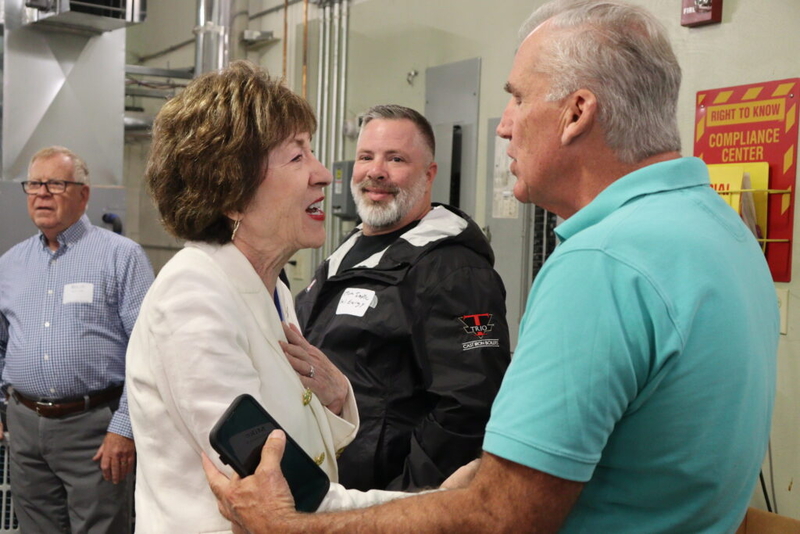
Republican U.S. Sen. Susan Collins of Maine tours the Maine Energy Marketers Association Technical Education Center in Brunswick on Sept. 3, 2026. (Photo by Emma Davis/ Maine Morning Star)
Tom McShane of Windham will likely split his ticket in November. He likes a Republican candidate running for his legislative district but plans to vote for Democrat Troy Jackson for Senate, although reluctantly since his first choice dropped out.
His choice in the Senate race is irrespective of the recent corruption allegations against incumbent Republican U.S. Sen. Susan Collins. “That’s pretty common among politicians,” he said.
As discourse about Collins’ alleged involvement in a pay-for-play scheme ripples across the country, at home in Maine, several voters said they were unsurprised and unmoved, indicative of their dwindling faith that the government is working in their best interest.
The extent to which the accusations first reported by ProPublica will influence voters is unclear. Interviews show that people firmly aligned with one party or the other appear to be dug in, while some swing voters are reconsidering their support of the senior senator — a key bloc in Collins’ 2020 win.
“They’re all doing it,” said Republican Jim Volkernick of New Gloucester. “I’m pretty skeptical about just about anyone.” He is considering leaving the race blank on his ballot, not because of the allegation but because Collins has at times voted against her own party.
Across the political spectrum, Mainers are collectively disgusted by the influence of Big Money in politics and overwhelmed by the barrage of negative ads blanketing the state, many backed by dark money. Ads supportive of Collins have highlighted Jackon’s son’s past as a lobbyist, and those supportive of Jackson have accused the senator of being in the pocket of special interests.
Democrats have been trying to nail Collins on corruption for years. Will this time be different?
Amid that landscape, many see the revelation that the FBI was looking into an alleged pay-for-play scheme as “just one more thing,” as several put it.
“I think all politicians are corrupt,” said Denny Conley of South Portland, who identifies as independent and said he’s probably registered with a party, but “couldn’t tell you what it is.”
Conley doesn’t like Collins or Jackson. “I think you are damned if you do and damned if you don’t,” he said.
Jackson and Maine Democrats have condemned Collins as corrupt and painted the accusation as a turning point that could upend the race, which is viewed as consequential for the balance of power in Congress.
Meanwhile, Collins’ team has denied any wrongdoing and said the story is a return to claims made during her 2020 campaign. In explaining why the story has no bearing on how they vote, some Collins supporters reiterated the same talking point.
“It hasn’t swayed my views,” said Shane Hill, a registered Republican who doesn’t always vote party lines. “The way I look at it is, really, you guys are going back to that because that’s all you have. It was never substantiated. Nothing’s ever come out of it. She was never formally charged. There’s nothing but an allegation that anybody can make at any time.”
One of Collins’ top donors, Martin Kao, the former CEO of defense contractor Navatek, pleaded guilty in 2022 to illegal campaign contributions involving a pro-Collins super PAC. No one in Collins’ orbit was charged as a result of the investigation then.
However, ProPublica revealed that the FBI was looking into the senator, her top aides and a pro-Collins super PAC in recent years — that was until Donald Trump returned to office for a second term and the probe died as part of his purge of the bureau.
As campaign finance experts told the Portland Press Herald, only federal agencies can launch investigations to seek recourse for potential ‘pay-to-play’ schemes and bribery.
Between 2022 through 2024, Kao told the FBI that Collins’ team was aware of the scheme in which he made donations with the understanding that she would award contracts to his company, which ProPublica found to be consistent with FBI records and interviews with dozens of people familiar with Navatek.
On Thursday, Huff Post reported that Collins’ current reelection campaign is backed by at least $7.4 million in dark money contributions that resemble the shell donations at the center of the alleged pay-for-play scheme.
Nearly every candidate in a competitive race is buoyed by some dark money. That includes Jackson, who has the backing of WinSenate, funded by a super PAC connected to Sen. Chuck Schumer (D-N.Y.). There has been little insight into his campaign’s finances so far given his late entry into the race. He replaced former nominee Graham Platner, who dropped out in July after an accusation of sexual assault, which he denies.
Mainers, and Americans broadly, believe that unlimited super PAC spending leads to government corruption. In 2024, more than 70% of Maine voters passed a law to put a limit on contributions to super PACs, which are political action committees that independently spend money to try to support or defeat candidates.
But that ran afoul to how campaign finance restrictions have been understood to date. In the 2010 ruling Citizens United v. Federal Election Commission, the high court allowed unlimited spending on the premise that there is a wall of independence between a candidate and outside spending groups.
Those defending Maine’s law in court do not dispute that. Rather, they argue that such restrictions do not stop the potential for corruption, given that donors and candidates have the opportunity to collaborate even if a PAC is independent. That is what is alleged in ProPublica’s reporting.
Volkernick and other Maine voters said they do not think how they vote in the upcoming election will make a dent in the enduring political system they decry.
“You can go in there and try to do something good,” Volkernick said, but “the machine’s too big.”
Lauren McCauley contributed reporting to this story.
Augusta, ME