Gen Z isn’t choosing a side. They’re choosing issues.
Oct 01, 2026 | 5:00 am ET
Description
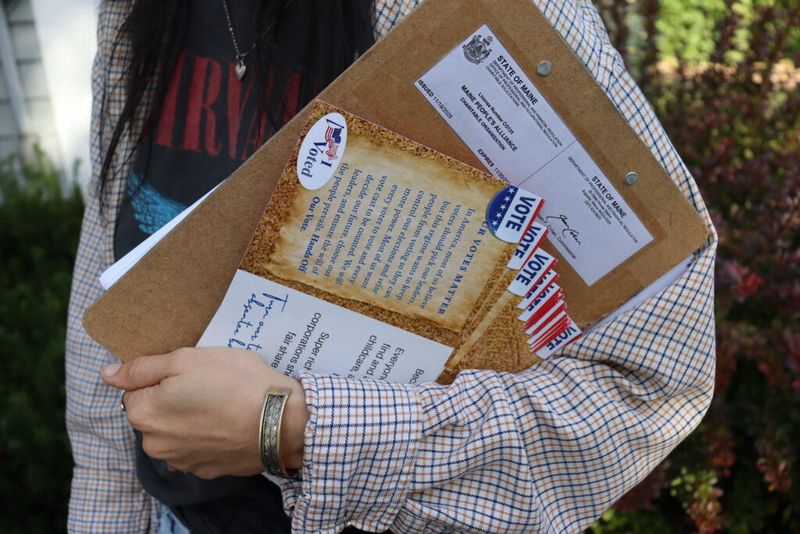
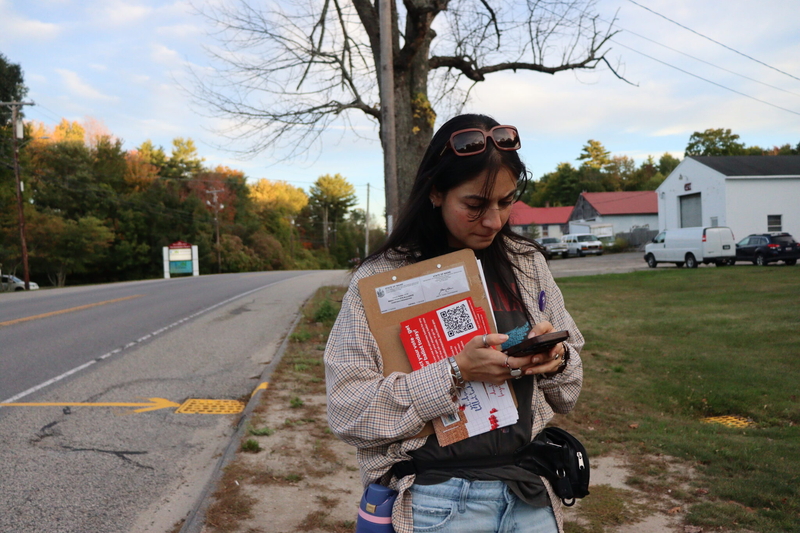
Maya Brooks carries flyers while out canvassing in Windham, Maine, ahead of the 2026 midterms. (Photo by Emma Davis/ Maine Morning Star)
Editor’s Note: This story is part of Gen Z at the Ballot Box, a collaboration between States Newsroom and The 19th.
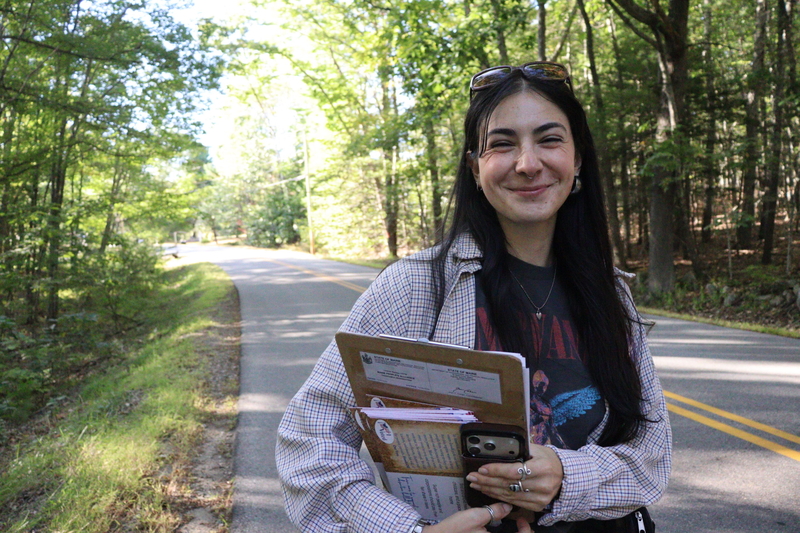
WINDHAM, Maine – As 24-year-old Maya Brooks walked winding roads in rural parts of Maine, a water bottle hooked to her fanny pack and a stack of “lit” on absentee voting and candidates her group has endorsed in hand, she was focused on reaching voters who either haven’t voted in recent years or have shown they’re willing to vote for both parties.
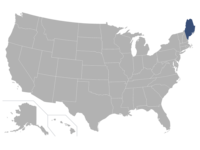
Mainers frequently cross party lines, as evidenced by the fact that U.S. Sen. Susan Collins is the only GOP senator running for reelection in a state Donald Trump lost in 2024. Maine consistently ranks among the highest in the country for voter turnout, even among young voters, despite having one of the oldest populations in the country.
That’s led Maine to be viewed as the top state where young voters could sway Senate outcomes in 2026.
As Brooks canvassed for the state’s largest progressive community action organization, she thought about one of her first interactions knocking doors this cycle. A woman — not much older than herself — told her she probably wouldn’t vote. Whoever she voted for, whatever their party affiliation, she felt it would not make a difference, Brooks recalled.
“I don’t blame her,” she said. While a registered Democrat, Brooks would rather do away with the two-party system altogether. “Politicians aren’t delivering.”
Generation Z, now roughly 14 to 29 years old, is a growing portion of the electorate with about 50 million eligible voters in the upcoming midterm elections. But these young voters have soured on both parties.
Younger people have long been more likely to identify as independents, but Gen Z is doing so at a significantly higher rate than any previous generation at the same age.
Being independent does not mean being moderate. Gen Z’s ideological gender gap is driven more by women moving further left than men moving further right.
“Really, what’s notable is that Gen Z women are the distinct group compared to both their young male counterparts but also to other American women,” said Melissa Deckman, a political scientist who studies the impact of gender, religion, and age on public opinion. “Simply put, Gen Z women are the most liberal and progressive group of voters in America today.”
A unifier among Gen Z is a belief that the government is failing to protect and address their needs, notably the high cost of living.
Trump capitalized on that discontent in 2024, making gains with young voters, particularly young men. Now, Trump’s net approval rating is underwater, especially among Gen Z, with 31% of young people who voted for the president saying they regret it, according to an August Navigator poll.
Both parties are trying to remedy mistakes of elections past in the hopes of winning over the Gen Z vote, launching targeted recruitment efforts, hiring more young people and leaning into social media.
No longer taking the youth vote for granted
At a time when many young people were running away from the Democratic Party, Anderson Clayton, chair of the North Carolina Democratic Party, ran to it.
That is not to say Clayton, who at 25 became the youngest state party chair in the country in 2023 when she ousted an establishment-backed incumbent, has not at times been disappointed.
She wants to see Democrats embrace progressive candidates who win primaries. She wants to get rid of the churn-and-burn cycle of campaigns prioritizing immediate national victories over long-term local sustainability. And she was “so pissed” after Democrats left 44 state legislative seats uncontested in 2022 that she decided to run for her current role.
“If you don’t like a party right now, you’re the only one that can change it,” she said in her high-energy cadence.
Clayton got hooked on political work a decade ago, when her county party pushed back on Republicans trying to eliminate the voting site on her college campus. She’s up against similar issues now, after a federal judge ruled against restoring early voting sites on several college campuses in her state earlier this year.
She has fellows on those campuses to try to turn out the student vote, part of the party’s broader voter protection program, which is in addition to 30 active college chapters and a 100-county, year-round organizing operation.
“When people look at me and they’re like, ‘Well, young men are leaving the Democratic Party,’ I’m like, ‘Well, let me introduce you then to the leadership that I have right now leading my young Dems, because they are young men,’” Clayton said. “I think that the ability to organize and to help other people see themselves in the party is to also give them that representation.”
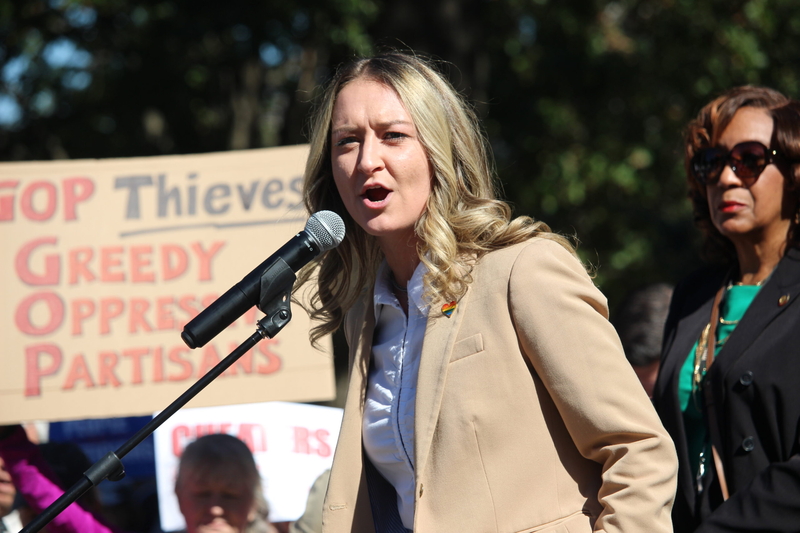
North Carolina Democrats collaborated with Voters of Tomorrow, an entirely Gen Z-led organization seeking to promote political engagement among that demographic, for its national summit in August. Communications director Jessica Siles, 26, said she has seen state parties in particular having more success appealing to young voters.
“I think in some ways that’s because obviously those ties to the direct local communities are stronger,” Siles said.
That is borne out in research, which shows relational organizing works because young people trust their neighbors or community networks far more than national parties. Siles sees a sweet spot in engaging Gen Z in events that offer in-person connection in a more social, cultural setting.
That’s an approach being used by the Community Organizing Alliance in Maine, a civic group focused on engaging Black and immigrant voters. Executive director Safiya Khalid, 30, said young people are leading voter registration and education efforts, which include more traditional methods like canvassing, but also events to strengthen community, such as an upcoming concert featuring Somali music, where the alliance will share election-related information to attendees outside the venue.
The alliance is based in Maine’s 2nd Congressional District. One of the most rural areas east of the Mississippi, it’s an open seat being eyed as consequential for the balance of power in Congress since moderate Democrat Jared Golden is not seeking re-election.
Another youth-led group in that district, Maine Youth Power, started in 2021 to offer young Mainers clearer paths to engagement in a state with one of the highest median ages.
“All of our politicians and parties cater towards old people, which is not a bad thing,” said Phoebe Dolan, 28, co-director and one of its founding members. “But it does leave young people often with not a clear sense of a county party that they can join and take leadership in.”
The nonpartisan organization now reaches roughly 200 young people annually and ahead of the midterms is launching a series of hubs across the state for members to make regional connections. Continuing year-round, the hubs will offer lessons on political history and organizing training, Dolan said.
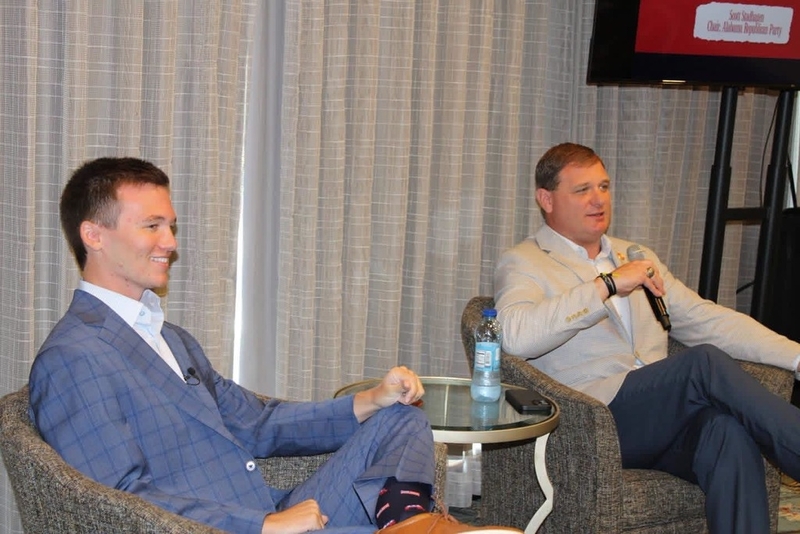
In Alabama, GOP chair Scott Stadthagen brought on Brilyn Hollyhand, a 20-year-old content creator from Auburn, who previously advised Trump on youth strategy, to launch Project Future Generation in late July.
The statewide effort to engage teens and young adults in the conservative movement “is not a separate auxiliary group,” Stadthagen said. “We’ve got the young Republicans, the college Republicans. This is creating new Republican members to our county parties.”
It is a three-pronged approach: a “student strike force” focused on door knocking and registering GOP voters in purple districts, “semester summits” where the party meets with student leaders on campuses, and tours of colleges and high schools. Hollyhand and Stadthagen have ambitions to expand the model to other red states, and eventually swing states.
Comparing the Grand Old Party to a Southern Baptist church, Hollyhand said that without a thriving youth ministry, “when the good ol’ Southern church’s congregation inevitably passes away, the church passes with it.”
The social media factor
When Hollyhand worked for Trump’s campaign, he led the initiative that brought content creators to the 2024 Republican National Convention and urged Trump to make appearances on podcasts and TikToks to reach young people.
That’s being mimicked by Democrats now. The Democratic National Committee is investing in thousands of content creators to aid wins in 2026 and beyond. Former first lady Michelle Obama launched a “Voting Squad” made up of popular content creators to try to encourage young people to get to the polls.
More locally, too, campaigns have been leaning on influencers. Independent of Brooks’ job as a senior canvass manager for the Maine People’s Alliance, she regularly posts political content for her more than 85,000 followers on TikTok, an account initially spurred as an outlet to air political rage when Trump got reelected. She was invited as an influencer to one of Maine Democratic gubernatorial nominee Hannah Pingree’s events.
Despite this focus, research on the effectiveness of influencers is limited. While some studies find that influencers may help boost political awareness among young people, that doesn’t necessarily translate into action.
“The sort of influence of influencers, if I can be redundant, has been a little bit overstated,” said Alberto Medina, communications manager at Tufts University CIRCLE.
Less than 1% of young people said an influencer had been one of their top three motivations to cast a ballot in CIRCLE’s 2024 post-election youth poll. And in its national pre-election poll this year of 5,549 young Americans aged 18–29, social media posts from influencers or celebrities ranked last for the sources of information they turn to for learning about politics and elections.
Most Gen Z voters do get their news on social media, but mostly through posts from advocacy or news organizations, according to the latest survey.
“Social media algorithms tend to send young men and young women to different places,” said Deckman, who is CEO of the non-partisan Public Religion Research Institute.
She attributes some of the gender divide to the fact that the two demographics are often presented with different informational realities, though it is difficult to quantify. Overall, Gen Z women have been raised with a greater sense of agency, she said, and were brought up politically amid the Me Too Movement and the first Trump presidency, during which his sexist comments shaped public discourse.
In addition to being ideologically divided, young men and women have vastly different beliefs about religion and gender. While young women, and Americans overall, have been shedding religious labels, young men have seen essentially no change in Deckman’s research. Young men are also far more likely to support pronatalism, which the Trump administration has embraced in encouraging families to have more children.
“No generation is monolithic,” Deckman said. “There definitely are conservative young women. There’s lots of liberal young men. But the trends are such that you’re seeing this gap emerging.”
Not party but issue motivated
Nelson Dorsey, 20, voted for Democratic presidential nominee Kamala Harris in 2024. Now, the Bowdoin College student is campaigning for Collins, explaining in Brunswick after his early morning football practice that her pitch as an independent voice for the state resonates with him.
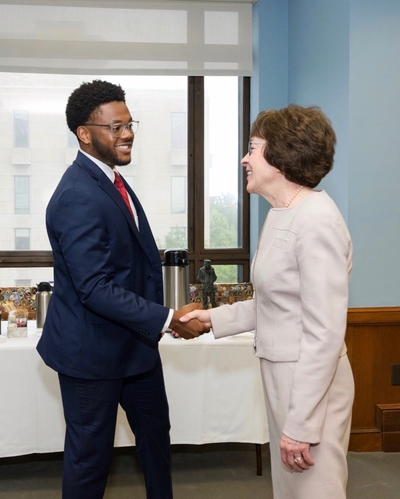
“I’m not necessarily afraid to go across a party line if that means doing what I think is best for the country,” said Dorsey, a registered Republican. “At the time, I was drawn to (Harris’) campaign because she really was drawing on the whole idea of ‘Let’s put politics aside, let’s put our parties aside.’”
Dorsey’s refrain from party loyalty is common among his generation, which is continuing to identify as independent at relatively high rates as they have gotten older, a contrast to older generations who had been less likely to identify as independents over time.
“You have really a story where Gen Z is really put off by party,” Deckman said. “It’s part of a larger distrust of institutions in society.”
As Gen Zers struggle to make ends meet, a point of common ground regardless of political leanings, they are seeing the rich get richer and the powerful gain more control. They are united in their concern about the abuse of political and economic power, including the United States’ role in foreign wars and lack of accountability for bad actors named in the Epstein files.
“Growing up in America at this time, there is a significant lack of hope,” said Katya Fromouth, a 17 year old from Yarmouth, Maine, who thinks she will likely never be able to buy a house and questions what her future will look like because of climate change. “That is the sort of thing that young people need — hope when we are envisioning our future.”
Fromouth was one of the young Mainers who initially saw hope in former Democratic nominee for Senate Graham Platner, who energized voters with a pitch to rally against corruption regardless of their party affiliation. Platner won over many young people by embracing some of the most polarizing issues at the center of the widening generational divide, such as calling to abolish U.S. Immigration and Customs Enforcement.
Seeing a candidate for national office with those values was “refreshing and frankly exhilarating,” said Cheyenne Hunt, who had initially endorsed Platner while leading the group Gen Z for Change.
But after several women came forward alleging sexual misconduct, which he denies, Hunt withdrew her support. She helped support his exes in speaking with media, leading to the publication of an assault allegation in Politico that ultimately ended his campaign.
While Hunt, founder of Reckoning Action, a nonprofit aiming to combat misogyny, said she received pushback because of the hope Platner inspired, she ultimately sees his swift downfall as evidence of the new kind of politics he had tapped into.
“Young voters are routinely disappointed with the quality of representation that we’ve been offered,” Hunt said. “They are really ready for a class of representatives that across the board — whether it’s with issues of violence against women, with issues of corruption in general — do not believe that they are above the law and that they deserve special treatment.”
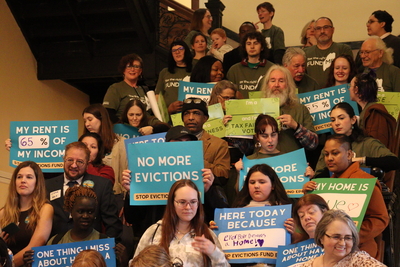
Tufts University CIRCLE has found some links between the issues young voters are focused on and their shifting politics. Those moving to the left care most about healthcare and abortion. Those shifting more conservative are prioritizing immigration and housing.
But regardless of whether their politics are shifting, young people are prioritizing economic issues.
“The centrality of economic issues and of those economic struggles that youth are experiencing is one of the big changes that we’ve been tracking in the last couple of election cycles,” Medina said.
Young people on both sides think their party needs to change how they talk about the economy. Hollyhand said he wants the GOP to outline solutions, not just offer speeches blaming Democrats. And Clayton said Democrats can’t just rely on the buzzword “affordability.”
“It’s got to be ‘Here is why the minimum wage is set at $7.25 and here is who’s doing that and who can help make it better,’” she said.
Young people are motivated most to cast a ballot in order to take action on issues they care about. In the Tufts University post-election youth poll from 2024, 46% said that was their top motivator.
Issues are what Brooks starts with when she speaks to voters canvassing across Maine. As she tries to beat the sun knocking doors into the evening, she asks what matters most to them before sharing what she likes about particular candidates, starting with a local race and not mentioning political affiliations.
After nearly 40 doors, more than 10,000 steps and three hours, mostly what she’s done is listen.
“People don’t want to be talked at,” she said. That’s also her message for how the party could improve its chances of courting her generation: “I wish they would just ask.”
Augusta, ME