A power boom in eastern South Dakota raises questions about what comes next
Sep 30, 2026 | 6:22 pm ET
Description
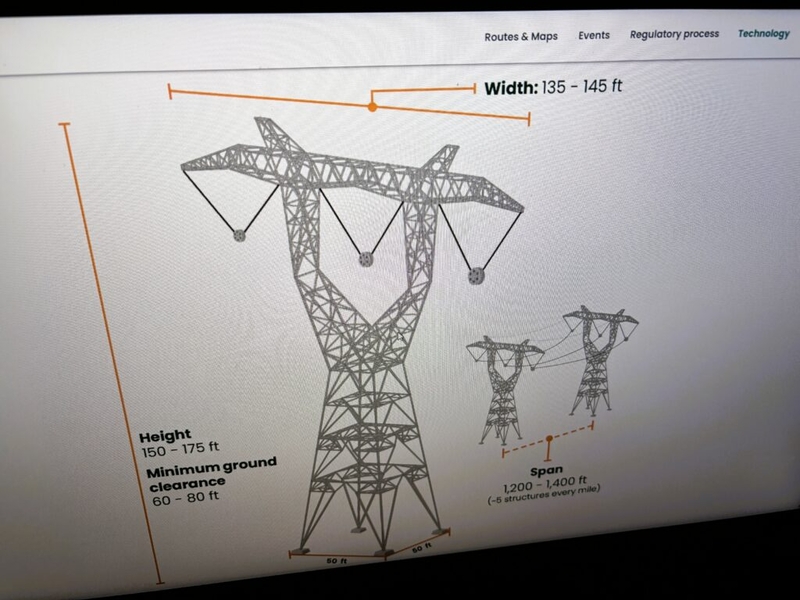
An image from the PowerOn Midwest website illustrates the dimensions of structures that would support a proposed 765-kilovot transmission line. (Photo by South Dakota Searchlight)
Eastern South Dakota could soon host the largest transmission project in the state’s history. South Dakota’s first 765-kilovolt line would run through Grant, Deuel and Brookings counties.
The larger story is what could follow it.
South Dakota’s largest existing transmission lines operate at 345 kilovolts. The proposed 765-kilovolt line is the electrical equivalent of replacing a rural highway with a six-lane interstate.
One line this large can move more electricity in either direction with lower losses and less land than several smaller corridors.
160 miles of transmission lines planned for eastern SD, costing upward of $2 billion
The line would begin at Big Stone South near Big Stone City, travel south to a substation near White and turn east toward Lakefield, Minnesota. From there, the regional network reaches toward Iowa, Rochester and the Twin Cities.
Big Stone South already connects to Ellendale, North Dakota. Approved and proposed projects would extend that network toward Jamestown and Fargo and toward Alexandria, Minnesota.
The northbound Big Stone South-Hankinson-Bison line is part of a joint effort by the Midcontinent Independent System Operator, known as MISO, and the Southwest Power Pool, the neighboring grid operator.
Essentially, eastern South Dakota is becoming a bridge between two enormous regional power systems.
The focal point is Big Stone South, a switching station near the Big Stone coal plant. The station could remain important whether the plant operates for decades or eventually closes. The grid is being built around a hub, not one generator.
Utilities say the network is needed as older plants retire, electricity comes from more scattered sources, and extreme weather increases the value of alternative routes.
MISO is overseeing a $21.8 billion rebuilding of the Upper Midwest transmission system.
MISO says utilities are experiencing an unprecedented surge of requests from data centers, advanced manufacturing and other electricity-hungry industries. Many want power within 18 to 36 months.
South Dakota’s 765-kilovolt line isn’t expected to enter service until 2034 but could influence where power generation and industry locate for decades.
At Ellendale, Applied Digital is developing an artificial-intelligence campus whose initial 400-megawatt demand and potential 1,000-megawatt expansion would approach three times the generating capacity of the 475-megawatt Big Stone coal plant.
Producing that much electricity from wind over a year would require the output of roughly 875 turbines — more than the roughly 720 now operating or approved across northeastern South Dakota’s wind corridor.
Wind couldn’t provide that electricity every hour. Storage, natural gas or other dependable generation would also be needed.
Other large data centers are proposed near Fargo, Sioux Falls and across Minnesota, including Google’s Project Skyway near Rochester.
Neither Ellendale nor the Minnesota project caused the 765-kilovolt line, according to the utilities. That’s one of the most interesting parts of the story.
Engineers concluded this exceptionally large transmission network was needed before much of the data-center boom entered their forecasts.
Now those customers are arriving.
Google and Xcel Energy, for example, have proposed wind, solar and battery storage to help serve the Minnesota development.
The Northern Border natural-gas pipeline also crosses northeastern South Dakota. The Astoria gas plant in Deuel County was built where that pipeline intersects the Big Stone South-to-Brookings transmission corridor.
Eastern South Dakota has wind, a major natural-gas pipeline, increasingly powerful transmission lines and access to two regional grids. Now some of the largest electricity customers ever contemplated on the Northern Plains are looking for places to plug in.
None of that guarantees another gas plant, more wind farms, batteries, data centers or factories.
But anyone who has watched development follow a highway interchange understands the principle. Once an interstate arrives in the neighborhood, the neighborhood seldom remains the same.
Electricity works much the same way.
Natural-gas developers need fuel and transmission. Wind, solar and battery developers need the grid. Large industries need enormous quantities of dependable electricity. A 765-kilovolt electrical interstate changes what is possible.
That could mean landowner income, construction activity, investment and additional tax base. It could also sharpen conflicts over agricultural land, rural housing, lighting, traffic and demands on local government.
For most of our history, South Dakota’s place in the power system has been defined by what we produced: Missouri River hydropower, coal-generated electricity, wind and some solar.
Something different is taking shape now.
An electrical interstate, a natural-gas pipeline, immense new customers and several forms of power generation are converging in the same rural corridor.
The new transmission line won’t determine what comes next. Farmers will still own much of the land. Counties will still make land-use decisions. Developers will still have to decide whether projects make economic sense.
But like a new highway interchange, the line creates opportunities that didn’t exist before — and intensifies competition over how the surrounding land should be used.
The towers may be only the first visible sign.

Pierre, SD