SC’s growth story is becoming the South’s growth story
Sep 30, 2026 | 2:11 pm ET
Description
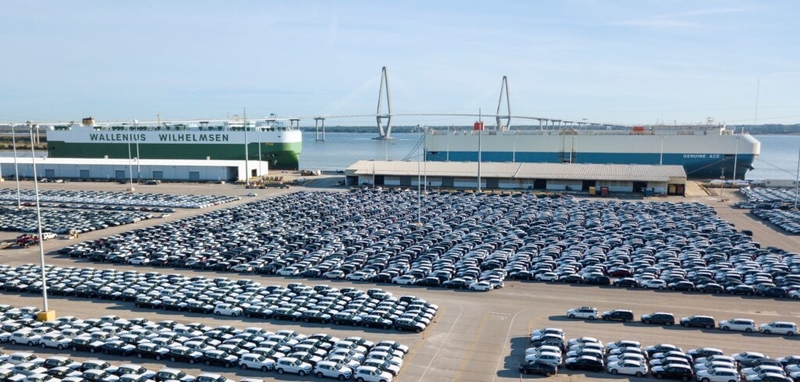
BMW vehicles parked at the Port of Charleston await being loaded for export Dec. 3, 2020. (File photo courtesy of BMW)
As the United States celebrates its 250th anniversary, the country’s economic center of gravity continues to move south.
My new report, Accelerating South, captures the scale of that shift: the American South is now a roughly $6 trillion regional economy, outpacing both the Northeast and the Pacific while attracting people, capital and industries at a historic pace.

Few states illustrate that momentum more clearly than South Carolina.
Over the past three years, South Carolina has assembled one of the strongest economic runs in the country.
It led the nation in real, inflation-adjusted growth in gross domestic product in 2024, at 4.2%; tied for first place in 2025, at 3.1%; and ranked first in population growth in 2024-25.
No other Southern state can claim that same combination of sustained output and population growth.
Those numbers are not simply the result of favorable weather or lower costs. They reflect an economic model built around global manufacturing, logistics, aerospace, defense and a growing base of skilled workers and residents.
The state has become a case study in how the modern South is competing for — and winning — investment that once might have gone elsewhere.
At the heart of South Carolina’s growth is its unusual ability to attract foreign capital. Its manufacturing sector is globally connected in a way few states can match.
That concentration matters at a time when global companies are reassessing where and how they manufacture.
Tariffs, geopolitical uncertainty, supply-chain disruption and a renewed focus on domestic production have all made U.S. operations more strategically important. South Carolina is well positioned to benefit from that recalibration because it offers something companies increasingly need: an established manufacturing ecosystem, access to ports and transportation networks and proximity to fast-growing Southern markets.
BMW’s recent $1.7 billion U.S. investment in Spartanburg County underscores that advantage.
While the 2025-26 tariff environment has created challenges, it has also strengthened incentives to build and invest closer to American consumers. South Carolina has emerged as a natural beneficiary of that trend.
But a state’s economic strength cannot rest on manufacturing alone.
South Carolina’s long-term success will depend on its ability to maintain the infrastructure, workforce and energy capacity needed to support continued growth. This is particularly clear in the competition for data centers and other energy-intensive projects.
The Southeast’s data center boom has created enormous opportunity — and real limits. Data centers require large amounts of reliable, affordable power, as well as water, transmission capacity and community support.
Legislators recognized as much this year.
Senators debated a pair of bills to set guardrails on data-center growth — including protections to keep ratepayers off the hook for the industry’s energy demands. Neither bill reached a floor vote.
In the absence of statewide rules, the question hasn’t gone away; it has simply moved to county councils, several of which have begun enacting their own moratoriums.
The next phase of economic development will require policymakers and business leaders to make difficult decisions about where growth makes sense, how infrastructure is funded and how to balance corporate demand with the needs of households and existing employers.
That challenge should not be viewed as a reason to retreat from growth. It is a reason to approach it more strategically. South Carolina’s advantage is that it already has a diverse economic foundation on which to build.
As national defense priorities increasingly focus on readiness, domestic production capacity and technological advantage, South Carolina’s aerospace and defense base is positioned for increased relevance.
Boeing’s 787 operation is not just a major employer; it is an anchor for a wider network of suppliers, engineers and advanced-manufacturing capabilities.
Population growth reinforces all of these trends. More residents mean a larger labor pool, greater consumer demand and a stronger case for business investment.
But growth also brings pressure: housing affordability, congestion, workforce shortages and the need for schools and public services that can keep up with expanding communities.
The lesson from Accelerating South is that the South’s rise is no longer a prediction. It is a fact.
South Carolina’s recent performance shows what happens when a state combines global industrial ambition with the fundamentals that companies and families seek.
The challenge now is to ensure that this extraordinary run becomes durable prosperity — sustained not only by the next factory announcement or population milestone, but by the infrastructure, talent and long-term planning necessary to keep South Carolina moving forward.


Columbia