NJ bill would again expand law that allows cops, judges to shield personal info
Sep 30, 2026 | 5:37 pm ET
Description
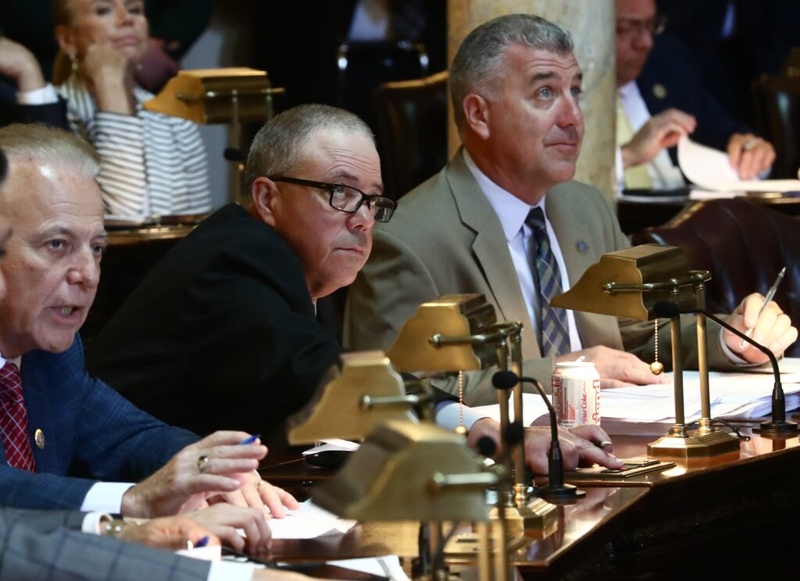
Sen. Parker Space, in glasses, is one of the lawmakers behind a bipartisan bill that would allow cops and judges in other states to shield their personal information from public disclosure. (Photo by Dana DiFilippo/New Jersey Monitor)
Two New Jersey lawmakers want to expand Daniel’s Law to allow judges and law enforcement officials who work in other states to shield their personal information from public disclosure.
The bipartisan bill sponsored by Sens. Parker Space (R-Sussex) and Brian Stack (D-Hudson) would allow judges, police officers, and prosecutors from other states to request personal information like their addresses not be shared by governments or private firms.
The bill was spurred by a request from a constituent, a retired New York Police Department detective, who worried someone might seek vengeance over his time on the force, Space told the New Jersey Monitor.
“In today’s world, people are getting nuttier on certain folks, so safety is always a number one priority when it comes to somebody in that line of business,” said Space.
As written, Daniel’s Law references definitions in the state Open Public Records Act that narrowly refer to law enforcement personnel who administer New Jersey law. Existing provisions do not apply to individuals who held identical positions outside of New Jersey.
The law is named for Daniel Anderl, who was slain during a gunman’s assassination attempt on his mother, U.S. District Court Judge Esther Salas, at their home in 2020.
Individuals covered by the law can sign up for a state-maintained registry to have their information shielded in public documents, and they or their agents can request private data brokers remove their personal information or face a $1,000 fine for each violation.
Lawmakers have more than once amended Daniel’s Law to extend its coverage to new groups of workers or alter its enforcement provisions, and those efforts have generally won broad bipartisan support. Space expects his bill to follow that track.
“Obviously I’m on the Republican side, but I think this would be a nonpartisan issue. I think it should move along fairly swiftly,” Space said.
Though the law enjoys broad support in the Legislature, it has faced legal challenges from the press alleging it impermissibly chills speech, and dozens of data brokers have charged its enforcement mechanism unconstitutionally punishes speech without considering intent. The law has so far been upheld as constitutional.
Data brokers’ challenge returned to the U.S. 3rd Circuit Court of Appeals last month after New Jersey’s Supreme Court unanimously ruled the law’s fines do not require violations to be intentional, a decision seen as a win for firms facing penalties for thousands of individual breaches.
Trenton, NJ