DOE announces $29.5M to national labs to advance critical mineral supply chain
Sep 30, 2026 | 7:39 pm ET
Description
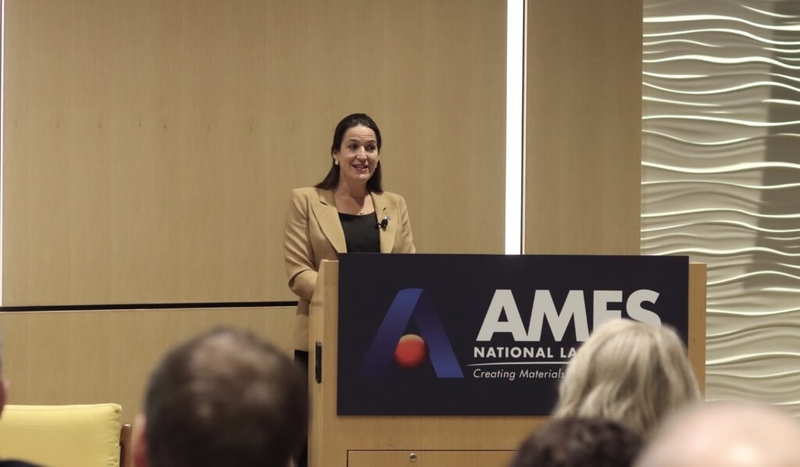
Audrey Robertson, assistant secretary of energy for the Office of Critical Mineral and Energy Innovation at the DOE announced funding for critical mineral mining research in Ames, Iowa Sept. 30, 2026. (Photo by Cami Koons/Iowa Capital Dispatch)
AMES — Researchers at the Ames National Laboratory are part of a U.S. Department of Energy initiative, called Mine of the Future Initiative, aimed at boosting the nation’s supply chain for critical minerals which are currently held almost entirely by China.
Audrey Robertson, assistant secretary of energy for the Office of Critical Mineral and Energy Innovation, announced Wednesday at the Ames National Laboratory the DOE was awarding $29.5 million toward Mine of the Future Initiative projects.
Robertson, speaking with reporters after the announcement, said the U.S. is “very far behind” China in terms of critical mineral supply, and said in “some cases we are 100% dependent or 90% dependent on China specifically for those materials.”
“But that doesn’t have to be the case,” Robertson said. “The innovation we talked about today, that can help liberate critical minerals from ore bodies that are here in the United States; they can help with recycling technologies and using what we already have in this country, and the ability to reprocess it into usable form.”
Critical minerals include the rare earth materials used in electric vehicles, minerals like lithium or cobalt that are necessary for batteries and electronics. Robertson said these minerals are not necessarily “rare” but rather “uneconomic” because they are “very difficult and very expensive to process.”
Access to critical minerals has been a key element of U.S. trade negotiations with China in recent years as the country is currently a key supplier of the materials.
Updated mapping from the U.S. Geological Survey found the U.S. has more critical mineral deposits across the nation than the agency had previously thought. According to USGS, the U.S. has deposits of nine of the 10 criticial minerals “at greatest risk for supply chain disruption.”
Robertson said the U.S. sits at a point, similar to when the Ames National Laboratory was initiated under the Manhattan Project, where researchers don’t “have time to sit back and think about problems for 10 years” but have to “act immediately.”
“I think we’re in that period where the creativity and the innovation that happens in this lab will have, and does have, some of the most important and strategic applications in the real world as it relates to our national security and our economic security,” Robertson said.
The Ames National Laboratory is operated by Iowa State University as one of more than a dozen DOE national labs across the country to carryout long-term government research.
Robertson said the Mine of the Future Initiative is about “applying American ingenuity to every stage of mineral production” to create more precise mining, improve mineral recovery, use less energy and create less waste materials through the process. Robertson said the goal is also to move technologies quickly from the lab and “into the real world.”
Iowa company recycles rare earth materials from wind turbines, electronics
“If we don’t control our supply chains, every part of our modern way of life is in jeopardy, and so the time to act is now from the standpoint of innovation in that supply chain,” Robertson said. “To secure the supply chain is the only way we’re going to do it – it’s just more critical now than it’s ever been.”
Better crushing
Projects in the Mine of the Future Initiative aim to support the domestic critical mineral supply chain by prioritizing technologies that advance discovery, recovery, processing and management of critical materials and reduce the energy use, waste and environmental impacts associated with making the materials usable.
The Ames Lab project, titled Magnetoacoustic-Induced Conditioning of Rare-earth Ores Guided by Computer Vision or MICRO-Vison, will use acoustic and magnetic fields to more intentionally crush rocks in the mineral extraction process. Robertson said by doing so, the critical minerals can be extracted with less energy, as compared to a traditional crushing system that pulverizes all of the rock to get to the minerals.
“The goal is to free more of the valuable minerals we need while using less energy, generating less waste, and that’s exactly the kind of innovation we need in the United States,” Robertson said.
Research at the Ames National Laboratory will also make use of computer vision and machine learning to figure out the best places to break the rocks apart, according to the lab. The project will be led by lab scientist and ISU associate professor of mechanical engineering Shan Hu. Hu will be joined by three colleagues, Ikenna Nlebedim, Yuderka Trinidad and Mark Mba-Wright.
Role of artificial or “super” intelligence in critical minerals
While critical minerals are essential for the expansion of artificial intelligence and data center build outs, Robertson said AI, or “super intelligence” as President Donald Trump renamed the technology Tuesday, will also help researchers “tackle” the challenge of onshoring critical mineral supplies.
‘Dumbfounds us all’: Congress struggles with policies rippling from AI development
“It’s not just in mining; it’s all of those steps along the way that we can iterate more quickly, we can find solutions more quickly,” Robertson said.
The Trump administration has launched a number of AI focused initiatives, including the Genesis Mission to accelerate government scientific research, and the recently launched America.gov site designed to help folks navigate government information.
Trump met with technology industry leaders Tuesday, to sign an accord for voluntary controls on artificial intelligence programs amid increased fears about the technology’s rapid development. This coincided with the “super intelligence” or SI executive order, which said the new term would “recognize the continuously advancing technological frontier and the limitless promise it offers the American people.”
Robertson said “super intelligence” can help researchers better understand where critical materials exist, and how to more efficiently extract them from the ground. She also referenced a recent article from the Ames lab that outlined how AI tools were helping to advance research on a critical-mineral-free magnet.
Karl Mueller, the director of the lab, said as researchers, they always want to do things “more efficiently” and quickly and that AI is one of the tools that allows that.
“The advanced artificial intelligence and machine learning tools that have been pioneered here at Iowa State and at Ames Lab as well will allow us to more quickly and more efficiently understand these materials and what processes work best for unlocking these minerals,” Mueller said.
The Ames National Laboratory was one of 12 national laboratories selected for award negotiations with the DOE for Mine of the Future initiative projects. According to the lab, it was selected for a $1.5 million project award.
“We’re not going to compete by doing what we did 100 years ago,” Robertson said. “ … We’re going to compete in the next century by taking new technology and innovation, by changing the way that we’re doing things.”

Des Moines, IA