Barrett pushes for international AI agreement as health professionals back Doctors Not AI Act
Sep 30, 2026 | 2:33 pm ET
Description
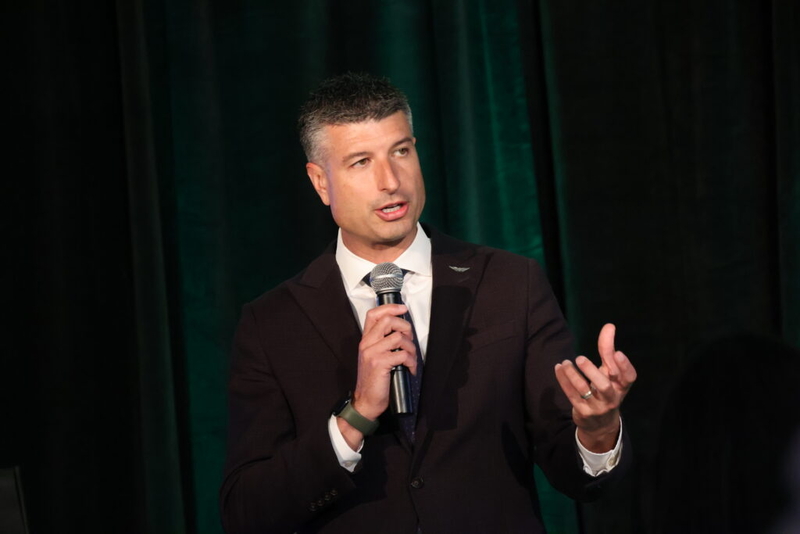
U.S. Rep. Tom Barrett (R-Charlotte) introduces a panel at the Michigan State University Research Foundation's 2026 Mobility Summit centered on mobility technology in national defense. Aug. 11, 2026 | Photo by Kyle Davidson/Michigan Advance
As the U.N. General Assembly concludes its High-Level Week meetings and discussions, U.S. Rep. Tom Barrett is calling on officials to work towards an agreement with other nations regarding AI development.
In a letter to U.S. Secretary of State Marco Rubio and U.N. Ambassador Mike Waltz, the Charlotte Republican voiced his belief that the General Assembly should include artificial intelligence as part of its conversations.
“The 81st Session of the UN General Assembly is uniquely positioned to begin these conversations with other countries,” Barrett wrote in the letter. “This should not only happen with our allies, but our adversaries as well. While we may have disagreements, we should all work towards the common goal of ensuring this technology is properly regulated for the common good and safety of all countries.”
Barrett said those discussions should include ideas for an international AI treaty, incident-report sharing, risk management techniques and human control of offensive and nuclear weapons.
“This next frontier in emerging technology has the ability to propel this world into a golden age or send us into collapse,” Barrett said. “I respectfully request that you both work to create regular and consistent multilateral dialogue on AI moving forward. It is critical that we begin these talks before it is too late.”
In addition to his calls for an international AI compact, Barrett has backed multiple pieces of legislation intended to regulate artificial intelligence.
He is among the lawmakers who led the effort to introduce a bill to ensure AI-enabled weapon systems cannot carry out an intentionally lethal strike without a human decision-maker in the loop.
Barrett also helped introduce a bill to ensure that artificial intelligence is not used in health insurance coverage decisions to determine whether a treatment, prescription or procedure is medically necessary. Known as the Doctors Not AI Act, this legislation has received support from a broad coalition of mental health and healthcare organizations, including the American College of Physicians, the American Psychiatric Association, the National Alliance on Mental Illness and The Trevor Project.
“When health coverage is denied, the consequences include delayed treatment, financial strain, worsening health conditions, and in some cases, life-threatening harm,” the groups wrote in their letter of support. “Americans expect that decisions about their care will be made by qualified professionals exercising independent medical judgment — not by automated systems designed primarily for cost containment.”
Barrett is up for reelection in Michigan’s 7th Congressional District against William Lawrence, a Lansing-area political organizer and co-founder of the Sunrise Movement, who has made opposition to big tech and data centers a major facet of his campaign.
Lawrence has called for a pause on advanced artificial intelligence development and data center construction and proposed a National AI Compact, which would include a jobs program funded by a tax on AI industry profits. Lawrence also supports efforts to reach an international treaty on the safe development, management, regulation and enforcement of AI.
Lansing, MI