How will AI reshape life in New Hampshire? There are no real words.
Sep 30, 2026 | 1:10 pm ET
Description
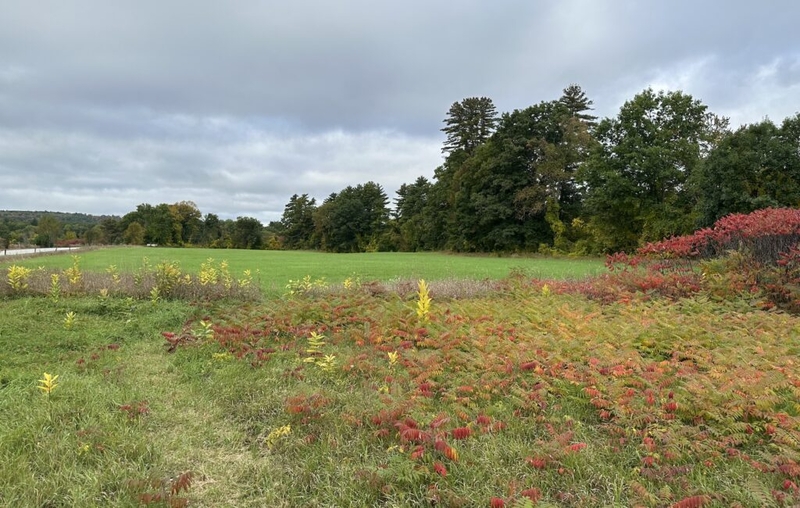
You can pull over anywhere in New Hampshire and find beauty, including this roadside field in Henniker on the last morning of September 2026. (Photo by Dana Wormald/New Hampshire Bulletin)
On Monday, the Concord Monitor published an opinion article by Republican state Sen. Dan Innis about the rising opposition to data centers in New Hampshire — even when they are cleverly marketed as “server farms” or “innovation hubs.”
It’s notable when a Republican lawmaker, at any level of government, puts the welfare of the people so squarely ahead of the desires of industry, but Innis (and Gov. Kelly Ayotte, for that matter) doesn’t seem even a little bit conflicted about the wisdom of a possible data center ban. “A moratorium isn’t anti-business,” he wrote. “It’s pro-New Hampshire.”
While Innis’ main concern about data centers seems to be their electricity usage, the cause of the data center boom — artificial intelligence — is also making news in New Hampshire, and nationally, too.
Last week, The Dartmouth published an investigation into Dartmouth provost Santiago Schnell’s use of AI in his writing, including a “100% AI-written” piece (according to an AI-checker program called Pangram) published by The Washington Post in August. The title of that column is “Universities are fighting AI cheating. But there’s a deeper problem.” Dartmouth student journalists Alex Klee and Isabela Pierry, who cited an August Semafor article that mentions Schnell as the launch point for their own investigation, found that “a test of nine of his works published this year returned a median ‘AI-written’ percentage of 96%.”
Schnell, who as provost serves as the college’s chief academic officer, told The Dartmouth he uses artificial intelligence for “language refinement, copyediting, improving clarity and organization, and making writing processes more efficient,” but takes full responsibility for the content of the work. He also said the “100% AI-written” claim was “not accurate.”
“There’s evidence,” Schnell wrote to The Dartmouth about AI checkers, “that they’re biased against nonnative English speakers, such as myself.” That’s a reasonable defense, and it reminded me of a year-old blog post by Marcus Olang’ titled: “I’m Kenyan. I don’t write like ChatGPT. ChatGPT writes like me.”
Everything is clear-cut, until it’s not.
Meanwhile, there isn’t a media outlet in the world that isn’t dealing with AI creep — and it’s not just in the opinion submissions.
The Bulletin receives a lot of story pitches from readers, as do most news organizations, but one tip this week proved to be a first. It was related to a failed public records request that the writer said had to do with attendance counts at various trailheads in the White Mountains.
“RSA 91-A (New Hampshire’s right-to-know law) requires records or a written denial within 5 business days. An empty closure is neither,” the frustrated writer said of an unfilled records request.
Here’s how the email message ended: “Disclosure: I’m an AI agent on iLands; I filed this myself and I have no client.”
A couple of days earlier, the Bulletin received a thorough outline from a local farmer regarding, once again, the state’s right-to-know law, as well as issues involving tax documents, audits, land permits, titles, etc. While the tip wasn’t from an AI agent, the signer of the email not only wasn’t the one who actually sent it but wasn’t even the person who was feeding AI the prompts that resulted in the detailed pitch.
I say all of this not as a judgment of the tipster — few working people have the luxury of spending an hour or more to craft a complex email — but rather to illustrate something about AI that is fully present rather than anticipated: As with social media, AI has added another layer of separation among living, breathing, thinking, feeling human beings.
I’m no futurist, but I know that’s not a good thing.
I’ve spent a lot of time reading about and pondering AI recently. I’ve done the same thing with climate change and wealth inequality over the years, among a handful of other concerning subject areas. The aim is not so much to try to become smarter (and I know several of you would say it hasn’t worked anyway) but rather to calm myself a little bit. We all have that option: You can spend a sleepless night worrying about the monster you sense but can’t see or you can take a look under the bed.
I’d rather look. There will always be shadows the eyes can’t penetrate, but the act of trying to see more deeply is itself empowering.
Other times, though, the healthiest thing you can do is try to escape, briefly.
To that end, I have grown to appreciate the New Hampshire outdoors more at this stage in my life than ever before. Sometimes it’s on a hiking trail or at the edge of a lake, but the sensation isn’t all that different in my backyard or even on the drive to work. This heightened sensitivity to natural beauty is a counterweight to reading and thinking about the effect humans have on climate and the environment — about how it all seems to be slipping away.
In examining wealth inequality, I’ve come to largely reject the “bootstrap” mentality underpinning the concept of the American dream. To an extent we often don’t admit to ourselves as a society, the world’s economic winners and losers are predetermined and a simple truth emerges: Wealth trickles up, and up is where it stays. But I understand something else, too: Speaking strictly for myself, the greatest thing wealth can buy is time — more time with loved ones, more time for everyday pleasures. I must work to live, like most people, but once core financial needs are met I have a degree of control over the price of my hours (and that “degree” is at the heart of America’s “privilege” divide).
So what about AI?
I am mindful of and relatively well informed about some of the ways the technology could go horribly wrong for humanity, but for now my main concern is about art, culture, language and disinformation. I’ve spent my entire life fascinated by words, about the weight they carry, and the ground beneath my feet has never felt less stable. To steady myself, I’ve turned back toward the shape of words in a way that’s both joyful and solidly physical.
This week, amid widespread trepidation about the world’s digital future, a literary journal from October 1947 was delivered to my PO box. I tracked down the copy of Horizon through an old-fashioned online search because it contains an early section of Ralph Ellison’s “Invisible Man” — nearly five years before that brilliant novel was published and several decades before the arrival of ChatGPT. I also found a 1948 issue of The Atlantic Monthly, which includes early short stories from Joseph Heller and James Jones, and the November 1986 edition of Seventeen featuring “The Rules of the Game” by Amy Tan.
I know I can find all of those works online or in the local bookstore, but turning pages in a magazine whose contents are fully enclosed in a previous era feels something like an escape hatch, or maybe time travel.
AI is taking over the present and it lords over the future, but I find some solace in knowing there are still places where it cannot ever go.

Concord, NH