NC school finance officials call for more flexibility in funding rules
Sep 30, 2026 | 9:00 am ET
Description
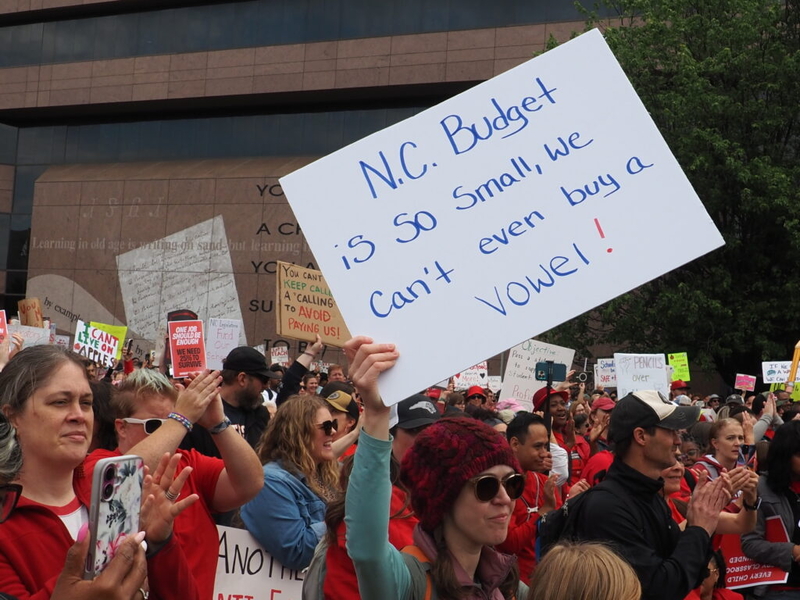
North Carolina public school educators, families, and allies demanded a budget that provides pay raises to teachers and funding to schools at a May 1, 2026 rally. (Photo: Brandon Kingdollar/NC Newsline)
School finance officers told a state commission Monday that North Carolina’s complicated funding rules and delayed state budget decisions make it harder for districts to plan and spend money where they need it most.
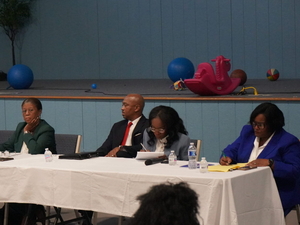
The comments came during a panel before the Blue Ribbon Commission on Public Education. The panel included superintendents and finance officers from Alamance-Burlington School System and Mooresville Graded School District, along with administrators from Lincoln Charter School.
“Public school finance today has never been harder and more complex, ” said Tony Messer, chief finance officer for Alamance-Burlington.
Messer said after Alamance-Burlington used all of its allotted classroom-teacher positions, the district had about $600,000 remaining in the allotment, but funding rules wouldn’t allow it to be used for other needs. He said the money could have helped cover costs such as exceptional children’s services.
“If we could get a little more flexibility and maybe loosen up some of the restrictions around that, that will be beneficial for all parties involved,” Messer said.
Angie Davis, chief financial officer for Mooresville Graded School District, said some reporting requirements ask districts for information state agencies already receive in another form.
For example, she said, districts must report supplemental-pay data through an annual survey, even though the Department of Public Instruction already receives district accounting data each month. Davis said the State Treasurer’s Office also asks districts to report employee income for health-plan purposes, while the retirement system already receives employee salary information each month.
“Just from a business standpoint, it’s very inefficient when you’re already supplying that information to different agencies,” Davis said.
Jonathan Bryant, chief administrator of Lincoln Charter School, said having a state budget in place this year brought certainty after the strain of operating without one the previous fiscal year.
Robert Taylor, the Wake County superintendent who moderated the panel, said the uncertainty becomes a problem when districts have to approve their own budgets before lawmakers finish theirs. A district could approve its budget and move forward, he said, only to learn months later that the General Assembly had added raises or other spending increases that the district would have to match.
“The thing that scared us the most is the idea that the General Assembly could come back and decide that they were going to put raises in, but we’ve already punched the ticket on our budget and moved forward,” Taylor said.
Bipartisan education panel unites NC Gov Stein, Republican leaders amid budget rift
Taylor said districts can absorb some delay, but not indefinitely. State lawmakers are supposed to complete the budget by June 30, he said, and districts can manage a delay into August. By December, he said, the uncertainty becomes much harder to manage.
“If there’s one thing that I think this commission could lift up, it’s the fact that a late budget has a significant impact on how a school district makes decisions,” Taylor said.
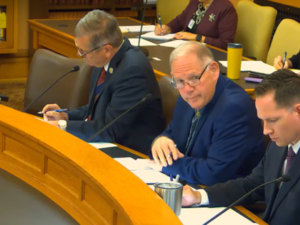
Rep. David Willis, R-Union, challenged the panel’s characterization of state budget delays, calling it “misinformation.”
“First of all, we always have a state budget, so let’s just clarify that,” Willis said. “Now, it may be last year’s budget, and you may not like that number, but you know what the number is.”
Willis said lawmakers regularly seek input from educators and school officials when writing the budget. He also agreed that the state’s education funding model needs to change.
“I think our model is broken,” Willis said. “Let’s go back to the drawing board and figure out what the funding model should look like.”
Raleigh, NC