Kansas Legislature’s budget cuts compel Fort Hays State University to close Sternberg Museum
Sep 30, 2026 | 8:50 am ET
Description
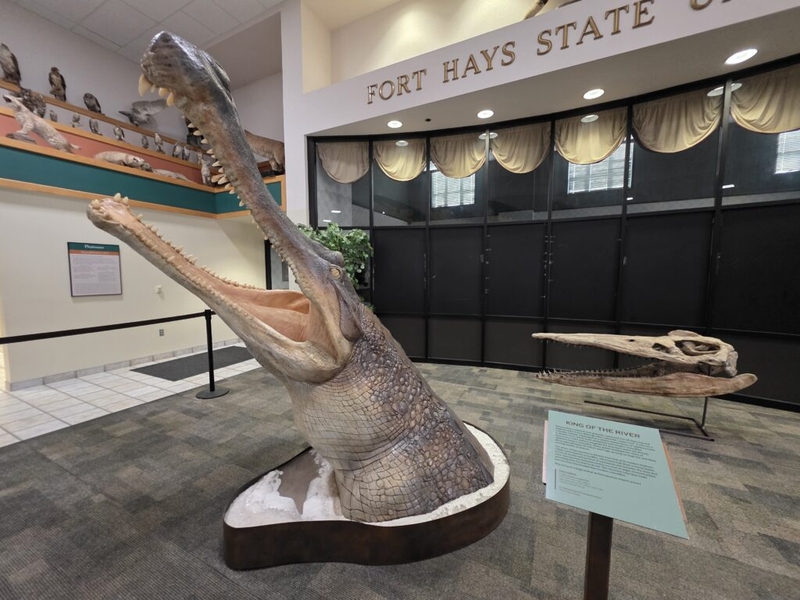
Fort Hays State University administrators are preparing for the December closure to the public of the Sternberg Museum of Natural History in Hays because of $2.4 million in budget cuts by the 2026 Kansas Legislature. (Photo by Morgan Chilson/Kansas Reflector)
TOPEKA — Fort Hays State University president Tisa Mason says the Sternberg Museum of Natural History will close to the public in mid-December because of budget problems.
She said museum faculty and staff would remain this academic year to review collections, determine what must be retained for research and teaching, and collaborate with “appropriate organizations to ensure every specimen is handled responsibly and legally.”
“This is not a decision I make lightly,” the president said Monday. “The Sternberg Museum is woven into the identity of this university and this region.”
The Sternberg Museum contains more than three million paleontology, zoology and geology specimens documenting life and environments in the Great Plains region. The collection has roots in the early 1900s, but the museum moved in a quarter-century ago to the concrete dome-shaped building in Hays adjacent to Interstate 70.
Last week, FHSU faculty, Sternberg Museum staff and community members shared disappointment with speculation the museum could be shuttered.
“I want to be clear about what closing Sternberg is and is not. It is not the cause of our budget problem,” Mason said. “When you cut into your leanest, most efficient state university, you are not trimming excess. You are cutting into muscle.”
Mason said in a 1,500-word statement that Fort Hays State received a $2.4 million reduction in state funding during the 2026 session. In addition, the Legislature requested FHSU assess how it would slash administrative costs by 10%. The university has relied for decades on revenue from higher education programs in China, but restrictions by the state could jeopardize as much as $6 million in funding.
She said closing the museum would lower Fort Hays State expenditures by $850,000 annually. That savings would be combined with $1 million in cuts across the university to compress the known budget gap to $550,000.
The museum has proven to be financially unstable with revenue annual revenue of $470,000 and average expenditures of $1.3 million per year. Complicating the issue was the $20 million in deferred maintenance at the museum.
Mason said options for Fort Hays State were limited. Unlike some higher education institutions in Kansas, FHSU doesn’t have access to local property or sales tax revenue. No individual, foundation or government entity stepped forward to underwrite the museum’s costs.
“I am open to solutions and welcome conversations and ideas,” Mason said. “But let me be direct about what any solution requires. The university would need about $1 million in new revenue every year. Not once, but annually, in perpetuity. This is a recurring cost, and it will not be solved by a one-time gift, a single fundraiser or any single event.”
In response to the $2.4 million cut imposed by the Legislature, in addition to closure of the museum, Mason said the FHSU president’s office was reorganized and staffing reduced. The university stopped hosting the Small Business Development Center and the FHSU men’s and women’s golf programs were paused in June. A new entrepreneurship director position was frozen, she said.
Mason said questions had arisen about the potential of using student tuition revenue to backfill the museum’s budget. Increases in tuition dollars have been earmarked to keep academic programs whole, she said.
“The frustration in our community right now is real, and it is understandable,” Mason said. “However, its true source is not a disagreement about whether Sternberg belongs in our academic mission. It does. That was never in question. The real source is a funding model that has asked more of FHSU than it asks of its peers.”
During fiscal year 2025, the level of state funding per full-time equivalent student ranged from a low of $6,713 at Fort Hays State to a high of $19,379 at Emporia State University.
Other full-time equivalent student funding levels in fiscal 2025: University of Kansas, $8,423; Wichita State University, $10,421; Pittsburg State University, $11,540; and Kansas State University, $11,664.
“We cannot absorb repeated, deep legislative reductions and simultaneously preserve everything our community values. Those are choices with real consequences, and those consequences fall first on the people who had no part in making them,” Mason said.
Topeka, KS