Alabama State Board of Education members raise concerns over virtual school performance
Sep 30, 2026 | 5:59 am ET
Description
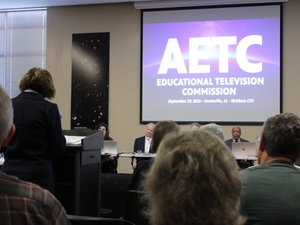
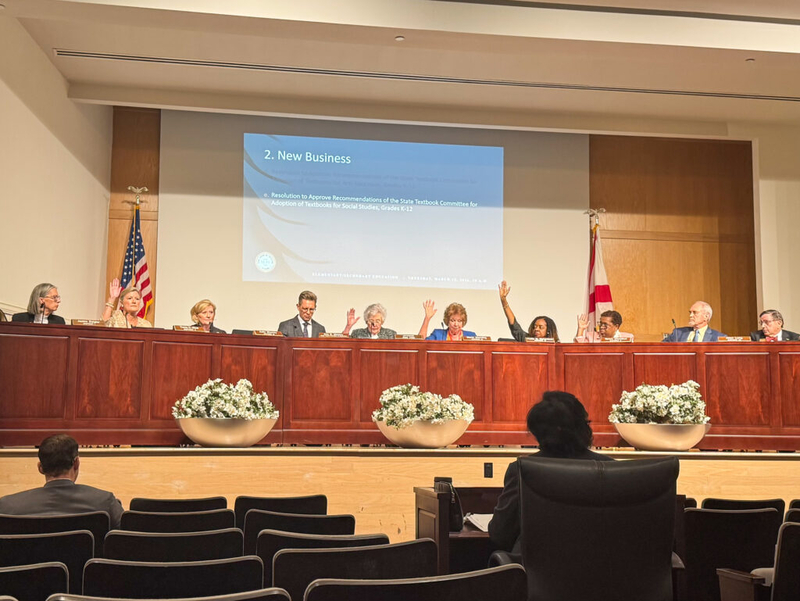
The Alabama State Board of Education votes to approve a recommendation for social studies textbooks on March 12, 2026. Board members earlier this month expressed their concerns with virtual school performance. (Andrea Tinker/Alabama Reflector)
Members of the Alabama State Board of Education expressed concerns with virtual school performance at a meeting earlier this month.
Under state law, local school systems must provide a pathway for students to graduate with an online education.
But Alabama State School Superintendent Eric Mackey said during a State Board of Education meeting on Sept. 10 that it can be hard to track where students are transferring from to the virtual schools.
“All of them (schools) enroll people statewide. Some of them enroll a lot more people statewide, but all of them enroll people who are, in the law, transfers from another district,” Mackey told board members. “A lot of them we don’t know where they transferred from.”
Board members received a packet during the meeting detailing enrollment numbers for virtual schools in the state. The packet was not made available to the public due to FERPA regulations.
Traci West, a board member representing District 2, said during the meeting that she was concerned about test scores at the virtual schools.
“I absolutely believe… that there are some students that will not be successful in a traditional classroom,” West said. “I am, however, disturbed by the performance of some, not all, particularly now more so.”
This month’s meeting isn’t the first time West mentioned virtual schools. During a July State Board of Education meeting, she raised concerns with test scores at online schools after hearing about a student in her district who moved back to traditional schooling from virtual.
West said in an interview Tuesday afternoon that performance at statewide virtual schools is lower because of the lack of oversight.
“The teachers are not employees of the district, the teachers are employees of the company, so we do not know truly what is being taught and to what standard,” West said. “We know what our standards are as a state board of education, but those teachers are not employed by the state of Alabama.”
There are three statewide virtual schools. Alabama Destinations Career Academy in the Chickasaw City district, Alabama Virtual Academy at Eufaula City Schools in the Eufaula City district and Alabama Connections Academy in the Limestone County district.
Of the schools, Alabama Destinations Career Academy and Alabama Virtual Academy at Eufaula City Schools both received a D on the state report card. Alabama Connections Academy received a C on the state report card.
Messages seeking comment were left with Alabama Destinations Career Academy, Alabama Virtual Academy at Eufaula City Schools and Alabama Connections Academy Tuesday afternoon.
Mackey said under state law “public schools have to teach the public school standards” but the responsibility to enforce those standards for online schools lies with the local boards.
Allen Long, who represents District 7, also had concerns about virtual school performance, noting that some of the lower-performing virtual schools were receiving funding similar to the higher-performing virtual schools.
“It seems to me like somebody needs to let the legislature know that some schools are doing great and some are not,” Long said during the meeting.
A message seeking comment was left with Long Tuesday afternoon.
Mackey said during the September meeting that the “performance is generally lower for virtual schools than non-virtual” and that the department is working to help online schools better prepare students.
“We actually this last year launched a special program to kind of help districts understand how to support their virtual schools because they’re not seeing those people day-to-day, so how do they support those students who are way behind? We’re trying to help them with that,” Mackey said.
West said in the interview that he believes that giving the State Department of Education jurisdiction over the statewide schools could improve performance.
“I think the law could be tightened up to allow for state department oversight,” West said. “I do believe that individual contracts with individual school districts from outside vendors could be tightened up to have some provisions that truly serve the students and not just the profits of the company.”
Montgomery