What do braids, cornrows and Bantu knots have to do with the news?
Sep 30, 2026 | 5:00 am ET
Description
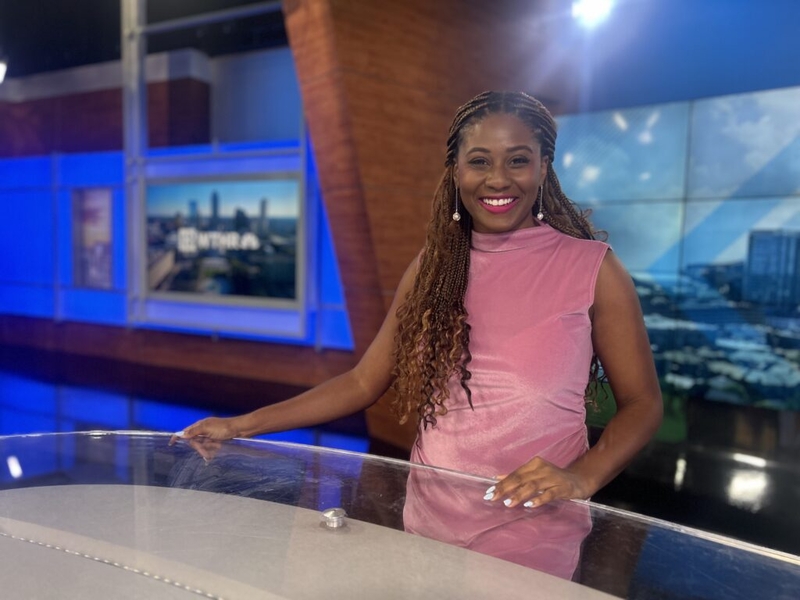
WTHR anchor Jalea Brooks had to get permission to change her hairstyle for her on-air look early on in her career while working in a different market. (Courtesy WTHR)
Black journalists on TV have had to think about their appearance on air in ways that other journalists do not. In August 2020, broadcast journalist Jalea Brooks knew she needed to have an uncomfortable conversation with her news director about her hair. She had been working in Montgomery, Ala. for nearly four years and wanted to wear a new style on air: braids.
Previously, a white manager in Montgomery pulled Brooks aside and told her that if she wanted to continue anchoring, she would need a consistent look. She could choose her hairstyle, they said, but would need to stick with it. At the time, she was between looks and had her natural Black hair pulled back into a bun.
“I could read between the lines, and I understood what he meant by that,” she said. “And I definitely knew that sticking to the status quo felt like the safest option.” Straight hair, she felt, was that safe option and it was stated in her contract that she would need to get permission to change her look in the future.
Because of that conversation early in her career, years later Brooks said she was hesitant to approach her news director in Montgomery about her desire to wear braids on air. However, she felt empowered by other Black journalists who were choosing to do the same. After talking to her news director and showing pictures of the style she would like to wear, she was given approval to wear braids and started doing so in August 2020.
She accepted a new job as anchor at WTHR here in Indy in December 2020, and she knew she wanted to have an upfront conversation about on-air appearance, specifically her hair and her desire to wear different styles. She was assured by her new boss that the way she wanted to wear her hair was her choice. Since then, every subsequent news director at the station has also supported her right to wear her hair how she chooses.
This issue is about much more than individual journalists’ personal choices. How Brooks and other Black journalists wear their hair has wider implications for Indy news consumers. The reason we watch local TV news is to hear the truth about our community from journalists who are members of our community. Newsrooms strive to reflect the people they serve. If the journalists sharing those stories conform to only white standards of beauty and professionalism, that comes at a cost. Viewers are less equipped to understand and relate to all of the people they encounter in their communities.
Also, representation matters. Presenting only straight, shoulder-length hair and thin body types as the standard is a distortion of our community and a disservice to it.
A risk worth taking: Indiana does not have a CROWN Act
Any time you see a Black TV journalist with braids, locs, or other natural hairstyles, know that they are taking a risk. This state does not protect them by law from discrimination because of their hair texture.

State Rep. Vanessa Summers (D-Indianapolis) tried to get such a law through the legislature in 2023. It was Indiana’s version of the CROWN Act, short for “Creating a Respectful and Open World for Natural Hair.” It prevents employers from discriminating against workers because of their hair texture, including Black hairstyles. It also protects people seeking housing and students in school settings. Thirty states have passed similar laws since California first adopted the policy in 2019.
When Summers introduced the bill, her fellow representatives in the Indiana General Assembly did not support it. She could not get a hearing for HB1284. It did not make it out of the education committee. Committee chair Rep. Robert Behning (R-Indianapolis) responded with a flat “no” when he was asked to consider it. As a Black woman, Summers could relate to the legislation and said she wanted to help women statewide and her constituents in District 99, where 52% are female and 37% are Black.
“I’ve had every hairstyle and every color that you can have, and I understood some of the discrimination you can get from having your hair a certain way,” Summers told me.
With today’s political climate, she said the measure is probably a nonstarter, but she will resurrect it in the next legislative session. Summers said it will take bipartisan support and a white female ally to at least give it a hearing and allow it to gain publicity, which she would count as “moving the needle a little bit.” Further success would be an “uphill battle,” she said, with the state legislature currently split 70 to 30, Republicans to Democrats.
Research documents that bias against Black journalists’ natural hairstyles is real. A 2023 CROWN Workplace Research Study, co-commissioned by Dove and LinkedIn, found that Black women’s hair is twice as likely to be perceived as unprofessional as non-Black hair. Studies in 2024, by a researcher at Indiana University-Purdue University Indiana, found that Black women did not want to work for companies with dress codes that restrict their hair choices. These dress codes sent a message that they could not be authentically themselves in the workplace, along with acting as a signal that Black women would overall not be valued in that workplace.
Even as the formal rules governing the hair styles of women in TV news have receded, Black journalists say they remain wary.
“Culture’s obviously going to be much harder to change than a piece of paperwork, but it is the most important step at the same time, right?” said Jasmine Beecham, who penned her PhD thesis, “Dress to Repress: Exploring How Dress Codes and Norms Harm Black Women in the Workplace.” By showing up to work with an array of hairstyles, Black journalists can help reshape cultural norms, making Indianapolis employers and residents more accepting of everyone in the community, she told me.
For better or worse, looks matter on TV news
WTHR’s Brooks said that Hoosiers’ perception of her professional abilities matters. As a TV journalist she believes appearance is a big component of how she is perceived.
“I would love to say that no, it shouldn’t matter, the journalism should matter, the story, the communities that we cover matter, but, no, it absolutely does,” she said. Being in a highly visible occupation leaves her open to public comments about her choices in clothes, makeup and hairstyles. Since coming to Indy, she’s received overwhelmingly positive feedback from viewers. She changes hairstyles often. For Brooks, straight hair has been the anomaly.
“So much so, that when I did actually wear my hair straight—after months, maybe even a full year on the job—I would often get questions of concern on whether my station ‘made me’ change my hair, to which I would tell them, no, the choice was my own,” Brooks said. “But, I absolutely understood why that would be a concern, as that has been a reality for other TV journalists.”
Former WRTV anchor and multimedia journalist Naja Woods embraced her natural hair long before launching her broadcasting career in South Bend, Ind. She started as a producer and transitioned to an on-air role. Woods, who wore her natural hair curly, was nervous about reporting the news in braids when she decided to change up her look.
“I didn’t know, it’s like, ‘are braids unprofessional on air?’” she asked herself at the time. “So all that went through my mind. I looked up examples of other Black women wearing their hair in braids, and I just went for it and never turned back.”
The positive reception she received from viewers of all ages was confirmation that she made the right choice.
“If I did anything with kids, in particular kids of color, little Black girls, they would say, ‘oh, I really love your hair,’ and, ‘that’s so cool that you wear your hair like that, if I get on TV, I want to wear my hair like that,’” Woods said. “Even parents or grandparents will come up to me and be like, ‘you’re really an inspiration’ because not only do I wear my hair naturally primarily, I’m a dark-skinned woman as well. They would say that was really inspiring to their grandkids or kids, stuff like that, so that was cool.”
Woods said she’s never had an issue with station management anywhere she’s worked.
“I’m not going to straighten my hair, put constant heat on my hair just to please somebody else,” she said. Woods said she would change stations if it came to an ultimatum, but she would stay in the industry because she does believe natural hair has become more accepted.
Representation in newsrooms is a window into communities
You’re seeing more journalists with Black natural hairstyles. It’s a movement that was slowly gaining ground, starting with hashtags like #FreeTheCurls in 2019. After the protests and movement that was sparked following the murder of George Floyd in 2020, the hashtag #BlackHairOnAir went viral. Black female on-air journalists and meteorologists started posting photos of themselves reporting the news in braids, afros, cornrows, Bantu knots and other natural hairstyles.
In 2026, with Black women of all occupations losing jobs due to the political climate, and the backlash against diversity, equity and inclusion initiatives, we don’t want our journalists to feel pressured to censor how they show up on air.
Telling diverse stories and presenting the many faces of a community is a tool for helping Hoosiers understand and relate to the people around us. When the storytellers can express their own style and show their authentic selves, the stories resonate.
Indianapolis, IN