Gargantuan feedlot telegraphs woes for cattle and the environment
Sep 30, 2026 | 4:33 am ET
Description
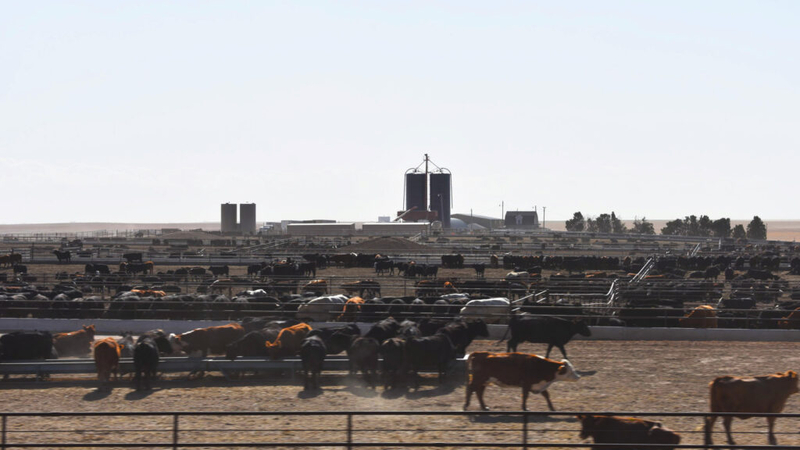
Cattle crowd a Kansas feedlot in 2022. Plans call for an enormous new operation in the region. (Jill Hummels for Kansas Reflector)
I was just reading about a feedlot in Nebraska, near where that state meets Kansas and Colorado. It is set to become the largest in the country, holding in one square mile up to 150,000 head — as many cattle as were driven here in 1886 during the peak of the great drives.
After reading that I did some math. One cow slaughtered yields about 550 pounds of beef, or about a quarter of a metric ton. According to a recent social media post from President Donald Trump, he will allow 300,000 metric tons of beef imported tariff-free from countries not mentioned (mostly not even shown on the JBS website, the mega packing firm controlled by Brazilian billionaire and Trump donor Joesley Batista).
Afterward, the August Feeder Board dropped several dollars per head. I figured that much beef would come from 1.2 million cows. (Likely more than that. Those Brazilian cows don’t look as heavy in spite of being raised on tropical grasses all year long, maybe due to the parasites.)
Instead of riding in boxcars to slaughterhouses in Omaha, Chicago or Kansas City, these cattle ride in aluminum double-decker semi-trucks called “cattle pots” for, you know, where the waste collects. Maybe they’re roomier than boxcars, but who can say, watching those faces through the slots as you pass one on the highway.
Before the feedlots, these cattle have only known rolling pastures, or the welcome sound of the rancher’s truck bringing hay or breaking ice on the water tank. One day comes the confusion of being rounded up and trucked to pens with crushed concrete floors and robotic waterers and feeders, packed alongside other terrified animals.
There isn’t even natural darkness there, as intense lights flood the area and can be seen from the next county. Residents of the nearby town of Haigler don’t get to see the night sky either.
The swill they are fed is mostly corn and distiller’s waste from ethanol plants — an industrial system. No selective grazing among native plants, no exercise, no respite from the flies and other tormenters. Their weight swells as their veins clog. The hormones reboot their physiology, the antibiotics disrupt their gut flora and they belch methane, the gas that disproportionately heats the planet.
Excuse me if I mentioned antibiotics. Or is it the growth hormone we like to say isn’t used in beef production (wink, wink, nudge, nudge).
Backers in Canada promise jobs and prosperity (wink, wink, nudge, nudge). But as the trucks roll in and out, damaging road surfaces and raising dust, few stop at local businesses. Few locals find employment.
Talk at the Country Café in Haigler is often about water woes of the region, where the Ogallala Aquifer has dropped out of reach and the nearby Republican River is reduced to a trickle of bathtub warmth, devoid of dissolved oxygen. It’s not just the drought (although recent summers have rivaled the Dust Bowl). Most of those planted windbreaks are gone. So is the Rockies snowpack.
The Bluestem Bison Ranch near Glade and pasture-finished cattle operations farther east offer sustainable alternatives, if only granted a level playing field with the big boys, those multinational conglomerates with deep pockets but shallow concern for local enterprises.
Wendell Berry passed from this earth in August. He was an eloquent voice in the 1970s warning against the corporatization of agriculture and emptying of small towns, which he called the “Unsettling of America.” He lived to watch it happen. His talks at the Land Institute in Salina were inspiring and hopeful, and his poetry warms the soul like the Chinook winds.
The company says it will compensate for the massive water use of the feedlot and its waste management system by buying irrigated crop fields that will be retired (as they would have been anyway). Supposedly they will be replanted to prairie.
Anyone who believes this is possible knows nothing of a prairie. True prairie develops over centuries or longer where soils are deep. They take much longer on the high plains, where competition with cheat grass and other invasives requires intensive management.
Once the banks of the Republican were home to vast herds of bison, although at least they moved about over an area stretching from Dakotas to the Pesos. The Pawnee called it the river of “much manure,” and how prescient they were!
Bill Beachly was a biology professor at Hastings College in Nebraska for 27 years before semi-retiring near Concordia, Kansas (where he still works at Cloud County Community College). Through its opinion section, Kansas Reflector works to amplify the voices of people who are affected by public policies or excluded from public debate. Find information, including how to submit your own commentary, here.

Topeka, KS