Eric Schmitt’s Hawks-Hawkeyes blunder and the politician he’s become
Sep 29, 2026 | 4:22 pm ET
Description
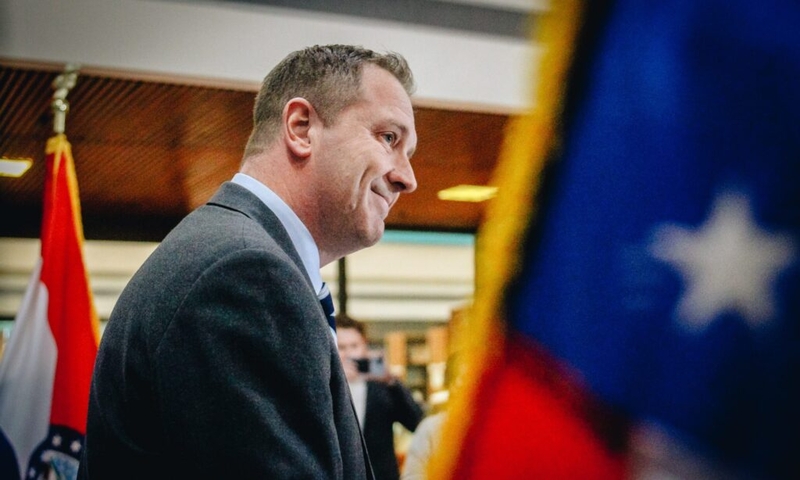
Eric Schmitt answers questions during a press conference after filing to run in the Missouri Senate primaries on Feb. 22, 2022 in Jefferson City (Madeline Carter/Missouri Independent).
On Monday, Missouri Sen. Eric Schmitt showed he still knows how old-fashioned politics works.
He helped pass a college sports bill he spent months negotiating with Democrats Maria Cantwell and Chris Coons. They disagreed over major provisions, compromised and produced legislation that passed the Senate 77-22.
A day later, a different Eric Schmitt showed up.
At a Senate Judiciary Committee hearing, Schmitt accused former special counsel Jack Smith of perjury. His case rested on what he portrayed as evidence that Smith had attended an Atlanta Hawks game and used the trip to meet with Fulton County District Attorney Fani Willis.
He came armed with a poster board of texts he said contradicted Smith’s testimony.
“I think you’ve already perjured yourself,” Schmitt told him.
Schmitt called Smith a “villain” and proclaimed he’d go down in history as “a total dirtbag.”
There was one problem. Actually, two.
The texts on Schmitt’s poster didn’t mention Atlanta.
And Smith didn’t attend an Atlanta Hawks game. He attended an Iowa Hawkeyes game in Maryland.
Democratic U.S. Sen. Amy Klobuchar said Schmitt, working from clearly wrong information, owed Smith an apology.
Instead, he went on The Charlie Kirk Show.
“It was the only NBA game going on at that time in Atlanta,” Schmitt said. “He claimed later that he was at another game.”
Then came his defense:
“Here’s the thing — my job is to ask the questions.”
Just asking questions.
Schmitt won a seat in the state legislature in 2008 with 55% of the vote in the middle-class suburbs along Interstate 44. Over eight years, he built a conservative record that regularly involved working with Democrats.
He stood with Democratic Gov. Jay Nixon to push insurance coverage for autism treatment. He helped legalize CBD oil for people with intractable epilepsy, drawing on his son Stephen’s experience. After Ferguson, he championed legislation limiting municipalities’ reliance on traffic fines and court fees.
The AFL-CIO endorsed him in 2012.
In a 2014 video tour of the Missouri Senate chamber in Jefferson City, Schmitt said lawmakers’ different backgrounds and opinions made respect important, and that the room reminded him of the need for “a more civil tone in politics, now more than ever.”
Schmitt said he had been inspired by Jack Kemp to “take that conservative message outside of the Republican echo chamber.”
The goal wasn’t merely to beat people who disagreed with you. It was to persuade them.
That changed as Schmitt headed toward the U.S. Senate.
In the year before Schmitt launched his Senate campaign, he used “radical left,” “tyranny” or “tyrant” on Twitter twice, according to an analysis by St. Louis Magazine. In the following year, he used them more than 100 times.
Last year, he said opponents of the president’s mass deportation program had nothing left but “the Marxist playbook, which is political violence,” and that federal money was flowing to a “radical ecosystem” of nonprofit groups and activists “working to undermine our civilization.”
At the National Conservatism Conference last year, he rejected the idea of America as a creed anyone can adopt. He waved off the notion that its meaning lies in a Statue of Liberty poem or in “all men are created equal.” America, he said, is a people and a homeland handed down by particular ancestors, and he described Americans as descendants of Europe’s Christian pilgrims.
Then he drew the line. Of the “radicals” he accused of tearing down statues and mocking American history, he said: “America doesn’t belong to them — it belongs to us.”
Schmitt has an explanation. He says he hasn’t fundamentally changed; the country and the left did.
Perhaps. But that doesn’t explain the transformation in his rhetoric or political style.
Republicans who knew him offered another explanation.
In 2022, former U.S. Sen. John Danforth, who was backing an independent candidate against Schmitt, told The Kansas City Star that prominent Republicans he wouldn’t name had called to reassure him about Schmitt’s candidacy.
“All of them said the same thing to me,” Danforth recalled. “Which was, in fact, some of them used the same word to describe Eric, and the word was malleable.”
“And one of them said during this campaign he’s been playacting,” Danforth said. “In other words, he doesn’t really believe it.”
The two Eric Schmitts on display this week sandwich a report by Axios that he has grown close to Vice President JD Vance, who has faced similar questions about his own ideological transformation. Schmitt is seen as a top prospect to be Vance’s running mate if Vance seeks the presidency in 2028.
Monday showed the Eric Schmitt that Missouri used to see much more often: ambitious and partisan, but willing to treat people on the other side as negotiating partners.
Tuesday showed the Eric Schmitt who has increasingly defined his national political career: certain of his enemies’ bad faith, eager to escalate and willing to reach the verdict before all the facts are in.
Whether that Schmitt represents a genuine conversion or, as one Republican told John Danforth, some measure of “playacting” is something only Schmitt can know.
Either way, that’s the Eric Schmitt now stepping onto a bigger national stage.

Jefferson City, MO