Pa. House panels hear testimony on automatic license plate cameras
Sep 28, 2026 | 4:33 pm ET
Description
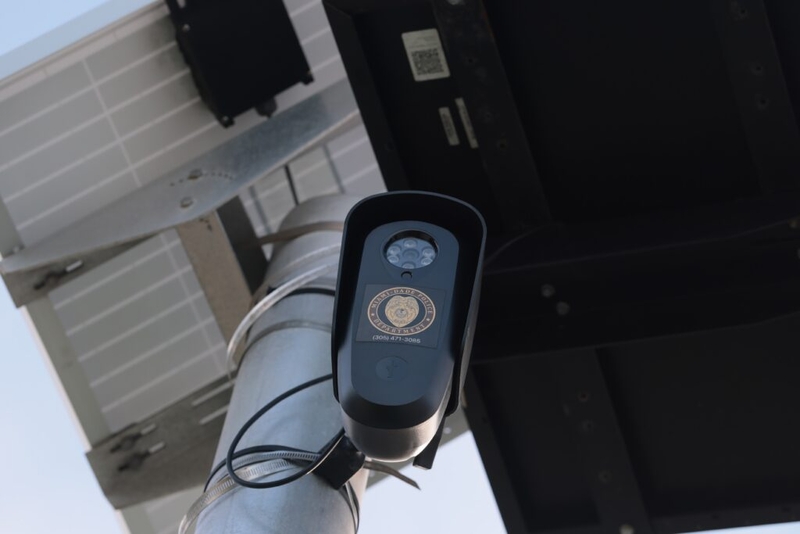
A Flock camera monitors passing traffic on Sept. 2, 2026 in Miami. The state department of transportation said this month it will remove license plate readers, such as Flock cameras, from all state highways, citing an increase in reports of misuse of the systems. (Photo by Joe Raedle/Getty Images)
(This article was updated Oct. 1, 2026, to correctly attribute comments Electronic Frontier Foundation senior staff attorney Lisa Femia.)
Amid a growing national backlash against automatic license plate reader technology and its potential for misuse, Pennsylvania lawmakers grilled law enforcement, tech and civil liberties advocates about how to ensure it isn’t abused.
Automatic license plate readers (ALPRs) are broadly deployed by law enforcement, parking enforcement and toll collecting agencies in the commonwealth. They collect images of passing vehicles and record the location, time, license plate number and, in some cases, identifying features such as bumper stickers or roof racks.
In recent years, they’ve been credited with helping police locate stolen vehicles and wanted people and allowing the Pennsylvania Turnpike Commission to eliminate toll booths, among other uses, speakers said Monday at a joint hearing of the state House Transportation and Judiciary Committees.
At the same time, proponents of the technology say they share concerns about privacy, data retention, unauthorized access, sharing and selling data and potential misuse.
Scott Bohn, executive director of the Pennsylvania Chiefs of Police Association, said his members’ position is straightforward. “Pennsylvania should regulate the responsible use of automated license plate reader technology rather than eliminate an effective public safety and investigative tool,” he said.
Civil liberties advocates, on the other hand, called for an outright ban, or, at least, strict constitutional limits on ALPR use, warning that the profusion of cameras photographing every car that passes when combined with artificial intelligence threatens the privacy of everyone who drives.
“AI-driven automatic license plate reader technology allows the government to do something now that it has never been able to do before, and that is to travel back in time and reconstruct where people traveled, whom they saw, and what they did,” said Mitchell Smith, legislative counsel at the Institute for Justice. “And all this information is now available at the click of a button and does not require law enforcement to first obtain a warrant.
Zealous opposition to APLRs has focused largely on one provider of the technology. Flock Safety markets ALPR cameras and other public safety technology including acoustic gunshot detectors in conjunction with software that allows law enforcement to search a nationwide network of databases maintained by law enforcement agencies.
Flock’s cameras, usually mounted on freestanding roadside poles, have been vandalized as stories about law enforcement abuse of the tech have circulated in the news. In August, The Washington Post published the results of an investigation that found well over 50 cases of officers who have been charged with misusing Flock and similar systems to spy on spouses or intimate partners, exes and their exes’ new partners.
It included the story of a mother from Leechburg, Armstrong County, who said she repeatedly warned police and the district attorney’s office that her police officer husband had used a competitor to Flock to stalk and threaten her. The officer, Michael McSherry, ultimately pleaded guilty to official oppression and served about 11 months in jail, according to the article.
The U.S. Senate Judiciary Committee Crime and Counterterrorism Subcommittee held a hearing last week where senators heard the story of a woman who was wrongly arrested for a fatal car crash after a Flock camera captured her car miles away.
Kevin Kane, director of government relations for Flock Safety, said his company has been taking steps to address concerns about how his company’s product is used. They include tougher controls on when officers can use it, shorter default data retention windows and automatically flagging searches for review if they don’t meet requirements.
“We’ve invested significantly to make sure this technology is used appropriately, and we’re going to keep doing that,” Kane said.
Elizabeth Randol, legislative director at the American Civil Liberties Union of Pennsylvania, said it’s important to distinguish between ALPRs and automatic traffic enforcement devices, such as red light cameras that issue tickets for violations of traffic laws.
“ALPRs capture the movement of every driver who passes, regardless of whether they are suspected of any crime, creating patterns of behavior,” she said, adding that the images are entered into a database where they’re checked against “hot lists” of license plates to identify vehicles being sought by police.
“Over time, this data can reveal personal details about our lives, our religious practices, medical visits, political activities, personal relationships, and daily routines. This dragnet surveillance threatens the freedoms the Fourth Amendment was adopted to protect,” Randol said.
She noted that ALPRs have been in use since the late 1990s, but have recently exploded in numbers with the entry of venture capital funding into the industry and with the advancement of artificial intelligence.
With investment in the technology, there’s pressure to sell more cameras, retain more data and share data to generate the profit investors are looking for, Randol said.
“In other words, ALPR companies are in the business of trading our privacy for profits,” she said.
Proposed laws would limit ALPR use
Several pieces of legislation have been introduced or proposed to regulate ALPR technology, many with bipartisan support.
State Sen. Doug Mastriano (R-Franklin) published a memo seeking cosponsors last month for a bill that would limit permitted uses to stolen vehicles; missing or endangered person alerts; manhunts for “wanted or dangerous” individuals; vehicles “reasonably believed to be connected to a specific criminal investigations”; public safety threats that are “specific and articulable”; warrant searches; and other emergencies with imminent threats to life or safety.
Sen. Dan Laughlin (R-Erie) would prohibit “networked” ALPR systems that create automatically databases of every passing vehicle, saying they “could reveal where someone works, worships, receives medical care, spends personal time and who they associate with.”
Rep. Tarik Khan’s (D-Philadelphia) proposal would give private individuals the right to sue and authorize the state attorney general and county district attorneys to investigate violations and bring civil enforcement actions.
Rep. Nathan Davidson (D-Dauphin) is a co-sponsor of Khan’s bill and introduced legislation that would prohibit law enforcement from sharing ALPR information with federal agencies or police in other states for purposes of tracking people who may travel to other states to obtain abortion care or other health care.
Deanna Dyer, a lobbyist representing the Women’s Law Project, pointed to what she called a “notorious case” in which a Texas sheriff’s office used Flock databases to investigate the travels of a woman who had a self-managed abortion.
“One officer was able to make one inquiry about one person regarding suspected personal action that’s not a crime, and successfully collected interstate surveillance data on this person from 83,345 cameras across over 6,800 camera networks, Flock networks to be specific,” Dyer said.
She urged lawmakers to consider the issues through the lens of gender equality and justice.
“This increasing reproductive police state under which many Americans are now living impacts the most vulnerable women and girls in our communities,” Dyer added.
Digital rights advocate recommends warrant requirement
The Electronic Frontier Foundation, which advocates for digital rights and civil liberties, has sounded alarms on the harms of ALPRs for years, senior staff attorney Lisa Femia said. The group is suing the city of San Jose, California, over its practice of searching its ALPR database without first obtaining a warrant.
She said the scope of the ALPR networks and the scale at which the databases are searched by law enforcement around the country make it difficult for agencies to meaningfully review how their data is being used. Thousands of police departments share access to their data and searches by external agencies can number in the millions, Femia said, amounting to a “serious invasion of privacy.”
“This is why EFF believes that ALPR mass surveillance should not exist and is incompatible with a free society. It’s why we ultimately urge governments to ban ALPRs and cease use of this technology altogether,” she said. “No system configuration or set of legislative guardrails can eliminate the risks inherent in this mass surveillance. But if and when cities do use ALPR surveillance, state legislatures must then impose strict enforceable limitations.”
That means there should be an “ironclad” warrant requirement before police can search for a vehicle in an ALPR database, Femia said. Searches should be connected with only the most serious crimes, she added.
Legislation should also mandate a rigid data deletion deadline. She noted New Hampshire requires data to be deleted after only three minutes if a license plate is not already on a hotlist. Flock recently changed the default setting in its software to delete data after seven days rather than 30.
Femia said there must also be a rigorous audit trail for every search and annual external audits to identify officers who are conducting invalid searches. Dyer added that the audit logs should be accessible to journalists and the public.
“Public records have often proved the best way to expose the harms and privacy violations of these systems … and Pennsylvania lawmakers should not cut off access to that vital tool for public transparency and oversight,” she said.
Finally, Femia said, ALPR data should not be shared with out-of-state or federal agencies.
“Pennsylvania has its own laws and values,” she added. “It should not allow its residents’ sensitive data to be accessed and searched based on the laws, policies, or whims of out-of-state and federal agencies.”
Harrisburg, PA