Clean Elections to AZ Supreme Court: Fraud case against Green Party candidates is growing
Oct 20, 2026 | 5:03 pm ET
Description
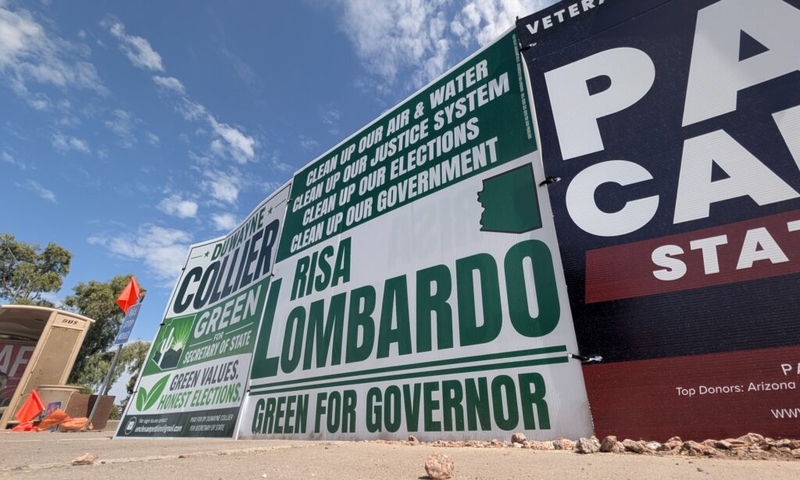
The Arizona Green Party says that gubernatorial hopeful Risa Lombardo is a "sham candidate" who is being propped up by Republicans. So far, she's spent most of her public campaign funding with a Nevada company that was created just days before she qualified for Clean Elections money. (Photo by Jim Small/Arizona Mirror)
A pair of Green Party candidates dismissed allegations they fraudulently obtained millions in public campaign funding as a “black helicopter” conspiracy theory, but the director of the Clean Elections Commission told the Arizona Supreme Court on Monday that investigators have already uncovered 17 voters who say they didn’t give money to help those candidates qualify.
“No helicopters. No conspiracies. No crackpots. Just proof,” attorney Craig Morgan wrote on behalf of Clean Elections Commission Executive Director Tom Collins in a brief filed with the Supreme Court.
The Supreme Court last week agreed to take up a lawsuit Risa Lombardo and Duwayne Collier, the Green Party nominees for governor and secretary of state, filed last month challenging the authority of the Clean Elections Commission to investigate whether their campaigns forged voter signatures and $5 qualifying contributions to get millions of dollars from the public campaign funding system.
In August, the commission opened a formal investigation into Lombardo, Collier and Republican Scott Neely, who lost his primary for governor to Andy Biggs. That decision followed an exclusive report from the Arizona Mirror that six people who were listed in campaign finance records as having made $5 contributions to all three candidates were adamant they didn’t give any money to the candidates.
That reporting corroborated preliminary findings from Collins, who separately discovered that thousands of donors were listed as contributing $5 to all three campaigns on the same days. Many of them had never made a contribution to any other candidate, according to campaign finance reports.
Voters rarely make qualifying contributions to more than one Clean Elections candidate, but the Mirror’s analysis found that the three long-shot candidates reported collecting contributions from nearly 4,000 of the same voters — including more than 2,600 who were listed as giving to all three.
In letters to each of the candidates, Collins informed them of the Clean Elections investigation into their campaign finances and warned them that they could be required to repay all or some of the money.
In the lawsuit, Tim La Sota, an attorney for Lombardo and Collier, argued that the Clean Elections Commission was attempting to overstep its legal authority by “decertifying” the candidates from receiving Clean Elections funding for their campaigns. Only the secretary of state, with the help of the county recorders, can certify that the candidates collected enough $5 contributions to receive public funding, he wrote.
And, the Green Party candidates argued, the Clean Elections Commission doesn’t have the authority to order them to repay the funding. They have asserted even if a candidate did receive money through illegal fraud discovered after the fact, a criminal investigation — which is ongoing — is the proper way to hold a campaign accountable.
A trial court judge dismissed the lawsuit and the Court of Appeals said it wouldn’t overturn that ruling, reasoning that it was premature because the Clean Elections investigation was still ongoing and the commission hadn’t yet ordered the candidates to return the money.
But the Arizona Supreme Court accepted their appeal and will decide whether the commission can effectively overrule the secretary of state’s certification that the candidates qualified, and if so, whether it can order them to repay the money if it concludes the money was illegally obtained.
The attempt to do so, La Sota wrote in his Supreme Court filing, is “a raw usurpation” of the power given to the secretary of state to determine whether candidates qualify for Clean Elections funding.
“There is absolutely no role by law for the Commission in this process, much less the power to effectively countermand the determination made by separate election officials,” he wrote.
And Lombardo and Collier, as they have done throughout the litigation, sought to minimize the fraud claims as “paper thin allegations” from the six voters the Mirror highlighted in its earlier reporting.
But Collins noted in his filing that the investigation is serious. As proof, he noted that the Clean Elections Commission has found many more voters who say they never gave any of the three candidates a dime, many of whom signed declarations alleging that the people gathering signatures for the campaigns either lied about the forms they were asked to sign or outright fabricated their signatures.
Among them are Donna and Daniel Korstick, who both said the signatures on forms bearing their names weren’t actually theirs. And, they noted in their declarations, none of the handwriting is theirs — and their street name was misspelled repeatedly.
And Geoffrey and Melissa Dowdle said that, while the signatures appear to be theirs, they never signed the forms that were turned in to qualify for the public campaign funding. Nor, they said, did they fill out any of the fields on the paperwork or misspell their own names or the city of Casa Grande, where they live.
Collins and the Commission also took aim at the legal rationale underpinning Lombardo and Collier’s lawsuit and said that the Clean Elections Act, which voters approved in 1998 to create the campaign funding program, doesn’t end enforcement once candidates clear “a signature-verification step” overseen by the secretary of state.
“A duty to guarantee that public money is spent only as the Act specifies necessarily includes the power to retrieve money that was not,” Morgan wrote in Collins’ filing.
The Clean Elections Act, attorney William Richards wrote on behalf of the commission, “makes the Commission the exclusive investigator and enforcer of violations of the act’s requirements and restrictions.”
If the Supreme Court finds otherwise, the commission argued, then it would only “encourage fraud by ensuring there is no longer the investigatory and enforcement bulwark intended by the voters.”
“Neither the (Clean Elections) Act’s text nor its structure, nor even reason, permit such an absurd windfall,” Collins told the high court.
Phoenix, AZ