New Mexico Election 2026: Lieutenant Governor
Sep 28, 2026 | 11:15 am ET
Description
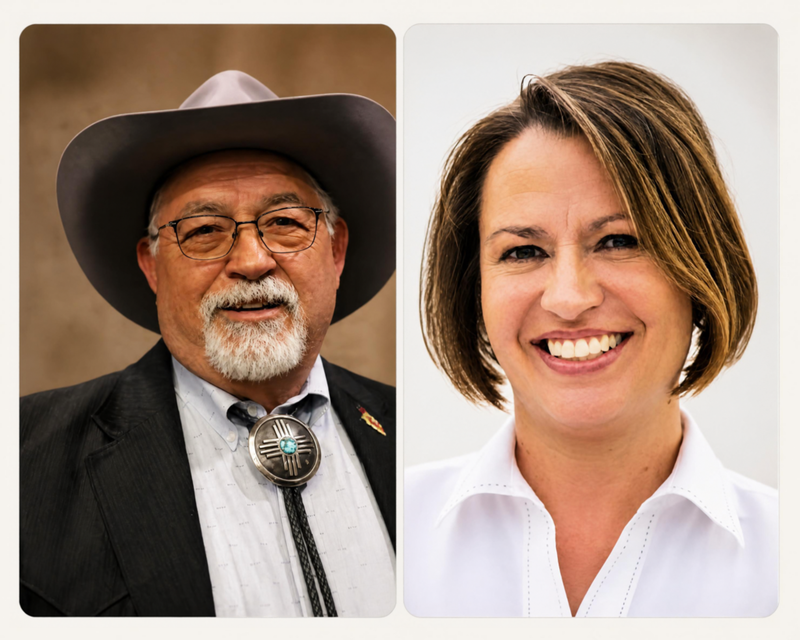
State Sen. David Gallegos (R-Eunice) and State Land Commissioner Stephanie Garcia Richard, a Democrat, are running in the Nov. 3 race to be New Mexico’s next lieutenant governor on their parties' gubernatorial tickets alongside Gregg Hull and Deb Haaland, respectively. (Gallegos photo by Danielle Prokop/Source NM; Garcia Richard courtesy phtoo)
In addition to electing a new governor, New Mexicans will also elect a new second-in-command on Nov. 3 to replace Lt. Gov. Howie Morales, the Democrat who has served alongside Gov. Michelle Lujan Grisham for the last eight years.
Commissioner of Public Lands Stephanie Garcia Richard, a Democrat, and Republican state Sen. David Gallegos are running on their parties’ tickets with gubernatorial nominees Deb Haaland and Gregg Hull, respectively.

In a surprise decision, New Mexico Secretary of State Maggie Toulouse Oliver dropped out of the race, citing her health, just a few weeks after winning the Democratic nomination in the primary election. State Democrats subsequently appointed Garcia Richard — who had suspended a lieutenant governor campaign of her own in late 2025, citing her husband’s health — to replace her on the Haaland ticket.
The state Constitution charges the lieutenant governor with two duties: presiding over the state Senate and acting as chief executive in the governor’s absence.
But both candidates say they want to elevate a lesser-known role of the lieutenant governor — acting as the state’s ombudsman.
Source NM spoke with both candidates for the job, which comes with an $144,714 annual salary, about their priorities. Their answers have been edited for clarity and concision.
New Mexico state Sen. David Gallegos
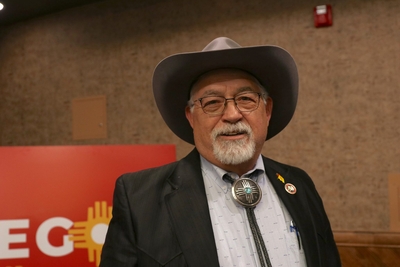
Sen. David Gallegos (R-Eunice) first won election to the state Senate in 2021, after spending seven years in the state House of Representatives.
Gallegos, who leads the state Republican Senate Caucus, resides in the heart of the oil-rich Permian Basin and led an extensive career in the natural gas industry. He also served on his local school board for more than 25 years.
He said he wants to take on the role of ombudsman, working as a liaison between New Mexico residents and state government leaders, with an eye toward helping rural New Mexicans.
“Mayor Hull is really good in large cities, but I’m more rural New Mexico,” he said. “I want to go out and try to find ways that we can help small businesses in rural New Mexico.”
What is the biggest issue facing New Mexico?
The Children, Youth and Families Department and public safety are high on the list. We’re hurting children through CYFD and we’re hurting all New Mexicans.
Look at what Mayor Gregg Hull has done in Rio Rancho and get that to Albuquerque, Las Cruces, Santa Fe or other parts of the state, we’d protect New Mexicans. We also need to get rid of the fentanyl issue.
What makes you the better choice for voters?
Being that I’ve been in the Senate, one of the big responsibilities is being the president of the Senate and to understand that Capitol and how it operates.
Now, Stephanie Garcia Richard did serve in the House, then she bailed on us. But her not participating in the Senate, in the upper chamber, is different. It’s quieter and more strategic in the Senate. I don’t think she’d come in understanding what’s going on and how to motivate people and move legislation.
What issues do you want to see the state Legislature take up in the coming 60-day session?
We had a point in time that Gov. Michelle Lujan Grisham called for a special session on crime and Democrats walked out on her. I think we need to go back there.
If you talk about fentanyl, talk about homeless, there’s a lot of things we could cure if we could get a hold on people not just going through the process of getting booked, but actually staying in jail.
If elected, what is your first order of business after being sworn in?
We’ve got to get to the business of understanding what’s coming in. We get bills that are pre-filed, so we’ll have to go through them, understand them and determine what’s good for New Mexico and what’s not, what’s politics or rhetoric.
I would just want to make sure that the session is seamless, because it’s important that we get the budget done, but this is a 60-day session, so anything goes.
What do you think the public should know about the lieutenant governor’s role in state government?
I think mostly people understand the Legislature part as president of the Senate, but they don’t know it’s also an ombudsman. When someone has an issue, they don’t go to the governor. Let’s say they have a water issue in Truth or Consequences, they don’t immediately go to the governor, but they come to the lieutenant governor’s office.
People need to understand that if they call, we’ll come. We need to have listening points all over the state, because this is a big state.
What complementary skill or perspective do you bring to the gubernatorial ticket?
I’ve been on the school board for 26 years, so I think I understand education really well. But also being in the House and then in the Senate, I’ve seen how we’ve gone more progressive and more socialist in our state and I would think that gives me a perspective on what we’ve done wrong for the last 100 years and what we need to change going forward, so we can benefit all New Mexicans and not a slim margin of those that are far-left progressives.
You spent decades working in the natural gas industry, which has become a vital lifeline to the state’s budget. How would that experience shape your approach to being lieutenant governor?
I’ve lived in Eunice for 37 years and I lived in Lovington before. The whole area is structured on oil and gas. I’d like to move the Oil and Conservation District to Lea County so they can understand the communities, the people that work there and the industry that’s trying to save their product, the environment and the employee jobs.
As lieutenant governor, you’d preside over the state Senate, which is controlled by Democrats. How would you approach that responsibility?
I’ve still got a lot of good friends on the Democrat side. Someone asked me to stop using the word Democrat, because it’s the progressives that we’re fighting. I think there’s enough moderates still out there that when it comes to vital issues for New Mexico, I think they’ll side with us or at least hear a good debate over it.
You also spent many years on your local school board. What’s your assessment of New Mexico’s education system and would you seek to implement any changes?
When Gov. Bill Richardson was in office, he took away the state superintendent and installed a secretary of the Public Education Department. As a school board member, I was in my classroom every year. When it came to evaluation time for teachers, you would give her a grade on the value of the class. I would like to go back to that.
Commissioner of Public Lands Stephanie Garcia Richard
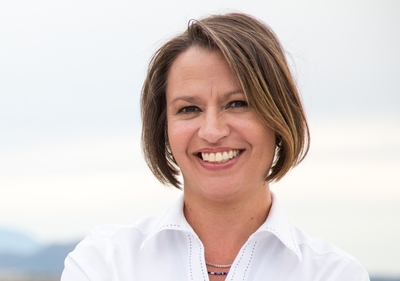
Commissioner of Public Lands Stephanie Garcia Richard first won election to her seat in 2018, after serving six years in the state House of Representatives as a Democrat.
She initially filed paperwork to run as a lieutenant governor candidate before the June primary election, but dropped out in late 2025 after her husband received a cancer diagnosis. She re-entered the race after Secretary of State Toulouse Oliver dropped out in June. At the time, Garcia Richard said her husband’s health had “greatly improved.”
Like Gallegos, she told Source NM she wants to embrace the lesser-known functions of the lieutenant governor’s office, such as being an ombudsman.
“I think the lieutenant governor should be present in all parts of New Mexico,” she said. “I think we need to have folks to have office hours and have the ear of the governor and lieutenant governor in Raton, in Clovis, in Farmington, in Silver City.”
What is the biggest issue facing New Mexico?
Affordability. Deb and I have been traveling the state and talking to folks in different communities. It doesn’t matter if it’s in Albuquerque, Taos, Silver City, Hobbs, gas prices and grocery prices have risen to heights that are almost unattainable for most New Mexicans.
I’m not even talking about rent and healthcare. Just the basics are unaffordable.
What makes you the better choice for voters?
Record and experience. I’ve been incredibly successful as land commissioner on a number of fronts, first being raising money for New Mexico’s public schools. It’s not just public schools, it’s government services including higher education and some of our rural hospitals. We estimate that because of the $16 billion we’ve raised in my time in office, we’ve saved the average taxpayer about $3,500 annually.
What issues do you want to see the state Legislature take up in the coming 60-day session?
Overhauling the Children, Youth and Families Department. There have been attempts to create an independent commission, to rebuild it from the ground up. Caseloads are too large for our case workers and our social workers and we need to ensure that support is there for them. We need to ensure that we’re hiring folks that are qualified and licensed.
If elected, what is your first order of business after being sworn in?
A lot of New Mexicans are vulnerable to federal actions that we foresee coming down. We know that there are some proposed cuts to things like Medicaid and SNAP that are set to take effect on Jan. 1. First order of business is going to be filling those holes.
The Legislature has already started by creating the Medicaid Trust Fund.
Deb would also like to introduce a public option that is available for people who either are not insured through their job or can’t afford the insurance that’s on the market.
The other thing is data centers. Deb has committed to a moratorium on day one of her administration.
What do you think the public should know about the lieutenant governor’s role in state government?
The most little-known assignment for the lieutenant governor is as the ombudsman. It’s the constituent services arm of the governor’s office. We’re very familiar that the lieutenant governor presides over the Senate and stands in for the governor if they are not available. But the lieutenant governor is really the conduit of communication between the governor’s office and New Mexicans at large.
I would like to chat with the Legislature about creating regional lieutenant governor’s offices.
What complementary skill or perspective do you bring to the gubernatorial ticket?
It’s interesting because Deb was in the federal Legislature and a federal agency, and I have mirrored experience at the state Legislature and a state agency.
New Mexico is facing so many headwinds. It’s going to take someone who can navigate both federal and state matters. Our experience is unmatched.
You’ve consistently opposed extractive proposals on state land, particularly those from data center and uranium mining companies. How might you prioritize those issues as lieutenant governor?
I want to bring my experience to bear on policymaking. Deb and I are aligned on a lot of these issues and I really see myself as a partner in the administration.
This is kind of the calculus — does the benefit for New Mexicans outweigh the harm? That’s the base-level question we should all be asking no matter what the industry is. If the answer is no, then how can we ensure that we increase benefits and reduce harm if we’re going to move forward with these proposals?
You took an unconventional route to appearing on the November ballot. What inspired you to get back in the race for lieutenant governor?
I was running for this position before my husband got a cancer diagnosis. It’s all-consuming. We were not sure what the prognosis was going to be and so we felt the best decision for our family in that moment was to pull back from that race.
He had radiation treatment and responded well to it.
When the secretary of state — and she’s in our thoughts — had to take a step back for her health, it opened up an opportunity for me.
As land commissioner, you helped return stolen land to Indigenous peoples. What actions would you take as lieutenant governor to advance those efforts?
We have made it a priority, because the land that the State Land Office manages is ancestral homeland to New Mexico’s tribes.
We had to do this within the bounds of the law. We’re not just giving land away — these are land exchanges. Often, these exchanges are large swaths of agricultural land for smaller parcels of developable urban land.
The Fort Sill Apache Tribe — also known as the Chiricahua Warm Springs — were forcibly removed from their homeland and imprisoned. Many of their very young members had never even set foot in New Mexico or seen where their people were from. We did a land exchange with them, and I was invited to join a ceremony in Silver City where multiple tribal folks from all across the country got to return home. That’s one of the proudest moments of my time as land commissioner.
Santa Fe, NM