Bridge barriers save lives. Why hasn’t Oregon built more?
Sep 27, 2026 | 9:00 am ET
Description
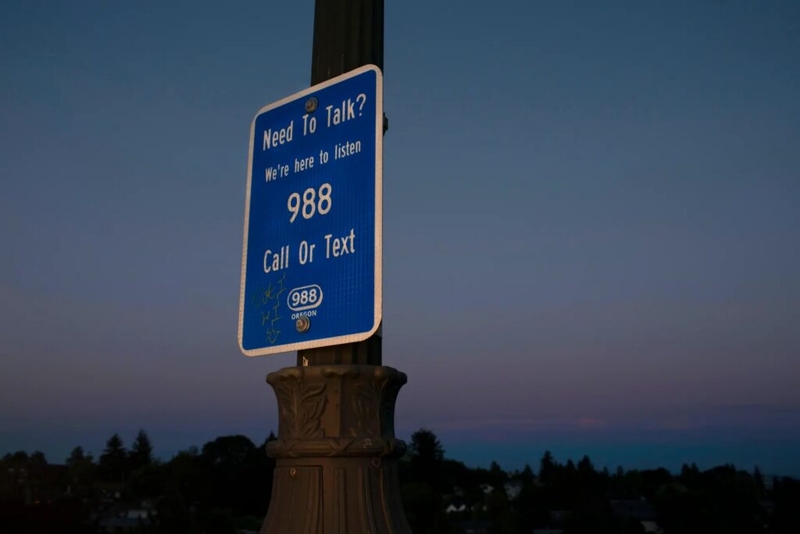
A sign offers a lifeline on the St. Johns Bridge in North Portland. Lines for Life, a nonprofit devoted to suicide prevention, operates the crisis line in Oregon. (Photo by Beth Nakamura/The Oregonian)
He saw it on her face. She wanted to live.
Scott Hughes still remembers holding the young woman’s hands, reminding her she wasn’t alone, asking if she had any pets. That was when he saw her mind click as she thought about her cat, alone in her apartment. She loved her cat. Her cat needed her.
Then he helped her back over the bridge railing.
That was two years ago. In the 20 years Hughes has worked at nearby Portland Fire & Rescue Station 22, he estimates he’s talked to dozens of people in crisis on the 95-year-old St. Johns Bridge, a hazard hidden in plain sight in a state where suicide is the eighth leading cause of death. Every other day last year, on average, someone called about a person potentially in crisis on the St. Johns Bridge.
Emergency response data from recent years show that an average of three to four similar 911 calls came in per day on one of Portland’s 13 river bridges.
As many as 13 people are believed to have died by suicide last year at a Portland river bridge, and 11 the year before. Those numbers may be higher.
Officials declined to release a complete count of confirmed or suspected suicides at area bridges. Some authorities are hesitant to call attention to the suicides publicly for fear of prompting more, a well-documented phenomenon known as contagion effect. Enduring stigma, too, tamps down on discussion.
In dozens of other cities, states and countries, officials have done more than discuss the issue. They’ve installed physical barriers, like nets and fences, which research shows do save lives. The Oregon Department of Transportation, which maintains the St. Johns, Fremont and Marquam bridges, has studied suicide prevention efforts but says they are too expensive to implement.
The Vista Bridge in Portland, where city officials erected fences in 2013 and curbed suicides, shows what’s possible. Despite community skepticism they wouldn’t work, the fences give people in crisis a moment to pause, reflect and reconsider.
“There’s another path, and it’s a beautiful path,” said Debbie Dedrickson, who has worked at Portland crisis call center Lines for Life for 18 years. “When we can get through that moment of crisis, it’s actually amazing how things can bloom and blossom.”
Years of loss
Last year in Portland, after eight bodies were pulled from the Willamette and Columbia rivers between April 1 and May 5, the Multnomah County Sheriff’s Office took the rare step of acknowledging the deaths.
“The number is not unusual, though it is tragic,” the sheriff’s office wrote in a press release. Half, the Multnomah County Medical Examiner determined, had died by suicide. One died in an accident, and the manner of the other three deaths — whether suicide, homicide, accident or natural — couldn’t be determined.
The sheriff’s office spoke up because some had filled in the blanks, prompting rumors a serial killer was on the loose. The speculation dismissed a more prosaic, more straightforward but perhaps more difficult conclusion. Death by suicide is more than twice as common as homicide in Oregon.
Between 2015 and 2025, the Multnomah County Sheriff’s Office recovered 165 bodies from the Willamette and Columbia rivers — between seven and 24 each year. By early September this year, deputies had already recovered 20.
The county medical examiner keeps the most accurate figures on deaths connected to the rivers but declined to release its tally of deaths ruled suicides to The Oregonian/OregonLive, citing privacy concerns.
The Oregonian/OregonLive appealed the public records denial, arguing the public would benefit from a clearer understanding of these deaths. The office of Multnomah County District Attorney Nathan Vasquez partially granted the appeal, requiring the medical examiner to release information on the bodies recovered during the period the sheriff’s office wrote about in its press release.
The limited data available and accounts from first responders suggest that the St. Johns Bridge appears to be among the most concerning for suicide.
The people found dead in the Willamette and Columbia rivers in the past five years — whatever their manner of death, if it’s even known — cut across categories of age, race and gender, just as they do in cases of suicide.
Their ages span from 16 to 93. Most were from Portland, but others were from Vancouver, Tigard, Gresham and Canby. Some were unhoused. Most were men.
Among those who died by suicide was the 44-year-old brother of Lori Madden.
“If this is such a norm,” she said, “can there be something that stops it?’”
‘What I needed … was time’
Suicide prevention research for decades has shown that physical barriers are a highly effective way to stop people from dying by suicide from high places.
Time and space — taking away easy access to lethal means — keeps people safe, said Portland State University instructor Monica Parmley-Frutiger, a licensed clinical social worker and director of a program that trains adults on how to talk to youth about suicide.
“Moving from more passive suicidal ideation to more active suicidal ideation often comes in waves,” she said. “If somebody in that wave of emotion has access to means, their risk of attempting increases. But if we can put time and distance in between their emotional wave and the actual means, time and distance will save lives.”
Kevin Hines didn’t have that distance.
Yet he lived.
Last November, the Georgia resident, now a 45-year-old advocate for suicide prevention, traveled to Eugene to share his story with the Association of Oregon Counties. Hines has devoted himself to a life of hope that was unimaginable to him as a 19-year-old on San Francisco’s Golden Gate Bridge.
On Sept. 25, 2000, he stared down at the water.
“It was arguably the toughest day of my entire life,” Hines said in a recent interview with The Oregonian/OregonLive. “I didn’t want to die. I believed I had to, and those are two categorically different things.”
As he fell, he thought: “‘What have I just done? I don’t want to die. God, please save me.’ And then I hit the water.”
Hines, miraculously, did not die. The U.S. Coast Guard quickly rescued him. Then he underwent an extensive recovery.
“I desperately wanted someone to stop me,” Hines said. If a net had been in place, he added, “I would have been given what I needed, which was time.”
It would be nearly two decades before California officials began installing anti-suicide nets on the Golden Gate Bridge, a project that took six years and cost $224 million. Made of stainless steel, the netting stretches 20 feet below the bridge sidewalks and extends 20 feet over the water.
Before, the Golden Gate Bridge averaged about 30 reported suicide deaths per year. Last year, four people died, according to the agency that manages the bridge.
Hines now advocates for suicide prevention barriers at high places around the world.
Nets, he said, are more than just physical barriers. They help, he tells public officials, “just because you showed people you cared.”
The Vista Bridge
The concept of bridge barriers is not new to Oregon policymakers.
Built in 1926, the Vista Bridge in Portland’s Goose Hollow often drew people in crisis. Until advocates stepped in.
Morgan Leets had been working at Lines for Life for a year when she found herself patrolling the Vista Bridge in a fluorescent safety vest more than a decade ago. After The Oregonian/OregonLive wrote about the crisis and the bridge reached a reported five deaths in a single year, then-Commissioner Steve Novick pushed the city in 2013 to install a 9-foot fence.
“It was the best thing I’ve ever done,” said Novick, who is now a District 3 city councilor.
During the construction, Leets and others took shifts patrolling the bridge to offer crisis support to anyone in need. Leets said she was “unendingly grateful” to the city for deciding to act and described the barrier as “absolutely vital.”
“Anytime there is that community-wide effort to show that care and that compassion and that desire to support folks who are struggling can improve the experience for everybody,” Leets said. “It decreases that stigma.”
The temporary fences on the 512-foot bridge cost the city $236,000. Plans for replacing them with more aesthetically pleasing barriers never moved forward.
An average of two people died by suicide every year before the fence went up. In the 13 years since, police have recorded eight deaths at the bridge. No one died between 2015 and 2019.
Novick said policymakers have an obligation when they learn that a place has become a hazard for suicides: “If we can, we should do something about it.”
‘This is doable’
Kimberly Lining’s hands clutched her orange binoculars. Perched on the bow of the boat, she scanned the river before her as frigid rain soaked her high-visibility sweatshirt.
Underwater cameras searched, too, though not without difficulty in the murky and choppy conditions.
Grief weighed on her.
It was Dec. 1, 2024, and she had set out before the sun rose with a boat captain and a volunteer for the nonprofit Oregon’s Vanished. They were looking for a 16-year-old from Vancouver. Family members suspected the teen had died by suicide at Interstate 205’s Glenn Jackson Bridge.
Despite the cold and the heartache, Lining, 45, who discovered Oregon’s Vanished through her work as the founder of a group that advocates for missing and murdered Indigenous women, felt full of purpose.
“This is what we have to do,” she remembered thinking. “Don’t give up. We have to be out here.”
The trio returned to shore hours later, just before sunset, exhausted and cold. It would be another five months before the teen’s body was found in the Columbia.
Since that day, Lining has been out on seven more river search missions, including on the Willamette.
First one person, then another, and another had died at the St. Johns Bridge. Lining saw the pattern.
“I remember one day I’m just driving in my car and just thinking about all these things, and all these people that are taking their lives,” Lining said. “I really felt like God put it on my heart: You have the ability to do something about this.”
Lining couldn’t shake that feeling, so she created a petition calling for safety nets and call boxes on the St. Johns Bridge. “People really need to understand,” she said, “that this is doable.”
Call boxes would connect to 988, the free and anonymous suicide and crisis hotline run by Oregon-based nonprofit Lines for Life. Calls and texts are answered 24 hours a day, 365 days a year.
Last spring, Lining and a group including Oregon’s Vanished met with U.S. Sen. Jeff Merkley to ask for help with the St. Johns Bridge. She said he was interested and seemed receptive, but asked them to come back with data.
It wasn’t available.
“It’s like this kept secret,” she said. “The excuse is, we don’t want sensationalism or more people to take their lives in that way. I don’t really understand that. I get sensationalism, but I think that it’s more important to bring this to the surface.”
That conflict is familiar to Lines for Life CEO Dwight Holton.
“Part of what’s shocking about it is that it’s happening right in front of us and all around us,” Holton said, “and yet we don’t know much about it.”
3,000 bridges
The issue had already been on the mind of Rian Windsheimer, the Portland-region manager for the Oregon Department of Transportation, who started looking into suicides from the St. Johns Bridge in 2022 after taking a call from an employee at the nearby University of Portland who was concerned for students.
The agency looked to the Golden Gate Bridge to calculate how much it might cost Oregon to build a physical barrier. Comparing the length of the California bridge to the St. Johns, officials estimated netting could cost between $50 million and $80 million. A fence, they estimated, could cost between $15 million and $20 million.
There were other challenges. For one, the St. Johns Bridge is a historic landmark, meaning any changes would have to adhere to certain design requirements. This is not insurmountable — the Vista Bridge, too, was a registered landmark.
The age of the St. Johns Bridge also raised more practical concerns, Windsheimer said. It was not clear if it would be able to support the additional weight of any barriers.
“It’s old,” Windsheimer said. “It’s not designed to hold a lot more than what it can currently do.”
And then, Windsheimer said, they discussed the rest of the state. ODOT manages around 3,000 bridges.
“Why would I choose St. Johns over the Fremont? Or why would I choose the Fremont over the Astoria-Megler Bridge?” he said. “How would you prioritize that?”
And at the time, the agency was forecasting it would run out of cash by 2025, a deficit that’s now grown to a projected $200 million for the next two-year budget cycle.
The prioritization issue ended the conversation.
Windsheimer said the agency also considered putting call boxes on the St. Johns Bridge, but ruled that out because the agency didn’t believe they would be effective.
Eventually, ODOT launched a $2,000 pilot program to install new signage on the St. Johns Bridge directing people in crisis to call 988. Those six signs went up in June.
‘A duty to act’
Parmley-Frutiger, the Portland State expert, said suicide prevention should be viewed as a necessary public health function.
“If somebody stopped breathing, we have some responsibility to get them help,” she said. “If somebody was thinking about suicide or they’re in emotional distress, then we also have a responsibility to help them get connected to help.”
San Francisco is not the only city where barriers have seen success. Researchers have studied bridge fences and largely dispelled concerns that people with suicidal thoughts will find another place. And most people who survive a suicide attempt don’t attempt again.
Seattle, San Diego, New York, Tampa and other cities have all fenced, or are currently fencing, bridges. In Washington, D.C., a retrofit is underway on a bridge that saw 13 deaths in 12 years. One woman’s advocacy in the wake of her partner’s death spurred D.C. to act.
In Maine, state Sen. Chip Curry sponsored a bill to build a fence over the Penobscot Narrows Bridge in 2023. The state completed the project in 2025.
“We do not need to ‘own’ every tragedy that occurs in our state,” the Democrat wrote in testimony for the bill. “But in this case, we do literally own it. We designed the bridge and built it. We constructed the railing for the safety of cars but ignored the risks to people experiencing the temporary and often fleeting thoughts of ending their lives. Now that we know that it has become a suicide hotspot, we have a duty to act.”
135 people
For Hughes, the Portland firefighter, anything that could prevent a person from acting on their suicidal thoughts would help, he said.
“The more of those ways you can take away, the better,” he said.
The deaths stay with him. Every individual suicide may affect up to 135 people, researchers have found. That includes immediate family, but also those who only distantly knew the individual.
Of the dozens of people in crisis Hughes has tried to help directly, only one has died. Each person who lives — like the woman with the cat — feels like a win, he said.
When he’s focused on saving a life, Hughes blocks out everything but the person in front of him.
Sometimes, people ask Hughes why he cares. They assume he’s only there because it’s his job.
But Hughes said it’s because if his loved one were standing there on the bridge, he’d want to know that someone did everything they could to help.
This story originally appeared in The Oregonian/OregonLive: Bridge barriers save lives. Why hasn’t Oregon built more?
Salem, OR