Nobody knows if Adam Hamilton will win in Kansas. But he’s already defined a populism of decency.
Sep 27, 2026 | 4:33 am ET
Description
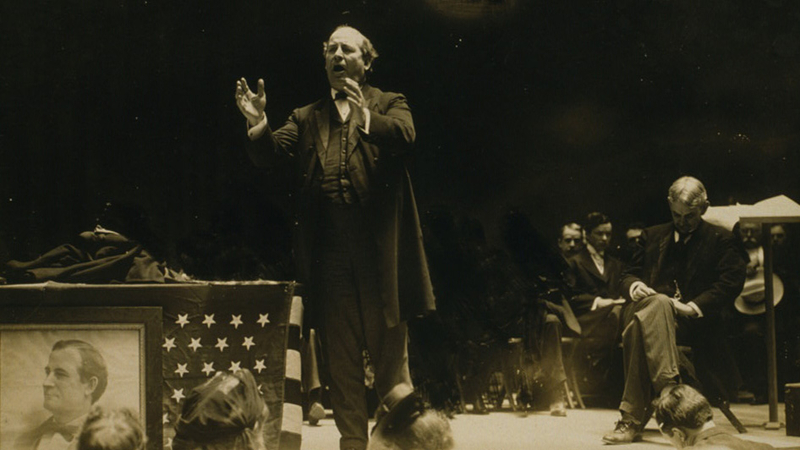
William Jennings Bryan of Nebraska delivers a campaign speech in 1908. Bryan, who died in 1925, ran unsuccessfully for president three times but is largely forgotten today. (Photo by Library of Congress)
At 7:30 on a September night in 1897, two trains collided on the Santa Fe railway about three miles northeast of Emporia.
An eastbound mail train smashed into the Mexico and California Express, a passenger train pulled by a pair of steam locomotives. The express, which had seven or eight full coaches, was on its way back from Burlingame, some 40 miles away, where evangelical populist William Jennings Bryan had delivered a speech to “nine thousand Kansas farmers,” according to a report in the Kansas City Times.
The impact of the trains was so fierce that boilers of all three locomotives exploded. The cars following behind the express plowed into the maelstrom of fire and steam and were flung about. One coach landed atop the twisted remains of the engines, teetering there upright before it burst into flames. Passengers jumped from windows, some to a horrific death.
In all, 13 died.
The accident was caused by a railway dispatcher who mistakenly put the opposing trains on the same track.
Emporia is still a train town, and I sometimes reflect on that long-ago tragedy when the Amtrak rumbles through on autumn nights. I’m thinking of it now because Bryan, who survived unscathed because he was in the last Pullman car and felt merely a jolt, was an evangelical Populist who might have understood what’s happening now in Kansas.
A Kansas Democrat now has a reasonable shot at being elected to the U.S. Senate for the first time since 1932. National news outlets increasingly report that Kansas is in play and that GOP nominee Roger “Doc” Marshall, infamous for suing hundreds of his own patients for payment and owning more stuff in Florida than in Kansas, is sweating bullets over the challenge from Democratic hopeful Adam Hamilton.
Hamilton has more in common with Bryan, the prairie populist who said God wants us to care for the poor, than with Democrat George McGill, a Wichita lawyer elected to his last U.S. Senate term in 1932.
Hamilton is a megachurch pastor from Leawood, and he’s saying some of the same things Bryan did, and getting national attention for it. During the senatorial debate Sept. 12 at the Kansas State Fair, Hamilton said he’s spent the last 38 years trying to teach people “what does it mean to be a decent human being, how are we meant to live our lives, to love God and to love our neighbor.”
Bryan is remembered today, if at all, as an antique from a bygone era.
But back in 1897, Bryan was adored by millions.
He was just 37 years old, an evangelical Christian, a famed orator, and a self-professed champion of the common man. The year before, he had been the Democratic nominee for president and come surprisingly close to defeating Republican William McKinley. McKinley won, but by a margin of just a few points in the popular vote.
Bryan eventually became a parody of himself, a politician with three failed attempts at the White House and the leader of a movement to keep public schools from teaching Darwin’s theory of evolution. Bryan, or at least a dramatic version of him, was held up to scorn in the 1955 Lawrence and Lee play “Inherit the Wind,” a fictionalized account of the Scopes Monkey Trial of 30 years before. The real Bryan had testified against the young high school teacher charged with teaching evolution and was skewered by famed defense attorney Clarence Darrow, who demanded to know when exactly the earth was created and where Cain found his wife.
I mentioned Bryan in this 2024 piece about some wackos in Topeka who wanted to make gold and silver legal tender. As a young congressman from Nebraska, Bryan had argued against high tariffs as a form of taxation on American consumers. He rose to fame when he delivered his “Cross of Gold” speech at the 1896 Democratic convention at Chicago. Although the politics are difficult to understand now, Bryan was arguing for “free silver” and against the gold standard because it favored wealth and empire over workers and agrarian interests.
“You come to us and tell us that the great cities are in favor of the gold standard,” Bryan said. “We reply that the great cities rest upon our broad and fertile prairies. Burn down your cities and leave our farms, and your cities will spring up again as if by magic; but destroy our farms and the grass will grow in the streets of every city in the country.”
Bryan, with his fiery oratory and rustic ways, became a hero of rural America at another time when economic depression and cultural strife had set working people on their heels.
“Bryan was the first leader of a major party to argue for permanently expanding the power of the federal government to serve the welfare of ordinary Americans from the working and middle classes,” writes historian Michael Kazin in his 2006 biography of Bryan. “With the backing of his followers, he preached that the national state should counter the overweening power of banks and industrial corporations by legalizing strikes, subsidizing farmers, taxing the rich, banning private campaign spending, and outlawing the ‘liquor trust’ (a monopoly on whiskey).”
More than any other politician, Kazin argues, Bryan transformed the Democratic party from Gilded Age insiders to FDR liberals. While the New Deal embraced much of what Bryan had proposed, it rejected the racism shared by nearly every white Democrat until the late 1930s — including Bryan. “Inherit the Wind,” though historically inaccurate, captured the white Protestant bigotry and mistrust of science that was a hallmark of a past age.
This is where any comparison between Hamilton and Bryan falters. Hamilton carries none of the generational sins that Bryan did, nor is he so obsessed with his own rhetoric that he might be lacking in substance. His political weaknesses may be in his handling of child sexual abuse incidents at a church camp in the mid-2000s and descriptions of him as a petty tyrant with high expectations by former employees, as reported in July by Kansas Reflector. Hamilton was not accused of abuse himself, and others praised his fast-paced, if taxing, leadership.
Hamilton is a fine and confident speaker and owned the stage at the state fair from the beginning (to be fair, Marshall was the target of much booing).
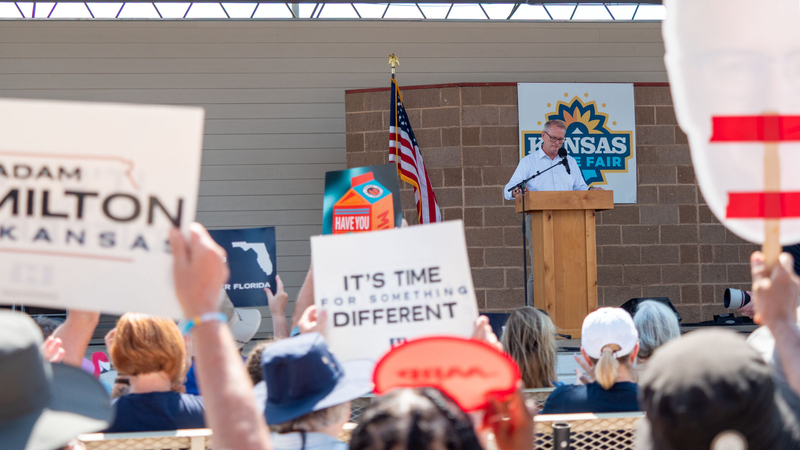
No, I’m drawing a parallel between the young and idealistic Bryan and the Democratic candidate we saw on the stage at Hutchinson.
Hamilton has seized the political imagination in a way that few Kansas Democrats have in what feels like ever. But in the Trump era “ever” can be measured in minutes and many voters may be driven to Hamilton out of a sense of increasing desperation about the state of the country. Although his megachurch credentials might be off-putting to some (I raise my hand here), his religious background provides a bridge for many undecided Kansans who find expressions of faith reassuring. It doesn’t hurt that he’s a Methodist, which is like the universal donor blood type of evangelical Christianity. The United Methodist Church, in 2024, also lifted a ban on LGBTQ+ clergy and same-sex marriages, a move that caused thousands of conservative congregations, mostly in the South, to leave the denomination.
The same thing happened to the Baptists in 1845, when they denounced slavery.
Hamilton’s megachurch, Resurrection, in the Kansas City suburb of Leawood, has 24,000 members and is one of the largest Methodist congregations in the world. Hamilton co-founded it as small church in a former funeral home in 1990.
Hamilton may be the counter to MAGA’s stranglehold on the faithful in the heartland, a well-spoken white pastor who loves Jesus and condemns the grift of Donald Trump. At the state fair debate, he was particularly hard on Trump’s promise of $5,000 bonuses if the GOP wins the midterms, saying that it was “exactly what’s wrong in Washington, D.C., right now” – and likely illegal. Marshall also said he disagreed with Trump on the bonuses, but was waiting for more information. Then, amid heckling, he quickly changed the subject to a chest-thumping defense of Kansas agriculture.
Hamilton has gotten attention not just for his numbers, but for a kind of moderate white bread charisma. Here is Bill McKibben writing about him in The New Yorker, making the point that what Hamilton says about loving one’s neighbor is a radical political notion in the era of Trump. The Atlantic also covered Hamilton, sending a writer to witness firsthand an August visit to a coffee shop at Emporia.
“Gravel City Roasters is a combination coffee shop and art gallery located directly across Emporia’s main drag from the county Democratic headquarters,” David von Drehle reported. “There is a Pride flag on the wall with REFUGEES WELCOME superimposed on its rainbow stripes. The chai, served in mismatched mugs, is excellent.”
Hamilton was at home at the coffee shop, according to Drehle, and Hamilton said he was one of the few Democratic politicians who could recite the Lord’s Prayer — and that it reminds us to make sure people have enough to eat.
What Hamilton offers is a kind of emotional glue that hasn’t been seen in the Democratic Party in at least a decade. It is a correction toward the middle. Before the arc of history can bend toward justice, there must first be a consensus of what is good — how to live a decent life — and then the people in agreement can work toward meaningful change by winning elections. In the past decade, people of conscience have been confronted by so many injustices that it has been easy to become paralyzed, not knowing which battle to fight first. What Hamilton is saying is that it’s all the same fight, and he speaks the language of the heartland.
“I hear God speak through the Bible,” Hamilton writes in his 2014 book on scripture. “Its words convict me, challenge me, and comfort me. And some of them disturb me. In this book, I’d like to share with you how I and many others have wrestled with the Bible and have come to make sense of its thorny passages while listening carefully for the One to whom all scripture bears witness.”
Hamilton hears something in the Bible I don’t, except for perhaps the “Song of Solomon.” But this is no matter. Hamilton writes not for me, but for the faithful. He is no fundamentalist, as he believes the earth is 4.5 billion years old, thinks Darwinian evolution doesn’t rule out the possibility of divine guidance and teaches that Bible verses condemning homosexuality shouldn’t be taken at face value.
At the state fair debate, Marshall said Hamilton was “too woke, he’s too weak, and he doesn’t stand for anything.”
But Marshall was shouting into a gathering wind. None of those hot buttons work anymore, and Hamilton’s gospel of compassion may appeal to voters beyond Kansas because of the way it’s framed. Others have said the same thing before, but pastor Hamilton tempers the message with a call to reject extremism.
Hamilton’s concept of personal decency, told through a personal struggle to understand scripture that is often indecently brutal, speaks to the conflict in the American soul.
After that 1897 train wreck, Bryan joined in the rescue to help carry the dead and wounded from the scene. As related in a newspaper account published the day after the accident, a badly maimed individual called out to Bryan.
“I went to hear you today,” the man said. “I am dying now and want to shake your hand and say God bless you. If possible, Mr. Bryan, can you get me a drink of water?”
Bryan, according to newspaper story, which seems so fantastically Biblical as to be untrue, went to a burning mail car and returned with water for the dying man. (Wasn’t the water hot? Never mind, that’s not the point.)
At that moment, 129 years ago this month, Bryan so held the trust and the promise of rural America that a newspaper anecdote anointed him a political prophet.
Hamilton carries a similar cup of spiritual and political water.
Or maybe it’s chai.
Max McCoy is an award-winning author and journalist. Through its opinion section, the Kansas Reflector works to amplify the voices of people who are affected by public policies or excluded from public debate. Find information, including how to submit your own commentary, here.

Topeka, KS