As states seek to rein in Flock license plate cameras, New Hampshire is considered a model
Sep 24, 2026 | 5:00 am ET
Description
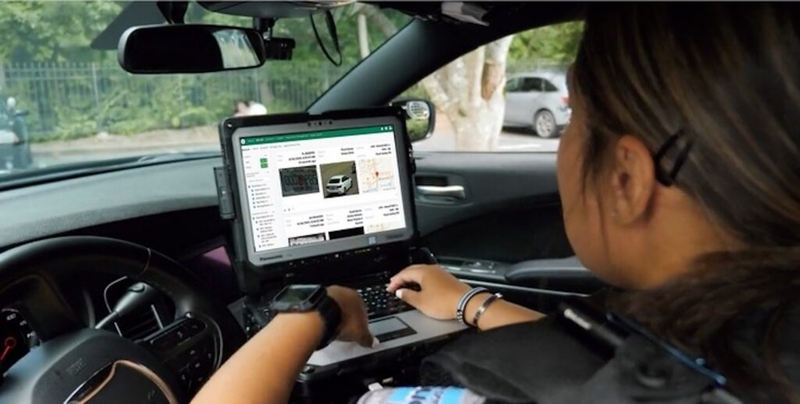
A police officer uses the Flock Safety license plate reader system. Since 2016, the Granite State has had one of the strictest laws in the country regulating and limiting such readers. (Photo courtesy of Flock Safety)
As backlash to Flock and other license plate-tracking cameras grows, some states are exploring limiting the technology.
New Hampshire is already a decade ahead.
Since 2016, the Granite State has had one of the strictest laws in the country regulating and limiting automated license plate readers. The result: While license plate-tracking cameras from companies like Flock, Axon, and Motorola Solutions have proliferated in other states in recent years, New Hampshire’s years-old law appears to have prevented those companies from establishing a foothold here.
Now, as bipartisan opposition has led states such as Florida, Arizona, Connecticut, and South Dakota to seek to restrict the cameras, New Hampshire has provided a possible template.
In a press conference earlier this month, Florida Republican Gov. Ron DeSantis urged legislation to bar the cameras from his state — and pointed to the Granite State as a model.
“Florida’s going to need to do something for sure on that,” DeSantis said Sept. 2, according to WESH. “I think New Hampshire showed the way it can be done.”
But even as other states explore restrictions, some New Hampshire lawmakers say the state’s laws should be tightened further. Rep. Michael Granger, a libertarian-leaning Milton Republican, has filed a legislative service request for the 2027 session “relative to surveillance on public ways and on public property” — the first step toward a bill. Granger did not respond to requests for comment.
A narrow New Hampshire law
Since 2016, New Hampshire state law has allowed only state, county, or local law enforcement officers to use “number plate scanning devices,” or automated license plate readers. And the statute also tightly regulates how even those officers may use them.
The devices may be used to identify stolen vehicles; vehicles registered to people with outstanding arrest warrants; vehicles involved in suspected terrorism or major crimes such as homicides and shootings; vehicles associated with wanted, missing, or endangered people; vehicles in the vicinity of a recent crime; and vehicles that have violated commercial trucking requirements or whose drivers have had their licenses or privileges suspended.
When using the cameras, the police department may hold onto the image of the license plate only for three minutes, unless an arrest, citation, or protective custody order arises or a missing person is found, in which case the record is retained. If the scan does not result in those actions, the license plate image must be deleted.
The cameras may only be installed to check license plates — they must not be “capable of photographing or recording or producing images of the occupants” of a vehicle.
And even if the plate reader does produce a positive match in the department’s database, the officer must still establish probable cause to pull over the vehicle. The match does not itself create that cause, the law states.
The law also regulates who can use the cameras in the first place. Any agency’s use of a licence plate reader must be approved by the chief or top officer in that department and must be registered with the Department of Safety, the statute states. The law enforcement agency must show it is training its officers to use the readers lawfully.
Taken as a whole, New Hampshire’s current camera statute is “fairly narrow” and “far more restrictive” than in any other state, said Caitlin Hennessy, research director at the International Association of Privacy Professionals, based in Portsmouth.
Because most license plate captures must be deleted within three minutes, the law would likely preclude Flock camera systems — which currently are automatically deleted every seven days, according to the company. The company reduced that previous 30-day default retention period to seven days in August, though individual customers or law enforcement agencies can specify a shorter or longer retention period in their contract with Flock.
“I think New Hampshire is one of the strongest (states),” said Jake Laperruque, deputy director of the Security and Surveillance Project at the Center for Democracy & Technology, a Washington organization that advocates for privacy rights and democratic principles in technology.
New Hampshire’s three-minute rule also effectively prevents most license plate images from entering a proprietary database to be queried later. Without that, New Hampshire law enforcement agencies do not have the ability to search for a specific license plate in a system such as Flock and track that vehicle’s past location data — unless the license plate resulted in law enforcement action.
“It is those longer retention periods that create and inform a broader database that law enforcement then are able to search on a cross-state basis,” Hennessy said.
Representatives for Flock did not respond to multiple requests for comment about New Hampshire’s state law and whether it prevents the use of Flock cameras in the state.
Low use in New Hampshire
Even with the laws limiting license plate tracking, it is not clear exactly how many Flock-aligned cameras are in New Hampshire.
The crowdsourced website “flockcameralocations.com” has documented 68 cameras in New Hampshire — far fewer than the 1,189 reported in Massachusetts but more than might be expected given the laws. Many of those are at toll plazas, according to the website’s map; New Hampshire state law allows the state Department of Transportation to use license plate trackers to send toll bills, but the law specifies that the license plate data must be siloed in its own database and bars law enforcement access to it.
A Flock representative did not respond to queries of how many cameras the company is operating in New Hampshire.
Meanwhile, while the state law prevents New Hampshire law enforcement agencies from installing their own cameras, it does not stop them from entering into contracts with Flock and other companies to access other states’ databases. Manchester Police Department has a contract that allows for its database to be queried, according to the New Hampshire Union Leader.
But the state’s 2016 law has largely kept the cameras out. New Hampshire also adopted a state constitutional right to privacy in 2018 that could allow courts to prevent widespread use of license plate tracking cameras, Hennessy said.
National backlash
New Hampshire’s laws are getting renewed attention as the debate over Flock cameras heats up.
Automated license plate readers, which have existed for decades, have been in use by U.S. Immigration and Customs Enforcement and other agencies since the 2010s, said Laperruque. But as the technology has become cheaper to produce, companies have marketed the cameras to local governments, businesses, and homeowners associations in recent years.
“As a result of that, we not only have more people being subject to (automated license plate reader) surveillance as they drive around in their town, but also we have potential for sort of tapping into a nationwide network, and we’ve seen some serious issues with that,” Laperruque said.
An Aug. 2 Washington Post investigation tallied 50 instances of law enforcement officers using the technology to stalk civilians not related to law enforcement investigations, such as ex-partners and spouses, Laperruque noted.
Some states and municipalities are reversing course, canceling their Flock contracts and eschewing use of the databases. Since 2021, more than 200 cities and counties have dropped Flock contracts, with 90 of those cancellations taking place in August, according to Secure Justice, an advocacy group.
While the cancellation of Flock contracts represents a small proportion of the total number of communities that have adopted the technology — the company said in July it operated in more than 6,000 communities — Laperruque said the spate of cancellations in August has shown strong momentum against them. “I think we are seeing a lot of energy and momentum to make a course correction and to change things,” he said.
Still, Laperruque noted that cancelling a Flock contract is not the same as banning license plate readers from most uses in the state, as New Hampshire has done. If an agency or business cancels the contract, any cameras in that municipality or state owned by others will continue collecting data.
CDT ultimately says states should go further through legislation. Among the measures it recommends: limiting use to specific investigations, as New Hampshire has done, and requiring warrants, which New Hampshire has not done.
“Canceling these contracts is a good measure,” he said. “It’s a good first step to say, ‘We’re pushing the pause button until we figure out what’s the right balance and what are the right rules on this.’ But actual laws in statute are the only real guarantee of safeguards.”
Hennessy pointed out that the state laws have filled in “a void that has existed at the federal level.” Congress, she noted, has failed to pass a nationwide privacy law despite years of efforts by advocates. States, whose legislatures and governors generally move much faster to pass legislation than Congress and the White House, can get more done.
That dynamic has led to state attorneys general “beefing up their enforcement capacity” when it comes to privacy laws, Hennessy noted.
“Often we’re comparing ourselves to the regulatory structures in Europe, where the approach is kind of: ‘Regulate first when there is a new technology, and this is how we expect it to be used,’” she said. “Whereas in the United States, it’s: ‘Let’s see what happens, and then we’ll regulate the harms.’”
The International Association of Privacy Professionals does not take stances on public policy; its role is instead to provide information to employees who design company privacy policies. But Hennessy said the debate is a “positive development,” because it is causing more people to carefully consider the privacy implications of technology.
“I do think that we are in a moment right now where society is beginning to ask questions about the embedding of cameras in all kinds of devices, whether they are used by individuals, homeowners, schools, places of business, or law enforcement,” she said.
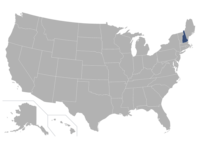
Concord, NH