Data shows New Mexico students making gains in literacy, while math and science trail behind
Sep 23, 2026 | 5:50 pm ET
Description
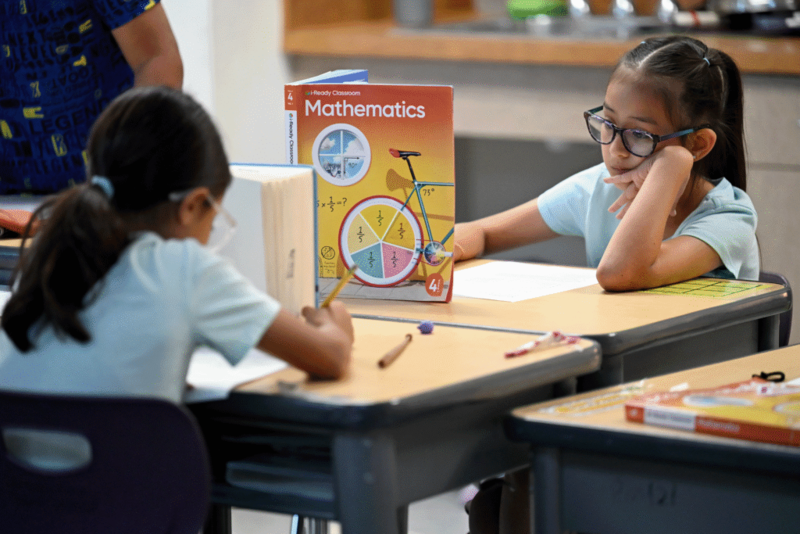
New Mexico Public Education Department officials presented new assessment data to state lawmakers on Sept. 23, 2026, showing significant gains in reading and literacy over the last year, modest gains in math and stagnant results in science. Pictured above: students at Valley View Elementary School in Las Cruces. (Leah Romero for Source NM)
New Mexico public school students made significant gains in reading and literacy over the last year, while math showed modest gains and science remained largely stagnant since 2022, according to recently released data presented to state lawmakers on Wednesday.
The New Mexico Public Education Department’s 2025-2026 school accreditation data evaluates 10 elements, such as attendance, staffing, financial accountability, governance and student outcomes. Its statewide assessment results, the NM Vistas school report cards, evaluate academic achievement, student growth, attendance and graduation rates. The two accountability systems inform the PED and federal government about which schools need additional support and resources to improve student outcomes.
According to Wednesday’s presentation to the Legislative Education Study Committee by Lynn Vásquez, senior manager of assessment, research, evaluation and accountability for the PED, New Mexico students improved literacy proficiency by 10 percentage points to 44% between 2022 and 2026. Math proficiency improved only one percentage point to 26% during the same time, and science remained at 34%.
Early literacy “is where we have the greatest opportunity to change long-term trajectories for students,” Vásquez said during the meeting in Anthony. “I will also point out that the grade level that had the biggest growth was, again, kindergarten.”
Representatives Joy Garratt (D-Albuquerque) and Catherine Cullen (R-Rio Rancho) both pointed to the stagnant science scores, calling the subject “overlooked” and “underfunded,” respectively.
“Science gets overlooked because of the drive for math and language arts, reading,” Garratt said during the meeting. “We’re a state where science, emerging science, is vital, it’s exciting. You can’t do science without hands-on [experience.]”
PED Secretary Mariana Padilla added that science is one of the subject areas that can get kids excited and engaged in learning. “They tend to be hands-on. They allow you to hopefully get outside, get dirty, explore the world around you and really overlooking those content areas are really doing, I think, a disservice to our students,” she said.
The PED reported that 252 of the 830 schools in the state received approved accreditation status during the 2025-2026 pilot accreditation year, while 578 were approved with conditions. None failed to receive approval. At the same time, 17 schools improved their NM Vistas ratings and 67 were given designations requiring further support.
Vásquez’s report also noted that certain risk factors, such as economic disadvantages and chronic absenteeism, were associated with lower performance, but do not necessarily define student potential. “Risk is not destiny,” she said, and added that even high performing schools still have students that experience risk factors.
Rep. Brian Baca (R-Los Lunas) said he would like to see more emphasis on attendance interventions in earlier grades because patterns of chronic absenteeism are already established by the time students reach high school.
“We already have years of disengagement, so what I want to focus on is our elementary,” Baca said during the meeting. “I think that’s where we have an opportunity—early identification, early intervention and supports through our MLSS System (Multi-Layered System of Supports) is where we can make a lot of these changes.”
Santa Fe, NM