Washington nears final step in joining California-Quebec carbon market
Sep 23, 2026 | 3:41 pm ET
Description
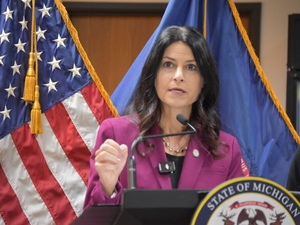
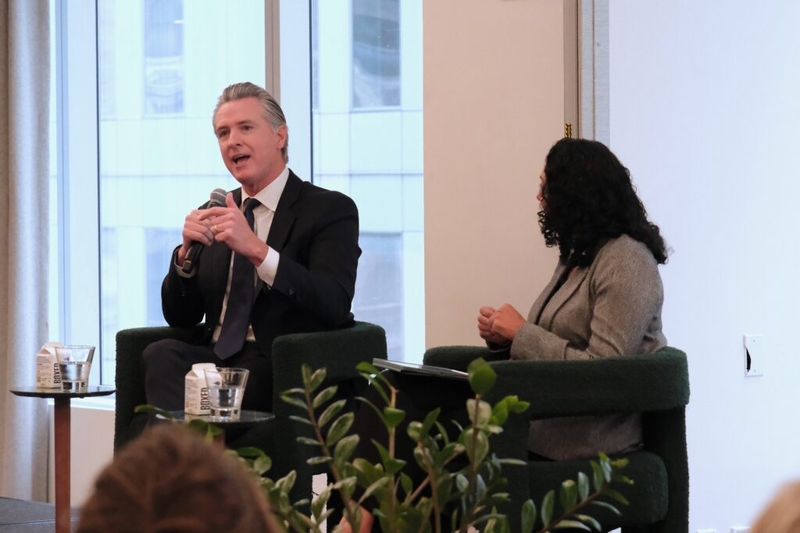
California Gov. Gavin Newsom announces his authorization to link Washington state in its carbon market during Climate Week in New York City on Sept. 23, 2026. (Photo courtesy of Washington State Department of Ecology)
Taking the stage at Climate Week in New York City Wednesday morning, California Gov. Gavin Newsom announced his authorization to move forward with linking Washington into its carbon market that’s shared with Quebec, Canada, the next-to-last step in California’s process to complete the merger.
On the same day, Washington state officials completed the rulemaking process to allow the linkage. California and Quebec will still need to complete regulatory changes, the final step, before merging can occur.
In June, the three jurisdictions signed a linkage agreement to fully join operations in 2027. Washington hopes that joining the older and well-established carbon market will stabilize prices for businesses, which have swung wildly in recent years on the state’s 5-year-old market.
“By joining forces with our partner in Washington state, we will build a stronger, more durable carbon market that will drive investment, cut pollution and power the clean economy of the future,” Newsom said.
For more than a decade, California’s carbon market has sought to cut climate pollution by setting a cap on greenhouse gas emissions and requiring major polluters to buy allowances to cover their share of emissions. In 2014, its market linked with Quebec.
Former Gov. Jay Inslee signed Washington’s carbon market into law in 2021 under the Climate Commitment Act. Since the state’s first auction in 2023, it has raised just over $5 billion in revenue.
A Washington-California-Quebec carbon market will put the same price on greenhouse gas emissions across an economy that ranks as the third largest in the world, said Caroline Halter, communications manager at Washington’s Department of Ecology.
“Linkage isn’t just good climate policy — it’s smart economics,” said Washington Gov. Bob Ferguson in a press release. “Linking will unlock greater emissions reductions, lower the cost of clean technologies, and create good‑paying jobs in high‑growth industries.”
Both supporters and critics of Washington’s carbon market say that linking would stabilize prices and cut costs for polluters who have navigated an uncertain market with widely fluctuating allowance prices.
Large polluters covered under Washington’s carbon market are required to obtain allowances for each metric ton of greenhouse gases they emit.
In Washington’s first year of auctions, the highest allowance cost soared to $63 per metric ton of emissions, and the state raised nearly $2 billion in revenue. In 2024, amid the campaign for an initiative to eliminate the Climate Commitment Act, allowance prices dropped dramatically. When that measure failed, the market bounced back.
In December of 2025 Washington’s allowance prices hit a peak of $70 per ton. During its most recent auction earlier this month, allowances were $39.
Meanwhile, allowances in the California-Quebec market have been comparatively stable and hover around $30. Its most recent price was $32.
Newsom added that the linkage would create “more reliable pollution reductions and local investments, no matter what happens in DC,” in a post on X.
Olympia, WA