Takeaways from former Gov. Mark Dayton’s book stop in Northfield
Sep 22, 2026 | 1:26 pm ET
Description
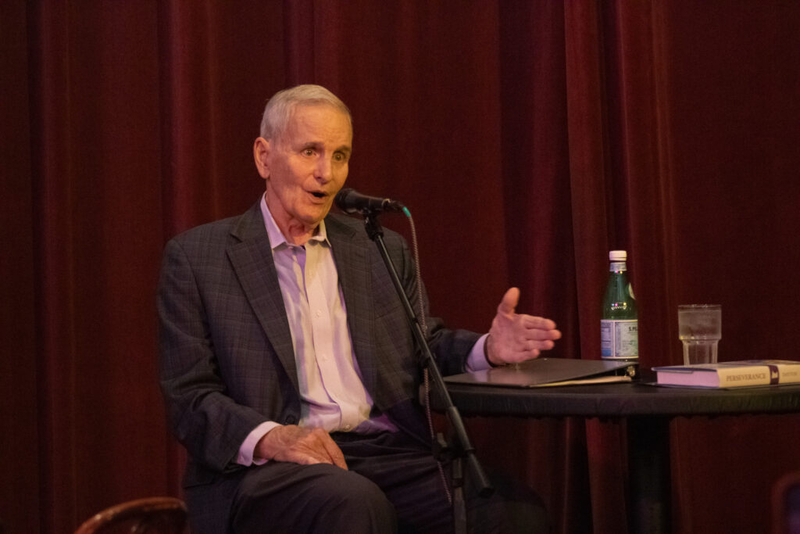
Gov. Mark Dayton, appearing at Content Bookstore in Northfield, compared his activism against the Vietnam War to Operation Metro Surge during a recent book talk: “Vietnam was so appalling because you saw these innocent people being maimed, attacked,” he said. “But, you know, that was Americans attacking people in another country. These were Americans attacking Americans.” (Photo by Maya Betti/Minnesota Reformer)
Former Gov. Mark Dayton recently began a book tour following the release of “Perseverance,” a memoir reflecting on his nearly five decades in Minnesota politics.
Dayton has rarely been seen in public after retiring from office in 2019. In revisiting the people and experiences that influenced his career, however, he’s sought to offer some insight into the current political landscape ahead of November’s elections.
Dayton recently joined longtime friend and semi-retired Minnesota Star Tribune columnist Lori Sturdevant, editor of his memoir, for a conversation hosted by Content Bookstore in Northfield.
Here are some key takeaways.
Why now?
As Dayton approaches 80, the “L” word is hanging over him: legacy, especially how future generations — including his five grandchildren — view his public life.
“I wanted to write something that they could remember me by, and something that hopefully the next generation will take to heart,” he said.
The book’s title draws from advice Dayton said he received early in his career from late U.S. Sen. Ted Kennedy: “Perseverance is the prerequisite for success in politics.”
Dayton has survived multiple losing campaigns, mental illness, addiction and myriad health problems.
The two-term governor added: “I hope if people reading this get nothing else out of it, they’ll think, ‘Yeah, I’ve got to persevere.’”
Echoes of Nixon era felt today
Dayton was involved in the anti-Vietnam War movement in college at Yale, which he describes in the book. His activism eventually put him under federal scrutiny. He was investigated by the IRS, had his phone tapped and was called before a grand jury.
He was also, quite proudly, on former President Richard Nixon’s “enemies list.”
“Back then, Richard Nixon had all the power,” Dayton said. “They were harassing people and imprisoning people unfairly.”
During Operation Metro Surge, Dayton, who spends his winters in Arizona, began to draw parallels as he watched what was happening in his home state.
“Vietnam was so appalling because you saw these innocent people being maimed, attacked,” he said. “But, you know, that was Americans attacking people in another country. These were Americans attacking Americans.”
Nixon’s career ended in the disgrace of Watergate, which revealed widespread corruption that had permeated his administration.
“I’m hoping that parallel continues today, starting with the election in November,” Dayton said.
Minnesota’s next leaders will face hard choices
Dayton said Minnesota’s next leaders will face a tougher economic climate than he did as governor.
During his eight-year tenure, Minnesota was coming out of the Great Recession, the farm economy was strong and employment rates were rising. Today, however, 47% of Minnesotans reported that their personal finances have worsened over the past year, according to a Chamber of Commerce poll. Minnesota’s population is aging, and both population and economic growth have slowed.
“The choices are going to be much more difficult,” Dayton said. “Setting priorities can be much more important.”
His suggestions? A continued focus on education and an assurance that the state government’s fraud epidemic is finally squashed.
“The checkpoints in state government were just not set up for that kind of onslaught. Now, they are,” he said. “Setting up the guardrails, making early detection, and responding immediately when there’s the first sign of any misdemeanors is going to be crucial.”
What makes a good politician?
The November election features races in each of the state’s constitutional offices including governor and attorney general, as well as contests for U.S. Senate, eight congressional seats and all 201 legislative districts, with voters preparing to make key decisions about the state’s future.
“I think we’re going to turn this country around. To do that, you got to lead upward,” Dayton said.
The government and its leaders can and should recognize differences among people, but instead of deepening divisions, Dayton said, a good leader looks for a common cause and asks: “What matters that unite us?”
“I say there’s no saints in politics; they’re only shades of sinners,” he said. “But, there are shades.” (Dayton won over many crowds with his self-deprecation and wit.)
For Dayton, that distinction between shades comes down to intent — whether leaders are serving themselves or the public.
And, in the end, we’ll need something new — or something old again.
“It’s going to take a new brand of leadership, or an old brand reestablished,” he said.

Saint Paul, MN