Michigan Smart Trade Alliance tracker shows over $26 billion in tariff-driven costs paid statewide
Sep 22, 2026 | 10:15 am ET

Description
U.S. Customs station at the Blue Water Bridge in Port Huron, Michigan. (Photo by Jon King/Michigan Advance)
The Michigan Smart Trade Alliance has launched a tracker estimating that Michigan households have incurred more than $26 billion in tariff-related costs since January 2025, or about $6,419 per household.
That number is based on the National Taxpayers Union Foundation’s state tariffs tracker, which uses import and duty data from Trade Partnership Worldwide and U.S. Census Bureau household counts. According to the alliance’s website, the tracker “reflects only the highest of several published, credible estimates of tariff costs to Michigan households.” The website also notes that other analysts and the White House put the number lower, while some dispute that tariffs impose any net cost after accounting for other economic effects.
“The costs on Michigan families is taking a toll in the form of higher costs and frustration with trade policies and tariffs that are holding our economy back,” said Michigan Smart Trade Alliance spokesperson John Sellek in a press release. “It’s time to end the trade war with Canada, get both sides to the negotiation table, and find a solution that will end this affordability crisis in Michigan.”
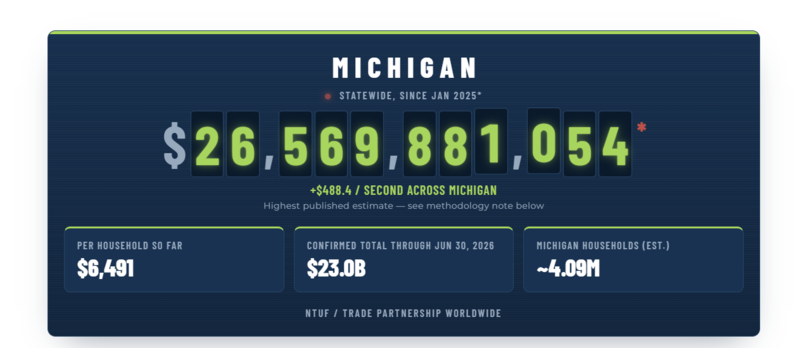
The tracker projects an average increase of $488.4 per second across Michigan in statewide tariff costs. That number is a calculation, not a demonstration of constantly updating data — it divides the last confirmed total from the National Taxpayers Union Foundation, $23 billion, by the 545 days in that data period, to find the average per-second cost, and projects that amount forward.
The website also notes that the tracker was created using artificial intelligence.
The group also released the results of an early July Ipsos poll of 559 likely voters, which showed that, across party lines, voters were in strong support of statements that they would be more likely to support a candidate who says, “I support smart trade that protects Michigan jobs” and support congressional action to increase trade with trusted allies such as Canada and Mexico when it protects jobs and lowers costs.
“Anyone who is running for office right now should consider themselves on notice: Voters in Michigan across the political spectrum want smart trade and an end to erratic trade policies that raise prices and make it difficult or impossible for businesses to plan for the future,” Mark Fisk, another spokesperson for the Michigan Smart Trade Alliance, said.
Another poll commissioned by the organization and conducted by EPIC-MRA in June showed similar pushback on tariffs, with a 70% to 20% margin saying that “state and federal lawmakers should pursue a different trade policy that reduces tariffs and lowers costs for consumers.”
However, opinions in that earlier poll varied along party lines — “A 79% to 12% majority of Democrats, 58% to 31% of Independent voters oppose tariffs, while an 81% to 13% majority of Republicans said they support tariffs,” according to the alliance’s website.
Lansing, MI