New Hampshire survey shows jump in support for small-lot single-family homes
Sep 22, 2026 | 5:00 am ET
Description
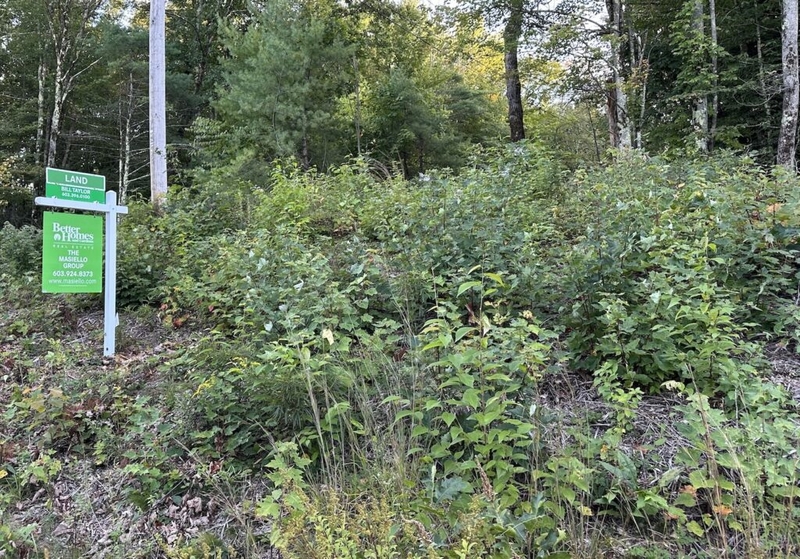
Housing advocates have long argued the best way to make single-family homes more accessible for young families is to build on smaller lots. Here, land is listed for sale on Route 114 in Henniker. (Photo by Dana Wormald/New Hampshire Bulletin)
New Hampshire cities and towns are increasingly embracing mixed-use apartments in commercial zones and, in some cases, large residential developments.
But state survey data suggests residents are craving a specific form of housing: the single-family home.
About 80% of residents between 18 and 40 would prefer to live in a single-family home, compared with about 10% who preferred an apartment and smaller percentages who chose a condo, shared house, accessory dwelling unit, or manufactured home, according to a September 2025 St. Anselm College survey commissioned for the advocacy group Stay Work Play.
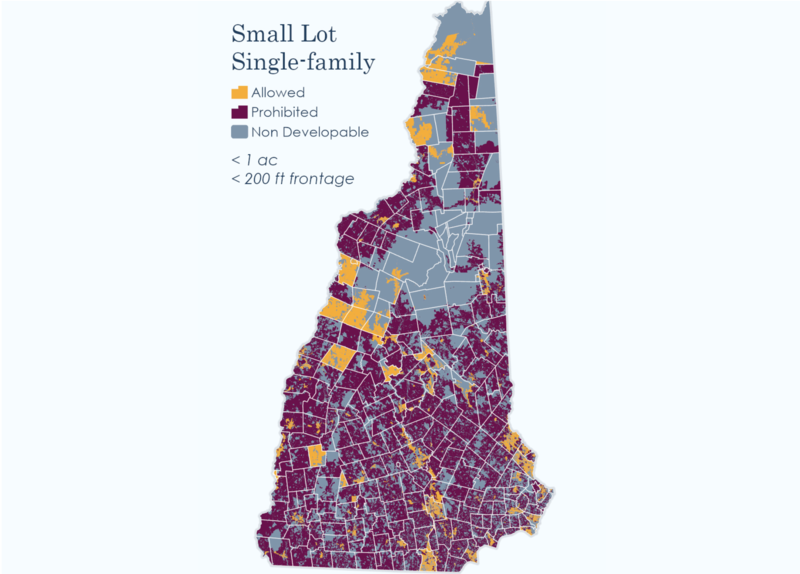
Housing advocates have long argued the best way to make those homes available to young families is to build more on smaller plots. Currently, 93% of New Hampshire zoning codes prohibit building single-family homes on lots smaller than 1 acre, according to findings from the New Hampshire Housing Atlas, a project of St. Anselm.
Now, a new survey suggests residents think cities and towns should change those codes.
About 74% of Granite Staters support “having parts of every town where people are allowed to build single-family homes on smaller lots,” according to a survey released by St. Anselm last week. That represents a leap from 2025, when an identical survey question found 59% support for smaller lot sizes.
The jump in support could energize efforts to pass state laws requiring cities and towns to allow small lot sizes.
One Democratic lawmaker, Rep. Ellen Read of Newmarket, who is running for reelection unopposed in the Nov. 3 general election, says she will bring legislation forward in 2027 to support smaller lot sizes.
“I have legislation that would consider large lot minimum requirements to be an extraordinary restriction on residential property, forcing municipalities to beat the burden of proof that such requirements were absolutely required for health and safety, and the most minimally restrictive option,” Read said in a text message Monday.
But even after the Legislature passed a raft of legislation in 2025 to restrain municipal zoning practices from restricting accessory dwelling units and residential housing in commercial zones, efforts to legislate lot sizes have been less successful.
A 2025 bill by Manchester Republican Sen. Keith Murphy to limit minimum lot sizes for single-family homes to 1 acre, Senate Bill 84, fell short in January, when the House voted to send it to “interim study” in 2026.
Continuing high support for housing
The 2026 St. Anselm housing poll, conducted in late August among 1,293 registered New Hampshire voters, found that support for housing remains high.
Seventy-three percent of respondents supported the statement that “My community needs more affordable housing to be built,” while 61% supported more affordable housing in their neighborhoods.
The survey also showed 63% of respondents said cities and towns should change their zoning to allow more housing, with 32% opposed and 5% unsure. That is a marked increase since 2020, when 29% supported changing zoning and 42% opposed. It reflects a broader shift in New Hampshire residents’ greatest concern in recent years, from the opioid crisis to housing, according to the University of New Hampshire’s Granite State Poll.
The St. Anselm survey also found that 65% of voters support including public investments in affordable housing in the state budget. In 2025, amid broader budget cuts, Republican lawmakers declined to add new funding to a Housing Champions program meant to incentivize towns to change their zoning codes to allow more housing development with state grants.
The 2025 Stay Work Play survey, meanwhile, revealed that the desire for single-family homes increases as Granite Staters enter their thirties. About 65% of 18- to 25-year-olds prioritized single-family homes over other types of housing, compared to 80% of 26- to 30-year-olds, 85% of 31- to 35-year-olds, and 90% of 36- to 40-year-olds, the survey found.
Elissa Margolin, director of the Initiative for Housing Policy and Practice at St. Anselm, says the two surveys taken together indicate a surprising demand for single-family homes among young people that might influence city and town zoning policy.
“I think we were thinking that younger people were showing a market preference like … they love tiny homes, they love these innovative small spaces,” she said in an interview. “And they’re saying, ‘No, we live in New Hampshire. We would like a starter home with a small yard and a white picket fence, but we can’t afford one.’”
She also said the survey suggests voters may be becoming “smarter” about housing.
“I wonder if the electorate is just starting to be able to articulate tools better around naming specific housing type preferences instead of just saying, ‘Help, this is really expensive,’” she said.
However, while the historical survey data shows that interest in housing development has increased since 2020, it also suggests that support could be hitting a ceiling. For instance, the 73% of respondents in 2026 who supported more affordable housing in their communities is up from 63% in 2020, but below the 78% measured in 2025.
Margolin said some of that difference could be explained by the survey’s 2.7% margin of error. The rest of that dip, she said, could simply represent “a leveling out” of support.
‘People want to own their own homes’
The recent survey results, and the pending legislation, suggest the political battle between state lawmakers and local zoning boards over the pace of housing development is still raging.
To Read, New Hampshire towns’ existing minimum lot sizes for single-family homes represent an attempt at exclusionary zoning by local government.
“We have a dozen towns that have areas of 20-acre lot minimums and greater,” she said Monday. “That is not how you attract and keep the young working families we need. People want to own their own homes, not be zoned out of any opportunity and at the whims of a landlord for their whole lives.”
Read has personally introduced a number of bills for 2027 in the early filing period, including one “limiting local authority to adopt restrictions on the building and development of residential properties,” and another “permitting in all residentially zoned areas by right the placement of newly constructed manufactured homes.”
Other lawmakers are expected to file pro-housing bills later this year, when the legislative filing period reopens following the general election.
But others in the House argue the Legislature has passed too many restrictions on cities and towns, threatening local control, and say prohibiting certain minimum lot sizes would stop reasonable measures to prevent strains on town resources like schools and fire departments.
Rep. Michael Harrington, a Strafford Republican who has voted against some of the zoning overhaul bills in recent years, has his own legislative service request for 2027 titled “relative to planning board authority over subdivision applications.” Harrington did not respond to a request for comment Monday.
In the 2026 session, the New Hampshire Municipal Association backed a series of bills intended to reverse the slate of 2025 zoning restriction laws, arguing that municipalities were being unnecessarily hamstrung, and that many already support more housing without needing state mandates. Those repeal bills failed, and now many cities and towns are undergoing the process of bringing their zoning codes into line with the new state laws.
Margolin argued many municipalities are doing their best to meet the new demand.
“You kind of inherit the map that you’re given in every community, and it takes work to change the map,” she said. “And once you change the map, you can change the housing type. And I think that’s what Granite Staters are saying they’re asking for in this survey.”

Concord, NH