A tale of two notices: Rhode Island redesigns public benefit letters to make decisions clearer
Sep 22, 2026 | 5:15 am ET
Description
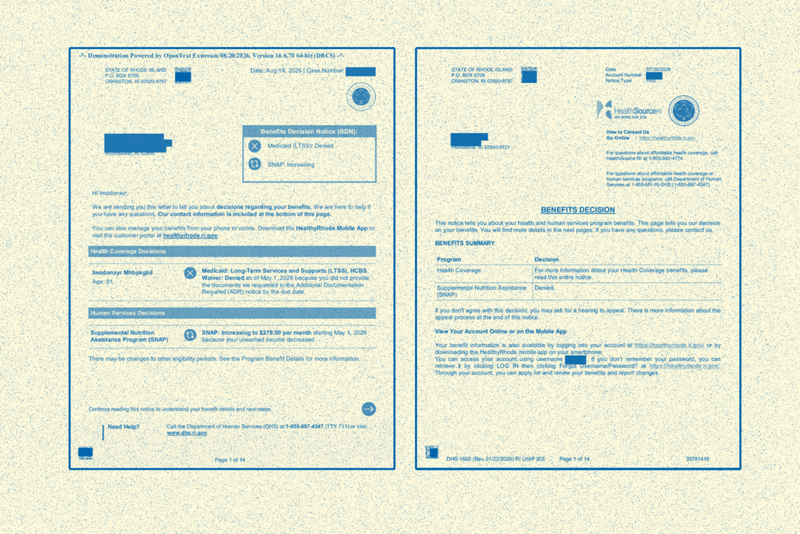
A redesigned Rhode Island Benefit Decision Notice, left, presents eligibility decisions and explanations more prominently than the previous format, right. (Photo illustration by Alexander Castro/Rhode Island Current)
Each month, approximately 60,000 benefits decision notices travel through Rhode Island’s mail. When the notices land in residents’ mailboxes, they tell people when their Medicaid coverage and other public benefits have been approved, denied, or changed.
This month, the state gave the notices a makeover in hopes that the often complex decisions they relay will become easier for beneficiaries to understand.
The notices are generated via the state’s public benefits portal, RIBridges, and they are sent after a formal eligibility decision has been made for programs like Medicaid, the Supplemental Nutrition Assistance Program (SNAP), Rhode Island Works or child care assistance. The notices can be information rich, especially when consolidating decisions sent to multiple people living in the same household, each of whom may be receiving multiple benefits.
“The original notices were confusing because the information was presented piecemeal,” Nora Salomon, a supervising attorney at Rhode Island Legal Services who helps clients navigate public benefit decisions and appeals, told Rhode Island Current.
Salomon’s example: A chart on the old notices may have told participants which benefits the notice concerned, but they still had to read more than the first page to gather the full scope of any determinations or changes affecting those benefits.
“The rationale behind those changes was often very brief, which made it difficult for customers to understand,” Salomon said.
The new notices, which began going out in mid-September, attempt to inform recipients more directly and immediately about what happened to their benefits and why, instead of digging through multiple pages to find the rationale behind the state’s decision. They also use icons and callout boxes to highlight approvals, denials and other changes. Health coverage decisions are also separated from those involving other human services programs.
The new notices include program names and eligibility terms in Spanish and Portuguese unlike the previous ones where these terms were only in English. They remind recipients about their responsibilities to report changes which may affect their eligibility or benefit renewals, prompting them to keep reading for all the details.
The redesign is meant to “help improve agency communication to customers, reduce the amount of confusion they face regarding final eligibility decisions” and also cut down on the volume of phone inquiries the agency’s call center receives regarding benefit decisions, Kerri White, a spokesperson for the Executive Office of Health and Human Services, said via email.
White added that “Workers, consumers, and community partners were engaged in the review, design, and testing of the new format.”
Salomon noted, however, that it’s too early to tell whether the notices will meaningfully improve recipients’ understanding of their benefits. She said that, as of Sept. 18, she had seen “some snippets” of the redesigned notices but hadn’t yet heard from clients who had received a complete one.
The problem, Salomon said, is that “the underlying programs described in these letters are really complicated and there is a limit as to what can be accomplished in a simple notice.”
“They can’t contain too much technical information because most people will not read past the first few pages,” Salomon said. “But they also need to contain enough information to adequately inform a person of their eligibility (or lack thereof) and their appeal rights.”
People frequently misunderstand their benefit notices, Salomon said, but she couldn’t attribute that confusion solely to the notices themselves. She gave the example of a recent client on Supplemental Security Income (SSI) who was also eligible for one form of Medicaid. He mistakenly applied for a different form of Medicaid for the elderly and disabled — and he was denied because he already had Medicaid coverage.
“Explaining to somebody without a law degree that ‘You were denied Medicaid because you have Medicaid’ — that’s a difficult thing to do when a person is clearly holding a Medicaid denial notice,” Salomon said.
The volume of notices sent out by the Department of Human Services also presents a point of confusion for recipients, Salomon said.
“DHS sends out a lot of mail,” she said — whenever there’s an eligibility change, a new or changed program, the cancellation of an existing program, or a request for documentation. “It is really hard to keep track of all the letters and I don’t know that people read everything.”
She said her clients miss deadlines “fairly often,” but said, in her experience, a lack of understanding when reading a notice has not made the appeal process any more difficult. Benefit decision notices come attached with instructions and paperwork to file an appeal if needed, and Salomon said DHS has allowed appeals even when a deadline has been missed and something filed late because of confusion over a notice.
The redesigned forms appear to have simplified their language and sound more natural, Salomon said, and they contain more visual cues than they did before.
Still, she added, “I think it may be premature to make any conclusions about these notices at this point.”
Providence, RI