Iowa harvest behind schedule due to ‘extremely soggy’ conditions
Sep 21, 2026 | 7:07 pm ET
Description
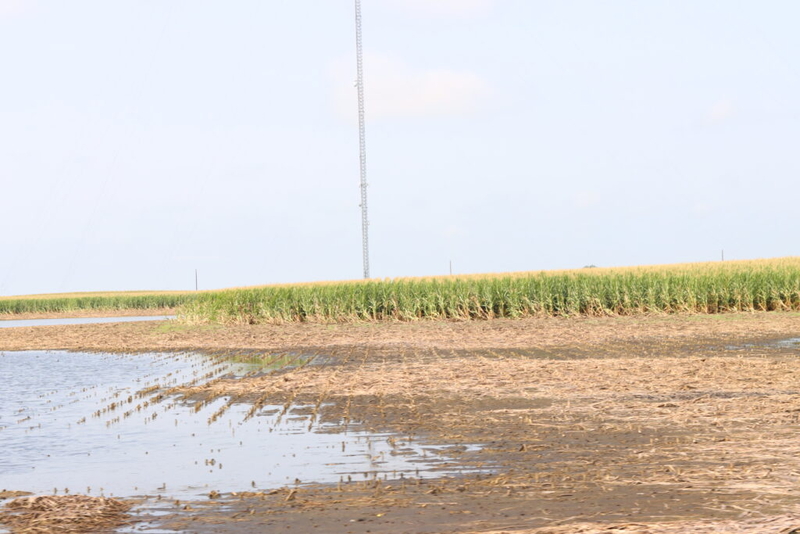
A flooded corn field near Alleman on Aug. 7, 2026. (Photo by Cami Koons/Iowa Capital Dispatch)
Iowa corn and soybean crops are slightly behind typical harvest and maturity schedules as farmers had less than two days suitable for field work due to rainy conditions over the past week.
The latest crop progress and condition report from the U.S. Department of Agriculture shows Iowa farmers had harvested 4% of corn acres and 2% of soybean acres as of the Sept. 14-20 reporting period. Both of those figures are behind the 2025 harvest pace and the five-year average.
State Climatologist Justin Glisan said the preliminary statewide weekly precipitation average for week was “higher than the 30-year climatological normal for all of September.”
The statewide average rainfall was 3.57 inches for the week, with many stations logging totals in excess of 4 inches. Ainsworth had the highest recorded precipitation for the week, according to Glisan’s report, with 10.63 inches.
Glisan said rainfall was reported in the state every day of the reporting period, but the biggest precipitation events occurred at the beginning and end of the reporting periods.
The heaviest rainfalls hit east central and eastern Iowa, where Glisan said flash flood warnings were issued in multiple counties and “major flooding” was reported in Muscatine County along the Turkey River.
Prior to the heavy precipitation week, Glisan said the state had already experienced “anomalous wetness” for the month. The most recent precipitation totals meant farmers had just 1.7 days suitablel on average, for field work according to USDA.
Iowa Secretary of Agriculture Mike Naig called the conditions “extremely soggy” and said the heavy rainfall led to flooding in several areas.
“We’re hopeful for a few dry days ahead, but more rain is in the forecast. Conditions are good for flying on cover crops, and the moisture can help get them germinated and growing,” Naig said in a news release, referring to aerial seeding of cover crops. “When fields finally firm up, Iowa farmers will get combines rolling and harvest will be fully underway.”
Corn maturity reached 56% during the reporting period, putting it behind last year’s crop which had 63% maturity by the reporting period. Corn maturity was only 2 percentage points behind the five-year average for the period. Nearly all, 95%, of corn acres have dented, which is one percentage point ahead of the 2025 crop and the five-year average.
The share of soybean acres dropping leaves, according to the report, was also behind previous years at 46% while last year’s report showed 58% dropping leaves by Sept. 20 and the five-year average has 53% dropping leaves by the reporting period.
Iowa’s dominant crops continue to rate well, with soybeans rated 75% good to excellent and corn rated 76% good to excellent.
Farm safety
In accordance with National Farm Safety and Health Week, Naig urged all Iowans, farmers or not, to “keep safety top of mind” as harvest ramps up.
“Farmers should take the time to work safely, get enough rest and look out for one another,” Naig said in a news release Monday. “Drivers can do their part by slowing down, putting away distractions and being patient when they encounter farm equipment on the road.”
The Iowa Department of Agriculture and Land Stewardship said farmers should stay alert, avoid shortcuts and remember to follow safety protocols. Naig said in addition to physical safety, farmers and farm communities should be cognizant of the stress and mental health challenges that can arise during harvest season.
IDALS encouraged farmers to make time for stress-relieving activities throughout harvest, to get adequate rest and to talk about their stress with family, friends or mental health professionals if needed.
“The stress and economic pressures facing agriculture can also take a toll, so I encourage farmers and ag workers to check in on family, friends and neighbors and reach out when help is needed,” Naig said. “A safe and successful harvest means everyone makes it home at the end of the day.”
Des Moines, IA