Theme of this year’s South Dakota ballot issues: Let’s make life tougher
Sep 19, 2026 | 7:30 am ET
Description
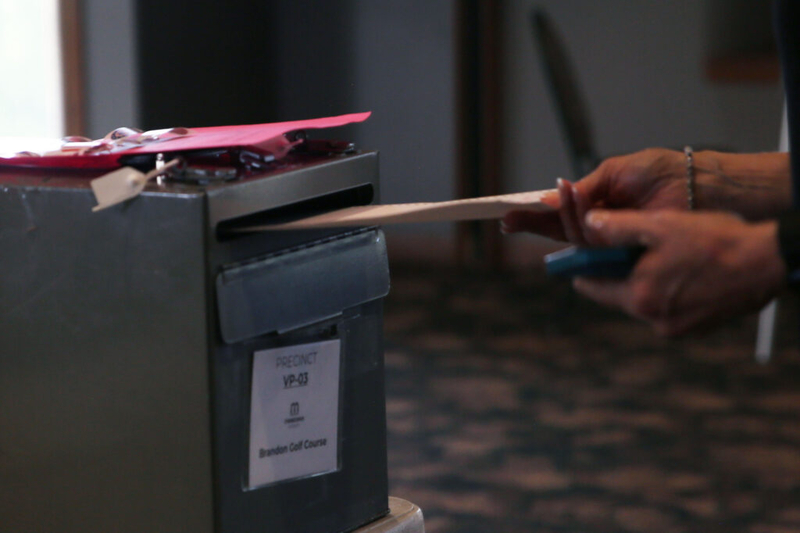
A voter drops a ballot in the ballot box at a Brandon polling place during the runoff election for the South Dakota Republican nomination for governor on July 28, 2026. (Photo by Makenzie Huber/South Dakota Searchlight)
As they cast their ballots now through Election Day on Nov. 3, voters will decide on four constitutional amendments, all courtesy of the South Dakota Legislature. Three of the amendments reflect their origins in a Legislature that’s top-heavy with Republicans. Those three deal with popular Republican topics: tinkering with voting rights, looking to squeeze out expanded Medicaid and making it tougher for citizens to have their say in changes to the state constitution.
Here’s a look at the four amendments:
Amendment K: Everyone must love it
Each election year, the South Dakota Secretary of State’s Office produces a Ballot Question Pamphlet that includes an explanation from the attorney general as well as “pro” and “con” arguments about the measure. Amendment K would create a trust fund for unclaimed property. It sailed through the House and Senate in 2025 without a negative vote. Maybe that’s why the Secretary of State’s Office couldn’t find anyone to write a “con” statement about the amendment.
In an age when no one seems squeamish about sharing their opinions, you’d think that there would be someone, somewhere who thinks that the trust fund is a bad idea. Secretary of State Monae Johnson could have turned to one of the proponents of Amendment I, which seeks a method for repealing expanded Medicaid coverage. One of them could tell her that the state’s financial arrangements should never be enshrined in the constitution, because that’s what they’ve said about expanded Medicaid.
Amendment I: Taking another swipe at expanded Medicaid
After successfully authorizing a work requirement for expanded Medicaid in the last election, proponents of Amendment I are seeking to blame the federal government for their need to put in place a mechanism to roll back the program.
The federal government pays for 90% of the insurance coverage. Amendment I says that the state constitutional requirement to offer coverage would end if the feds drop their share below 90%. As an example, they say that for every 10% drop in federal assistance, South Dakota will have to pay an additional $36 million per year. Their theory is that things are so bad in Washington, D.C., that it’s likely the federal government will need to cut its share of Medicaid financing.
That sounds like a scare tactic all dressed up as sound financial management.
Amendment J: For those times when a federal law just isn’t enough
Amendment J seeks to make it clear that noncitizens aren’t allowed to vote in South Dakota elections. The fact that there’s already a law banning noncitizens from voting doesn’t seem to matter to the amendment’s backers.
While Amendment J seems like a well-intentioned, if redundant, way of making the state’s voting laws clearer, there is a downside. The author of the amendment’s con argument offers the reminder that it’s now the law of the land in South Dakota that any registered voter may challenge another voter’s registration by claiming that they’re not a citizen.
Passage of Amendment J would add one more obstacle to citizens facing the challenge of proving their citizenship within the confines of Election Day or being barred from voting.
What the amendment’s backers would have you believe is that it’s a way to protect election integrity. In reality, the amendment takes a backhanded swipe at naturalized citizens and people of color — many of whom have been known to vote for Democrats.
Amendment L: Welcome to minority rule
Currently, for an initiated amendment to be enacted, it needs approval by a simple majority of voters. Amendment L would change that threshold, requiring 60% of voters to approve of an amendment in order for it to be added to the state constitution.
Backers of the amendment say changing the constitution should be held to a higher standard. Apparently they are unaware of the irony that, if approved, it would only take a simple majority of voters to require that all future amendments meet the 60% threshold.
Similar attempts to raise the voting threshold in 2018 and 2022 failed. Voters saw those for what they were — more attempts by the Legislature to keep citizens from messing with the constitution.
Activists have chosen constitutional amendments as their best vehicle for getting issues before the voters, because they still remember what the Legislature did to Initiated Measure 22 in 2017. Approved with 51% of the vote, IM 22 was a flawed, likely unconstitutional, attempt at policing corruption in government. Rather than wait for the court system to work its magic, legislators scrambled to dismantle IM 22 with the speed and efficiency of a NASCAR pit crew.
True, the measure was flawed. However, the ease with which lawmakers disregarded the will of voters still stings. Ballot measure organizers see initiating change via a constitutional amendment as the safest path because the Legislature won’t be able to touch it for two years and must attempt to make any changes at the ballot box.
All four of this year’s amendments have been offered by the Legislature rather than citizens. That’s a testament to all the restrictions the Legislature has put on petition drives. Those restrictions include petition deadlines, circulation requirements and allowing signatures to be taken off petitions.
Lawmakers continue to enjoy an easier path to getting amendments on the ballot, having to just convince a simple majority (ahem) of their colleagues that it’s a good idea. This is a means of working the system, using their role as legislators to get their issues before voters without going through all the mess and fuss of having to collect petition signatures.
Study your own copy of the 2026 Ballot Question Pamphlet to help you decide how to vote. From here it sure looks like these amendments reflect Republican-centric issues. Their passage would make life tougher by implementing unnecessary restrictions on voting, adding mystery to the prospect of getting Medicaid coverage and allowing a 41% minority to decide if the constitution will be changed.
Not only that, but thanks to the lackluster effort of the secretary of state’s office, there’s no one out there to tell us if the unclaimed property trust fund is a bad idea.

Pierre, SD