Andrew Young, Eric Holder reflect on the state of civil, voting rights after court decisions
Sep 18, 2026 | 10:03 pm ET
Description
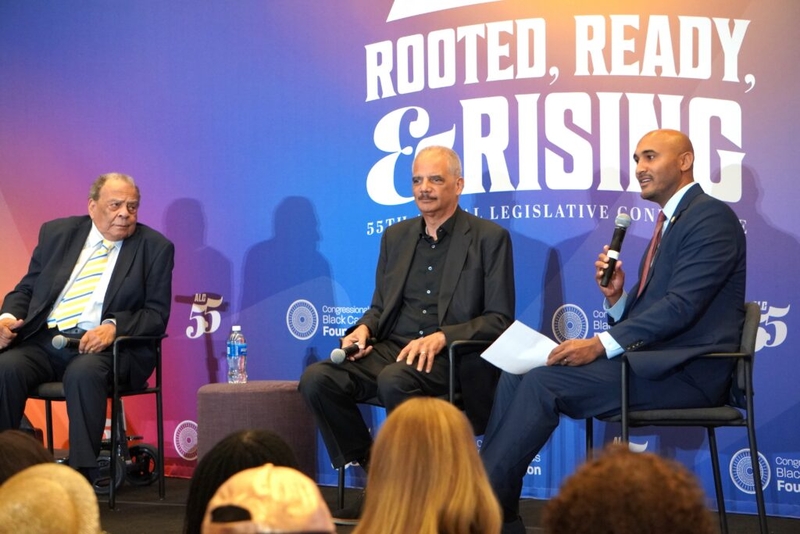
From left, Andrew Young, Eric Holder and Rep. Shomari Figures (D-Ala.) participate in a panel discussion Friday at the Congressional Black Caucus Foundation's 55th annual legislation conference in Washington, D.C. (Photo by William J. Ford/Maryland Matters)
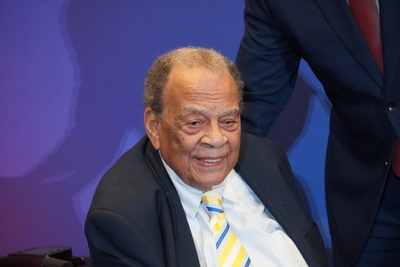
When Andrew Young rose from his motorized chair and took his seat on stage Friday, he received rousing applause.
U.S. Rep. Shomari Figures, an Alabama Democrat, recounted Young’s storied journey. Pastor. Mayor of Atlanta. Congressman. U.S. ambassador to the United Nations. Civil rights icon.
Working alongside the Rev. Martin Luther King Jr., Young played a key role with other civil rights leaders in securing support for Congress to pass the Civil Rights Act of 1964 and the Voting Rights of Act of 1965. Now 94, Young is among the few surviving members of King’s inner circle.
“One thing I really want to make sure that everybody understands. That we are in the presence here of a legend,” said former U.S. Attorney General Eric Holder, the nation’s first Black attorney general.
“All that I’ve been able to do, all that Shomari has been able to do, all that Congresswoman (Terri) Sewell has been able to do, is as a result of the great work, the sacrifices, the commitment, the determination and the courage of this man,” Holder said.
But the landmark legislation that Young helped draft has been upended by legal challenges, with the U.S. Supreme Court recently dealing the Voting Rights Act a blow. In April, the nation’s highest court ruled in Callais v. Louisiana that the state’s use of race-based redistricting amounted to an “unconstitutional racial gerrymander.”
“What worries me about this moment now is that this administration, aided by this Supreme Court, is bound and determined to take us back to a time that I thought, that we all thought, that might have been behind us,’’ Holder said.
Said Young: “I don’t know where we are now.”
Young, Holder and Figures shared a conversation about civil rights Friday at the Congressional Black Caucus Foundation’s 55th annual legislative conference in Washington, D.C.
A New Orleans native, Young’s work in voting rights began as an elementary student. He recalled that students were instructed to write a letter to their parents on why they needed to vote.
“You wrote to your own parents and took the letter home and gave it to your parents about why they should vote,” he said. “Even in segregation, we were being taught the struggle.”
Although he had studied Gandhi as a young man, he said his father taught him how to endure racism, a lesson that carried him through his work in the movement.
“My daddy said, ‘Look, you’re never going to be able to be big enough to beat everybody, but you can outthink anybody,’” Young said. “He said, ‘Don’t get mad. Get smart. If you lose your temper in a fight, you lose the fight. Your mind is the most valuable weapon you have, and if you get emotional, you cut your mind off.’ And so that’s the way I was raised.”
Young said he first met King at Talladega College in Alabama in the late 1950s. Young was studying at Hartford Theological Seminary in Marion where he would meet his first wife, Jean Childs Young. “We were both newly married, and we talked more about our baby daughters than we did about civil rights, and we talked about growing up,” he said.
The Youngs moved to Atlanta in 1961, where he joined the Southern Christian Leadership Conference (SCLC), eventually becoming its executive director and working alongside King.
In 1972, Young made history when he was elected to Congress as the first Black representative from Georgia since reconstruction. Five years later, President Jimmy Carter appointed him ambassador to the United Nations. Young also served two terms as Atlanta mayor and would work to bring the Olympics to the city in 1996.
He and Jean Childs Young were married for 30 years before she passed away in 1994. He is married to Carolyn Young.
Young is credited with helping draft the landmark Civil Rights Act and Voting Rights Act, barring racial discrimination.
Holder, a New York native, was 14 when Congress passed the Voting Rights Act in 1965 and acknowledged it was the impetus for his work as an attorney.
“I lived through the struggles, observing them from New York on television, to see the passage of the Voting Rights Act, to see the flowering of Black political power in the South and to see attempts to undo that history,” said Holder, who became the first Black U.S. attorney general under President Barack Obama, the first Black president.
“As I matured and to be able to be in these positions, it became my determination that not on my watch would we see a retrenchment, to go back to the America that existed before the great work that Ambassador Young and all those great heroes, heroines did before me,’’ Holder said.
But civil rights advocates have lamented decisions by the Supreme Court, in Shelby County v. Holder in 2013 and the Callais decision in April, that they say have gutted the Voting Rights Act.
Holder connected some of the past struggles to what the Trump administration is pursuing, citing the Iran war and attempts to add President Donald Trump’s name to the Kennedy Center. He said those running the country have “intellectual deficits.”
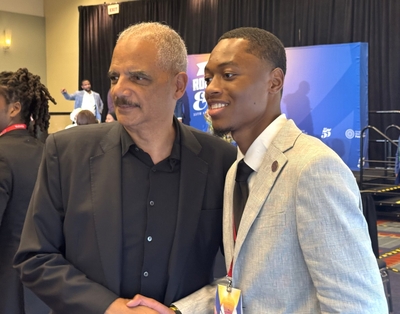
Watching the conversation at his first Congressional Black Caucus conference, James Fields IV, 23, of Birmingham, Ala., said the Young panel was his favorite “because it had a mixture of knowledge.”
“I’m learning from their footsteps, and also I think being able to hear their mistakes allows us the opportunity to know what we should and should not do as young people.” said Fields, who serves as the Alabama SDEC District 52 representative. “I’m just blessed and I’m honored.”

Annapolis, MD