Federal judge pauses Texas Republicans’ bid to close primaries
Sep 18, 2026 | 9:11 pm ET
Description
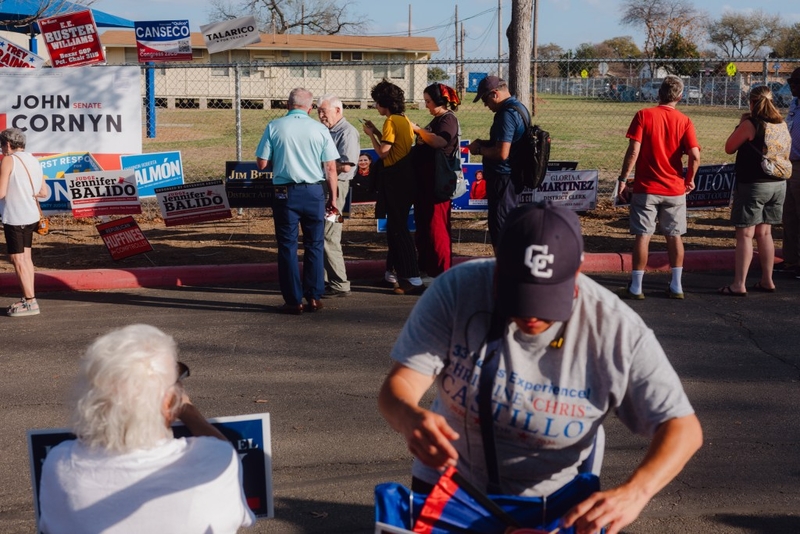
Voters stand in line at the Cody Branch Library polling location on primary election day in San Antonio on Monday, March 3, 2026. (Christopher Lee for The Texas Tribune)
A federal judge on Friday afternoon paused a bid by Texas Republicans to restrict participation in the GOP’s primary elections to voters registered with the party.
While Judge Matthew Kacsmaryk, a U.S. district judge based in Amarillo, stopped the effort, he wrote in his order that he expects the state’s Republican Party to succeed in closing its primaries during the upcoming Legislative Session.
“Prominent Texas politicians support similar legislative action,” Kacsmaryk wrote, later adding that his decision to put the lawsuit on hold is “because the Texas Legislature may soon amend the law challenged here.”
A year ago, the Republican Party of Texas sued then-Texas Secretary of State Jane Nelson, challenging her to limit eligible Republican voters during primary elections. Currently, any Texas voter can cast a ballot in GOP primaries.
Crossing party lines during primaries is a tactic some use to sway who their party’s opponent is during general elections. For example, Houston City Council Member Joe Panzarella received sharp criticism earlier this year during his campaign after records showing he voted in the 2016 Republican primary despite being Democrat.
Panzarella defended his decision to cast his ballot in the GOP primary as a “protest vote” against Donald Trump, according to the Houston Chronicle.
The Republican Party in its lawsuit argued that the state’s open primaries violate their First Amendment right to choose party leaders. Republicans have been trying to close primaries for years, but urgency to do so intensified in 2024 when two incumbent state representatives viewed as moderates — former House Speaker Dade Phelan and Gary VanDeaver — held off challengers in their primary races by fewer than 800 votes.
Some Republican leaders claimed Phelan and VanDeaver only won because they’d received votes from Democratic- and independent-leaning voters.
Gov. Greg Abbott made clear at the Texas Republican Convention in June that he wants to make sure that “only Republicans vote in Republican primaries.”
Nelson took heat from Republicans when she said changes to election laws has to be done through the state Legislature. Many lawmakers urged Abbott to fire her. She stepped down in June, and her successor, Robert Howden, said in a legal filing in August that he’s going to defend the state’s open primary system.
Although Kacsmaryk wrote that it’s likely that lawmakers next year will pass legislation to close the state’s primaries, it’s not certain.
“Texas’s current primary system may be distinct from a pure open primary anyways, because voting in a Texas primary does entail some level of party affiliation,” he wrote.
The state’s next primary election for all parties is in 2028.
Natalia Contreras, who reports for VoteBeat and The Texas Tribune, contributed to this story.
Austin, TX