Andy Biggs revives Kari Lake’s push for cameras in Arizona classrooms to spot ‘woke’ teachers
Sep 18, 2026 | 8:28 pm ET
Description
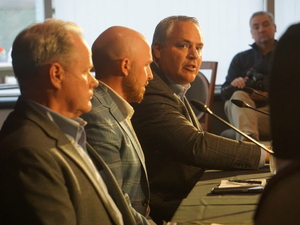
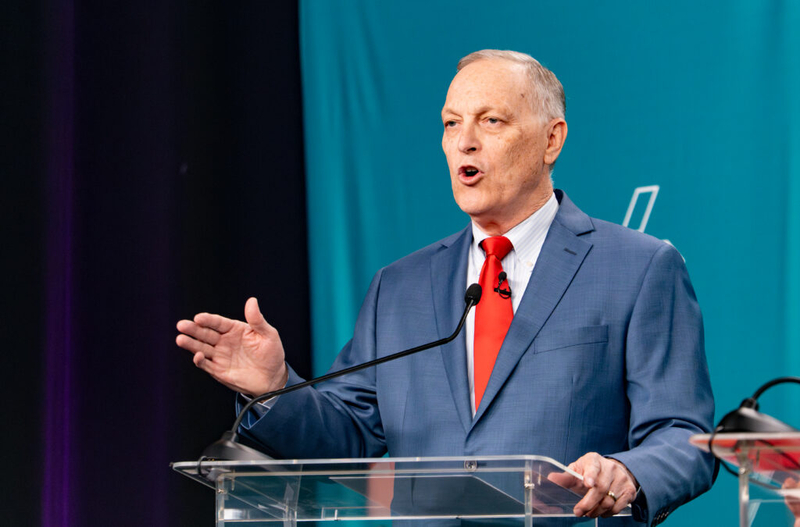
Rep. Andy Biggs debates with his Republican opponents in the 2026 AZ Clean Elections governor primary debate at Sneaky Big Studios in Scottsdale on June 17, 2026. Pool photo by Diannie Chavez/The Arizona Republic)
Andy Biggs, the Republican nominee for Arizona governor, said last year that he would support putting cameras in public school classrooms so that parents can keep an eye on “woke” teachers.
Experts say that doing so would put student safety and privacy at risk because, even if streaming camera feeds are meant for a private audience, like parents, they can be hacked.
After a Phoenix area elementary school teacher was criticized for how she spoke to students about the shooting death of Charlie Kirk, conservative radio show host Garret Lewis asked Biggs if he would support putting cameras in classrooms so that parents could monitor them.
“Absolutely, I would,” Biggs said during the Oct. 15, 2025, radio show. “I mean, you’ve hit on the reasons why, but look, you wouldn’t need to do it if you didn’t have what we’re seeing with some of these woke teachers and these woke lessons that are going on, and the indoctrination that’s taking place here.”
Biggs declined to comment for this story.
Michael Beyer, a spokesman for the Democratic Gov. Katie Hobbs’ reelection campaign, told the Arizona Mirror in a statement that Biggs’ plan would “fulfill the wish list of pedophiles.”
“Andy Biggs’ plan to put government cameras in classrooms is the latest gift to predators from a politician with a disturbing record when it comes to protecting Arizona’s children,” he said. “Biggs blocked bipartisan legislation to combat a corrupt pedophile cult that was abusing women and children in Colorado City, and now he’s pushing a classroom surveillance scheme that former Republican Governor Doug Ducey warned could allow predators to monitor children.”
Biggs has defended his vote on that legislation, saying it was poorly drafted, and accused Hobbs of protecting pedophiles for vetoing legislation that would give tougher penalties to sex offenders.
The idea of putting cameras in classrooms to monitor teachers for ideological reasons isn’t a new one. In 2021, then-gubernatorial candidate Kari Lake, also a Republican, said she backed the idea. At the time, people like Lake and former Fox News commentator Tucker Carlson were up in arms over untrue allegations that critical race theory, a graduate-school level concept, was being taught in public K-12 schools.
In 2022, legislation was introduced by Republican lawmakers in Iowa and Florida to require livestream monitoring of public school classrooms, but neither proposal became law.
While Biggs said during the radio interview that he would agree to cameras in classrooms only if access was limited to parents, there would be no guarantee that parents wouldn’t share their login information or that it wouldn’t be stolen.
In 2021, the Associated Press reported that a small hacking group accessed cloud-based live feeds of tens of thousands of Verkada security cameras, including those at schools and hospitals, and monitored them for two days. After that, Verkada said that it beefed up security.
Buckeye Union High School District confirmed in May that it installed Verkada cameras with artificial intelligence recognition capabilities at Estrella Foothills High School, but said the AI capabilities had been turned off.
“When you hook up a camera to the internet, you are making it vulnerable,” Jay Stanley, a policy analyst for the American Civil Liberties Union, wrote in 2021. “And you are making the privacy of anybody recorded by that camera vulnerable.”
Hackers used a “super admin” login to access Verkada’s video feeds, which allowed as many as 100 staffers, from salespeople to interns to access the livestreams from digital devices.
“Digital security is difficult,” Stanley wrote. “The bottom line is that it’s simply easier to attack an online asset than to defend it. To protect it, your defenses have to be perfect, while an attacker only needs to find one way to succeed — one weak password, one unpatched vulnerability, or one gullible worker.”
In a 2024 settlement with the U.S. Department of Justice, Verkada agreed to pay a nearly $3 million civil penalty and to “implement extensive data security measures.”
Even if classroom video stays in the hands of people who are supposed to have access to it, that doesn’t mean students are safe from predators. Last month, a former Tempe Union High School District surveillance officer was indicted for voyeurism for downloading security video of Corona del Sol High School students in a dance room where female students were changing clothes.
“Andy Biggs is proving yet again that he’s taking lessons from Kari Lake, dusting off her reckless proposal to put surveillance cameras in Arizona classrooms,” Nicholas Simões Machado, a spokesman for Copper State War Room, a messaging arm of a campaign to elect Democrats, told the Arizona Mirror in a statement. “Even former Republican Gov. Doug Ducey warned the plan could compromise student privacy and put children in predators’ crosshairs. Biggs continues to show he’ll put predators first and children’s safety second. Arizonans already gave Kari Lake’s extreme agenda a failing grade twice, and this November, Biggs is turning in the same failed agenda.”
A swift kick from the budget
An initial version of this year’s state budget included $2 million for a pilot program to put cameras with biometric scanners in Mesa Public Schools. The cameras would send alerts to analysts if the scanners identified registered sex offenders, people with criminal histories or missing kids. The proposal did not allow for live viewing of the camera feeds.
After criticism over privacy concerns, it was swiftly removed.
During a June 10 legislative hearing on the budget, Arizona Sen. Mitzi Epstein, D-Tempe, said that she and others had a lot of concerns about putting more cameras in schools.
“It’s of great concern, the idea of having cameras on students all day long, and the anxiety that that could produce,” she said.
Nearly all of the students who participated in ACLU focus groups in 2023 said that surveillance negatively impacted their interactions with staff and friends. And 26% of 500 high school-age students who responded to a YouGov survey commissioned by the ACLU said they were concerned about how their data, obtained via surveillance at school, was being used.
Several Arizona school districts already use cameras with biometric scanners, purchased with federal grants within the last few years, including Piñon School District on the Navajo Nation and Tolleson Union High School District.
A new law went into effect in Louisiana in February that requires some special education classrooms to have cameras in them, and many parents and teachers regarded it as a win to protect some of the most vulnerable students from abuse or neglect. But some parents had privacy concerns.
“We understand parents who are supportive of having cameras in the classroom, and at the same time, we’re understanding of some parents who may worry about over surveillance of children in schools,” Lauren Winkler, an attorney with the Southern Poverty Law Center who represents parents of special needs children, told the Louisiana Illuminator in January “So we, you know, we want it to be used to help families, but not to be harmful to children.”
Phoenix, AZ