National screen time debate reaches Oklahoma schools
Sep 18, 2026 | 6:30 am ET

Description
Jenks High School students use laptops and paper worksheets in an advanced chemistry class at the Jenks Public Schools Math and Science Center on Nov. 13, 2024. (Photo by Nuria Martinez-Keel/Oklahoma Voice)
OKLAHOMA CITY — As questions swirl nationwide about the appropriate role of technology in children’s education, some Oklahoma parents, lawmakers and districts are calling for a reduction to in-school screen time.
The nation’s two largest districts, New York City Public Schools and the Los Angeles Unified School District, rolled out policies this year curtailing use of personal devices and artificial intelligence in the classroom. Similar discussions are now burgeoning in Oklahoma.
Parent groups in multiple Oklahoma districts have started advocating for limits on education technology, like laptops, touch-screen tablets and lessons delivered digitally. State lawmakers have taken notice as they consider which bills to pursue in the next legislative session.
The state House passed a bill this year that sought to limit children’s screen time in elementary schools at no more than an hour a day, but the legislation didn’t survive the Senate.
One of the bill’s authors, Sen. Ally Seifried, R-Claremore, said she’s considering filing legislation on school screen time again. Seifried, the vice chair of the Senate Education Committee, also wrote laws banning student cellphone use in schools and implementing regulations on AI in education.
“I do think the time is ripe to make this a priority this upcoming session,” she said.

After the onset of the COVID-19 pandemic, many Oklahoma districts purchased a laptop or tablet for each student, a concept known as “one-to-one” devices, in an attempt to maintain instruction during a time of school closures and individual quarantines.
Those devices have largely remained, and some traditional, brick-and-mortar districts have incorporated digital or AI-based lessons into daily classroom instruction.
The chief question, Seifried said, is whether education technology better supports student learning than traditional teaching methods.
To Katie Smith, a mother of two children in Edmond Public Schools, the answer is a clear “no.”
Too many medical associations and academic studies have raised concerns about the negative impact screen time and digital media consumption can have on children, she said. Other studies suggested digital tools are less effective for learning. Meanwhile, national reading and math scores have declined since education technology became adopted more widely.
The American Academy of Pediatrics recommends parents consider the quality of their children’s digital media interactions, not only the amount of time spent consuming it.
Smith founded Pencils Over Pixels-Edmond Public Schools in June to advocate for limits on AI and screen time access, borrowing the name from a similar parent group in Pennsylvania.
She said her opposition to excess screen time isn’t based on a “bad feeling” about it, but rather experts and data.
“I think the evidence is in, and I think it’s clear and convincing,” said Smith, an attorney.
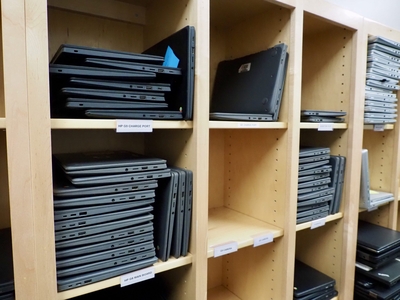
Her sons in pre-K and fourth grade each received school-assigned devices, and she said she found it worrying that no district policy limits daily use while they’re in the classroom.
In a statement to Oklahoma Voice, the Edmond district said it will convene a committee this year to look at overall technology integration in its schools, including screen time, and whether it needs to make any changes to its practices.
Smith has urged the Edmond Board of Education to adopt a resolution affirming support for pencil-and-paper instruction, physical learning materials like printed textbooks and use of digital devices only when they offer “clear, evidence-based instructional advantages that cannot be achieved through traditional methods of learning.”
About 500 Edmond parents have signed a petition supporting the resolution, Smith said. Even more have expressed support from other districts — Stillwater, Norman and Oakdale — where parent groups are advocating against overuse of screen time and “gamified” online lessons, she said.
Smith has supported an even more rigorous policy than her resolution’s language. Social media pages for Pencils Over Pixels-Edmond have promoted elementary schools being 90% to 99% screen-free, middle schools having no more than 50 minutes of screen time per day and high schools allowing up to 15 minutes of personal device use per class.
“I’m not totally anti-technology at school by any means,” Smith said. “I just think it needs to be put in its place. I think it’s just taking over everything. We need reasonable limits. We need a policy. We need breaks. We need balance.”
Oklahoma Teacher of the Year Kasey Bennett also has been advocating for a reduction in one-to-one devices, particularly at the early elementary level. Students miss out on critical interpersonal interaction and fine motor skill development when they spend too much time behind a screen, she said.
Bennett teaches elementary science, technology, engineering and math in Durant Public Schools through hands-on, tactile lessons. Use of screens in her classroom is intentionally “very, very limited,” she said.
“I know we have to take assessments,” Bennett said. “I know we have to have computer class. That is fine. Everything in moderation. There’s no reason a 6 year old needs their first grade work delivered to them sitting in their classroom behind a one-to-one device.”
Long before the pandemic, Putnam City Public Schools started purchasing iPads for students K-12, and it still does so today.
The touch-screen tablets and Apple software bolster the district’s emphasis on project-based learning, said Putnam City’s chief technology officer, Cory Boggs. He said the district, based on the west side of the Oklahoma City metro area, hasn’t seen any advocacy within its community against the devices.
Elementary and middle school students are mostly expected to leave their iPads at school while high school students can take them home, he said.
Unless they’re enrolled in online courses or credit recovery, Putnam City students don’t have lessons delivered to them through a digital platform, Boggs said. Classes are led by teachers, who decide how much they want to involve the iPads, and students are assigned both physical and digital copies of their textbooks.
The devices are still essential, though, because state-mandated assessments and academic screeners are taken electronically, Boggs said.
“We just have to look at the day and we look at their situation and make sure it is being used in the most appropriate manner,” he said. “I would be the first one to say you shouldn’t be using your technology all the time for everything you do. Never. It’s just a tool when it makes sense.”
In far northeast Oklahoma, Welch Public Schools has gone in the opposite direction. The district discontinued its one-to-one Chromebook program this school year.
Superintendent Jeremy Ramsey said the district now relies more on teacher-directed, hands-on learning, though Chromebooks are still available in school buildings when needed.
Ramsey said he hopes higher literacy scores will result from students reading physical books and taking notes on paper. The policy change also wiped away a $30 Chromebook fee that each family had to pay to cover repairs.
The district school board voted unanimously in favor of the change, and the Welch community gave “zero negative feedback about not using electronic devices,” Ramsey said.
“I’m a firm believer that districts need to do what’s best for their community,” he said. “If they have a good curriculum surrounding (devices), then I say more power to them.
“Do whatever you feel you need to do within your community. In my community, it was strongly positive.”

Oklahoma City, OK