Court upholds Kentucky’s ban on child sex dolls after constitutional challenge
Oct 23, 2026 | 3:40 pm ET

Description
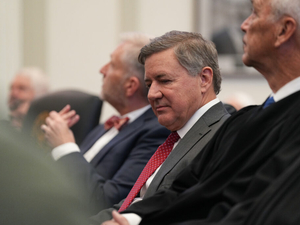
Attorney General Russell Coleman, along with representatives from the Kentucky Multidisciplinary Commission on Child Sexual Abuse, released an updated protocol on how to handle child sexual abuse in the state. April 22, 2026. (Kentucky Lantern photo by Sarah Ladd)
A Union County judge has rejected a man’s constitutional challenge of Kentucky’s ban on child sex dolls.
Kenneth Moore, 50, was charged in August 2025, according to court records, with a total of 16 counts of possession or viewing matter portraying a sexual performance by a minor, promoting a sexual performance by a minor less than 16 years of age and one count of trafficking a child sex doll — all felonies.
In February, he asked the Union Circuit Court to declare House Bill 207, the ban passed by the General Assembly in 2024, unconstitutional and dismiss the charges against him related to that law. He argued at that time that his child sex doll was “homemade, essentially papier-mached out of different materials with the head of some sort of doll attached” and that “at no point was any child abused.”
KY man challenges constitutionality of child sex doll ban. AG pushes back.
Kentucky Attorney General Russell Coleman defended the law, saying child sex dolls were not a form of protected speech.
According to Judge Daniel M. Heady’s October order rejecting Moore’s claims, items examined in Moore’s case included:
- Two or more purported child sex dolls, torsos, or parts thereof, as said evidence appears to be a combination of doll heads and homemade sex dolls or body parts, including at least one head or doll with extremely childlike in appearance head and facial features.
- 10 nude or sexually explicit photographs containing a combination of a nude/sexually explicit body with a child’s face, so that each photograph is a morphed image of what appears to be a real child’s face on a nude/sexually explicit body.
- Approximately five sexually explicit computer-generated videos containing subjects that appear to be the combination of an adult (or what appears to be an adult) nude/sexually explicit body with a child’s face, so that each video appears to be a morphed sexually explicit video with an actor/actress possessing what appears to be a real child’s face on a nude body.
“Moore argues that a possession of a child sex doll is a protected act of expression and entitled to First Amendment protections,” Heady’s ruling said. “This Court disagrees as possession of child sex dolls are not a form of protected speech or expression. Defendant acknowledges that a child sex doll or at least the purported child sex dolls items that he possessed were masturbatory tools, intended for use in conduct and not implicating speech, establishing that a child sex doll is a sexual device used for non-expressive conduct and not entitled to First Amendment protection.”
When Moore first brought the challenge, his petition argued that “there is nothing to indicate what differentiates features of a minor from those with features of an adult,” an idea Heady rejected emphatically.
Heady wrote: “The Defendant’s contention that ‘there is nothing to indicate the head, or rest of the body resemble a minor’ is completely without merit, and a borderline sanctionable offense as a misrepresentation of fact to the tribunal, as one of the dolls (or doll heads at least) is clearly that of a minor (or made to resemble a minor) and this Judge is of the strong opinion that any and every ordinary citizen of Union County, Kentucky would agree.”
Rep. Stephanie Dietz, R-Edgewood, who sponsored the ban of child sex dolls, said in a Friday statement that “we will not tolerate” sexual exploitation of minors.
“Our goal with HB 207 was to give law enforcement every possible tool to investigate and successfully prosecute cases involving the sexual abuse of children,” she said.
Moore is scheduled to be sentenced on Jan. 11, according to court records.
“Parenting in this ever-changing digital landscape can feel like whack-a-mole at a breakneck pace,” Coleman said in a statement. “We have a duty as parents and elected leaders to constantly be learning and adapting to combat the threat from predators. I am so grateful to Representative Stephanie Dietz and Senator Chris McDaniel who led the unanimous passage of this law through the General Assembly. Our kids are safer because of it.”
Frankfort