Virginia confronts $1.7 billion shortfall in highway maintenance funding
Sep 18, 2026 | 5:27 am ET
Description
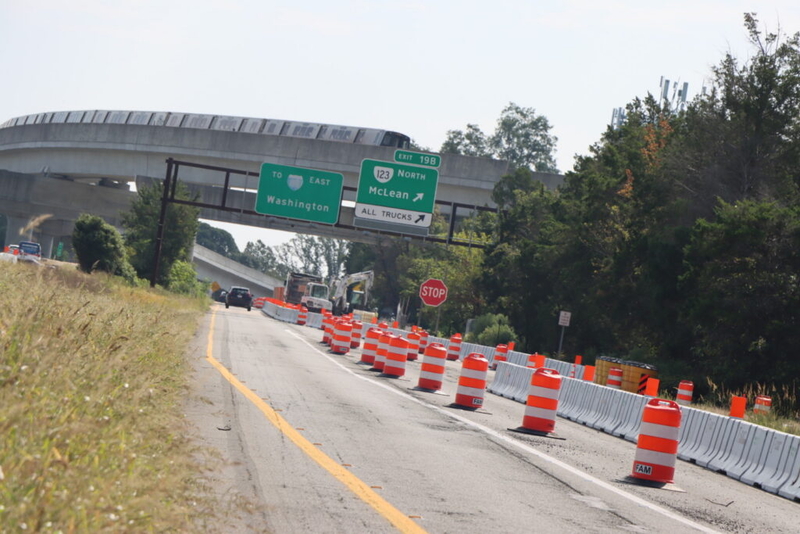
Construction work along the Dulles Connector in Northern Virginia, with roadwork equipment and activity visible along the roadway. (Photo by Nathaniel Cline/Virginia Mercury)
Virginia faces a funding gap of at least $1.7 billion for highway maintenance work, with roads falling into disrepair creating an economic and safety liability that could affect future construction projects across the commonwealth, state transportation department staff reported this week.
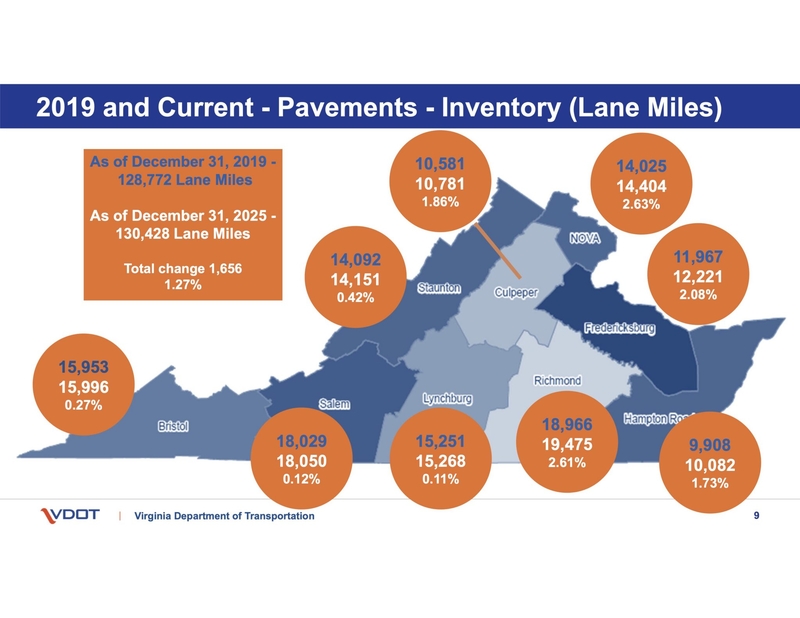
Over the past 20 years, Virginia’s bridge inventory has grown by 400, with a current total of 21,200 bridges. Pavement has increased by 2,000 miles, to 59,700 miles, while pavement lane miles have increased by 5,000 to 130,400 lane miles. All of them require millions annually for maintenance and repair.
Virginia’s Appropriation Act makes maintaining transportation assets the priority for budgeting, allocation, and spending. State law also requires the Commonwealth Transportation Board to set aside adequate maintenance money before funding construction.
However, the board learned from Virginia Department of Transportation staff during a work session on Tuesday that funding all the necessary projects will not be easy to address.
Solutions like reducing construction funding would be complicated by a prior 2025 action that reduced road maintenance funding for most of the years covered by the current fiscal year plan.
“There is no mitigation strategy that makes this not painful,” said Secretary of Transportation Nick Donohue on Tuesday. “This is going to be painful no matter what we do moving forward.”
Laura Schewel, deputy secretary of transportation, said that one method to address the deficit is to use crossover funds — money shifted from the construction program to maintenance — which would create a sizable shortfall in construction program dollars.
Beginning in fiscal year 2028, she proposed increasing maintenance to roughly $290 million per year, over the next six years. That would significantly reduce construction funding, including the state’s Smart Scale program, unless it adopts mitigations.
The agency is also watching whether the Infrastructure Investment and Jobs Act and the Federal Surface Transportation Act will be reauthorized, which have infused bridge repair and maintenance funding. Virginia receives about $115 million per year from the IIJA to help cover its bridges, VDOT representatives reported.
Next month, the secretary will provide the board with mitigation options to reduce the construction-program hit while still meeting maintenance targets. The options include phasing, timing adjustments, or balancing strategies across funding rounds.
Funding for transportation projects through the Smart Scale program could drop temporarily by around 51%. Severe weather events and a decline in federal funding could also increase maintenance needs.
How the deficit was created
Increasing highway construction costs and prior budget assumptions are key factors driving the projected deficit.
Beginning in 2022, the agency learned that pavement investments had begun to exceed the increased costs. As a result, the CTB made a series of one-time infusions by moving money from the annual construction budget to crossover funding to cover the gap, but those infusions were not sustained.
The discrepancy stems from previous budgetary decisions made under Gov. Glenn Youngkin’s administration. The board instead allocated funds for pavement maintenance through 2031 to Round 6 of Smart Scale.
On Jan. 14, 2025, then-Secretary of Transportation Shep Miller, appointed by Youngkin, led a conversation with the board about the agency deliberately striking a balance between maintaining infrastructure at acceptable condition levels and preserving funding for construction and other transportation priorities, rather than maximizing maintenance spending at all costs.
Then, in June 2025, the previous administration introduced a Six-Year Improvement Program (SYIP) to the board that did not assume the continued level of crossover funding. Instead, it assumed about $200 million less in crossover funds and allocated those funds to construction programs.
In addition, the SYIP included an approximately $40 million reduction in crossover funds for local maintenance programs.
Last November, the board also approved a plan to use unallocated funds from the Priority Transportation Fund and Grant Anticipation Revenue Vehicle (GARVEE) Bonds, along with $103.5 million in revenue collections, to advance several priority projects worth $715 million. That money could have given the transportation program more flexibility.
The much larger current deficit is mainly due to a structural mismatch between maintenance costs and the funding planned for fiscal year 2027 and beyond.
At Tuesday’s meeting, board member Marianne Moffat Radcliff, appointed by Gov. Abigail Spanberger, questioned whether prior decisions included any analysis on what would happen to pavement conditions if higher funding levels weren’t maintained.
Donohue said he was not serving as secretary when the decisions were made.
However, he said this was the first year the agency could analyze what had been done and share it publicly, most recently during the board’s July meetings.
“There were discussions in January 2025 when the decision was made to go from about $300 million extra a year in funding down to $100 million, but this year’s work is the first clear, public analysis of the longer-term impacts,” he said.
The board members who voted to advance the reduced funding didn’t comment on their decision.
Deficit faces criticism
The deficit invited criticism from advocacy groups, including the Coalition for Smarter Growth (CSG), which promotes walkable, bikeable, inclusive, and transit-oriented growth in the Washington, D.C. region.
“This deficit highlights the importance of a fix-it-first approach to our transportation network, spending our limited funds wisely by making efficient use of existing infrastructure and ensuring more compact and efficient land use,” Stewart Schwartz, CSG executive director, said in a statement.
Schwartz said Virginia should enable more housing near jobs, services, and transit, helping families shorten commutes and spend less on gas and vehicles. Doing so could “help the state achieve better transportation and quality of life outcomes without breaking the bank,” he said.
Bill Pugh, CSG’s transportation and climate director, emphasized that the think tank Transportation for America’s recent Repair Priorities report rated Virginia’s road maintenance in the bottom category of states, putting it in the category of “Bad Spending; Bad Repair Conditions.”
Pugh said highway expansion spending has outpaced maintenance. From 2018 to 2024, the state spent just 58 cents on maintenance for every dollar spent on expansion. The think tank’s analysis shows the proposed SYIP would continue that trend, with 35% of VDOT funds going to construction and 23% to maintenance.
The report notes that Virginia has improved bridge conditions from 2018 to 2024. Pugh said he believes that this was based upon the policy decision last decade to direct more funding to keeping special structures in a state of good repair.
Pugh said, “Virginia should similarly better prioritize funding maintenance of state-owned roads, including their ancillary facilities like streetlights, and walking and biking facilities.”
What’s next
The board is expected to take a final vote at its Dec. 9 business meeting, where it will decide on the maintenance strategy and the exact crossover amount. That decision will directly determine the available construction funds.
Richmond, VA