Kansas Board of Regents to focus on crafting artificial intelligence policy standards
Sep 17, 2026 | 4:04 pm ET
Description
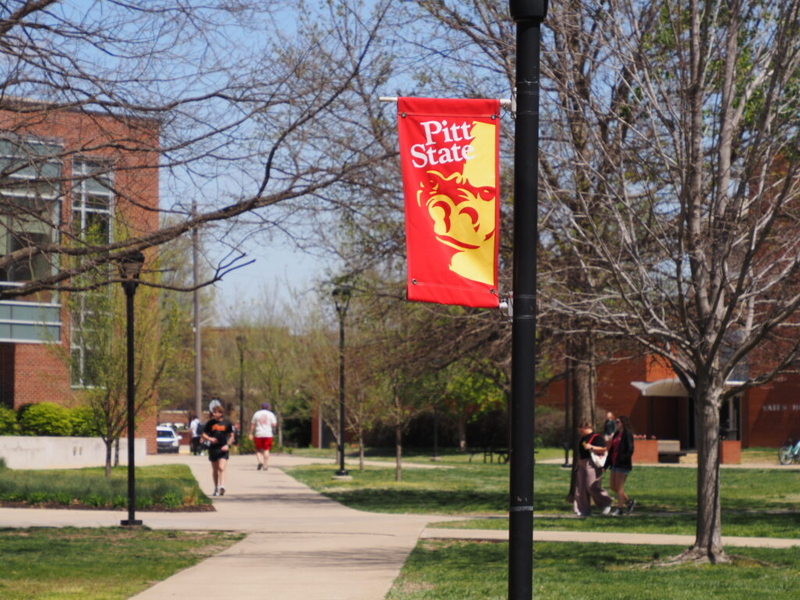
The Kansas Board of Regents is delving into a policy study of artificial intelligence at Pittsburg State University and the five other state universities in Kansas. The board also agreed to submit a budget plan to the 2027 Kansas Legislature that includes a request for $10 million to modernize PSU's science laboratories. This is an April 11, 2025, image of the PSU campus. (Photo by Anna Kaminski/Kansas Reflector)
TOPEKA — The top priority in the annual examination of the Kansas Board of Regents’ strategic plan for higher education will be development of a framework for responsible use of artificial intelligence in student teaching, academic research and administrative oversight.
Regent Neelima Parasker, president and CEO of the technology company SnapIT Solutions, was selected to chair the committee responsible for taking an exploratory dive into AI and drafting guardrail recommendations for review by the Board of Regents. The work of the committee would touch on examining AI activities at universities, the statewide AI priorities relative to higher education and AI’s role in workforce development.
“Any technology that doesn’t help us achieve these goals is taking us in the wrong direction,” Parasker said. “We may not achieve all guardrails and policies right off the bat, but we are trying to avoid the pitfalls and any blind spots.”
She said the large language models, or specialized AI programs used to understand, interpret and generate human-like language differed from university to university in Kansas. That would be among topics the AI committee considered in terms of advancing a unified policy, she said.
“Some universities are leading or ahead of others, but AI is not really a race to the end. It is to help us figure out what we want, what problems we have, what goals we need to do and who is our stakeholder here,” Parasker said.
The Board of Regents agreed the committee should focus on developing principles for responsible use of AI, identifying effective practices that enhanced student learning and promoting AI literacy in terms of workforce readiness. In addition, the committee would address data privacy, cybersecurity, academic integrity and other ethical issues.
Board of Regents chairwoman Alysia Johnston said the higher education board should have taken up the AI project before now.
“As you know, we’re behind on this, because obviously AI is something that’s been there for a while. It’s been way ahead, certainly, of me, and I would think of most of us,” Johnston said.
Meanwhile, the Board of Regents approved a budget proposal for the state’s public higher education system for presentation to Gov. Laura Kelly and the 2027 Kansas Legislature.
The outline would block continuation of cuts in state funding and guarantee state support for Extension and Agriculture Research Programs at Kansas State University.
“The regents, in partnership with institutional leaders, took a thoughtful, systemwide approach to identifying our needs and priorities, while remaining cognizant of the difficult funding decisions legislators face,” Johnston said. “With rising costs placing additional pressure on the higher education system, these investments would help ensure Kansas students continue to have access to outstanding educational opportunities while supporting efforts to grow the Kansas economy.”
Recommendations from the Board of Regents included earmarked requests from the six universities ranging from $1.5 million to $20 million.
K-State sought $5 million to improve the rural veterinary medicine clinical experience, while Pittsburg State University requested $10 million to modernize science laboratories. Fort Hays State University proposed $2 million for agriculture equipment tied to FHSU Tech. Emporia State University would welcome $1.5 million to modernize information technology.
The University of Kansas Medical Center requested $5 million for Alzheimer’s research. The University of Kansas suggested $20 million be directed to renovation of military science and ROTC facilities on campus. In addition, KU asked for $3 million for a Center on Energy Growth.
The state universities collectively sought $3 million for the Blueprint for Literacy and $10 million for student scholarships in high-demand academic programs.
In addition, the Board of Regents requested the state’s community and technical colleges receive $40 million for capital projects, apprenticeship programs and operating funds.
Topeka, KS