Doug Jones, Phillip Ensler propose overhaul of Alabama lieutenant governor’s role
Sep 17, 2026 | 5:59 am ET
Description
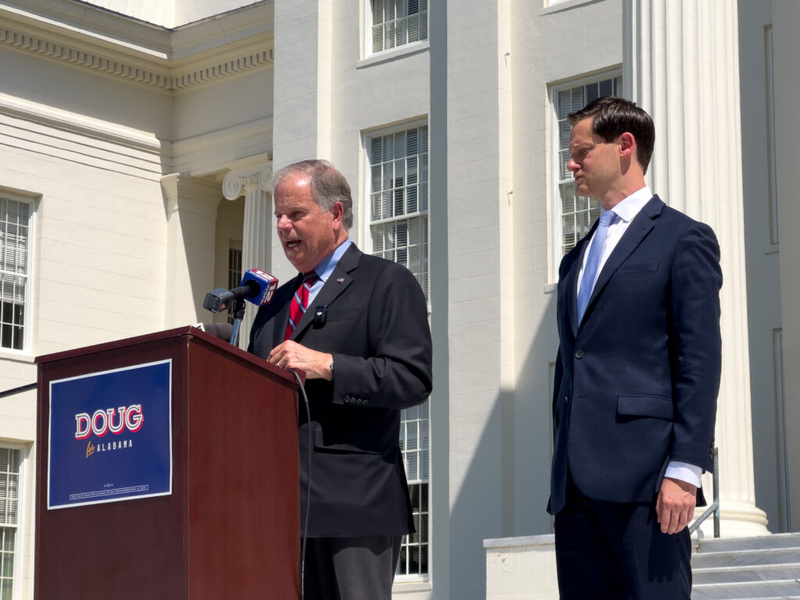
Democratic gubernatorial nominee Doug Jones speaks at a press conference on the steps of the Alabama State Capitol on Sept. 16, 2026 in Montgomery Alabama as Rep. Phillip Ensler, the party's nominee for lieutenant governor, looks on. The pair on Wednesday announced a plan to propose a constitutional amendment to make the offices jointly elected. (Anna Barrett/Alabama Reflector)
The Alabama lieutenant governor has a dwindling number of powers. The Democratic nominees on the top of November’s ballot want to change that.
Former U.S. Sen. Doug Jones, the party’s nominee for governor, announced Wednesday that he plans to work with the Legislature to introduce a constitutional amendment to reorganize the state government, if elected, hearkening back to efforts made over two decades ago to redefine the office.
“It’s almost like the lieutenant governor is a figurehead in the Legislature that just sits with a gavel,” Jones said. “The lieutenant governor, in my view, always should be a part of the executive branch, a partner with the governor to help implement the administration’s policies.”
The governor and lieutenant governor are elected separately. Jones said he would support a constitutional amendment that would have the governor and lieutenant governor elected as a ticket, like the president and vice president of the United States. According to the National Lieutenant Governor’s Association, 27 states jointly elect the two positions together.
Rep. Phillip Ensler, D-Montgomery, the party’s nominee for lieutenant governor, joined Jones on Wednesday and touted his bipartisan record in the Legislature.
“There is so much that I can do because of the relationships I have, as Doug said, across the aisle, and to be able to help carry out a vision, help fight for the people of Alabama,” Ensler said.
Jones wants to treat the lieutenant governor – regardless of November’s results – as a team member.
“I want him to have a seat at the table, whether as officially as a member of the government’s cabinet or at least as a member of the government’s cabinet in an advisory role, we’re going to talk during a transition about what portfolio he might want to work on,” Jones said of Ensler on Wednesday.
Messages seeking comment were left Wednesday afternoon with Tommy Tuberville and John Wahl, the Republican nominees for governor and lieutenant governor.
Section 280 of Alabama’s Constitution prohibits an individual from financially benefiting from two public offices – like a lieutenant governor and a cabinet position or staff member.
“When you elect Doug Jones and Phil Ensler, you’re electing a team to help implement the same strategies, the same efficiencies in government, the same programs that we’re talking about on the campaign trail,” Jones said. “So he’ll have a seat at the table, and more importantly, a voice at the table. It will not be double dipping, so to speak, at all.”
First attempt in two decades
State lawmakers filed similar legislation to redefine the lieutenant governor’s role more than 20 years ago, but no proposal received a floor vote in its house of origin. Sen. Bobby Denton, D-Tuscumbia, filed a proposal in 1999; Rep. Mary Sue McClurkin, R-Pelham, filed a proposal in 2004; and then-Rep. Cam Ward, R-Alabaster, filed proposals in 2005 and 2006.
Jones and Ensler said they plan to work with legislators in both chambers to get their proposal passed. Jones said he had “cleared it” with Senate Minority Leader Bobby Singleton of Greensboro and House Minority Leader Anthony Daniels of Huntsville.
A message seeking comment was left with Singleton. Daniels confirmed his support for the proposal in a phone interview Wednesday afternoon.
“The lieutenant governor is someone that’s elected statewide, so their duties should exceed just presiding over the Senate,” Daniels said. “I do think that they can be extremely valuable in the government.”
Currently, the lieutenant governor becomes governor should the occupant of that office die, resign or be removed. The office once had powers comparable to those of the Speaker of the House, with powers to control legislation and assign senators to committees.
But the office was stripped of its power in 1999 after a lengthy standoff between then-Lt. Gov. Steve Windom, a Republican, and the Democratic-controlled Senate, which transferred most of Windom’s powers to the Senate President Pro Tem.
The role had its powers further decreased by the Senate this spring through Senate Resolution 108, sponsored by Sen. Arthur Orr, R-Decatur. It allows Senate President Pro Tem to preside over the Senate if the lieutenant governor has not taken their seat five minutes after a meeting time.
The resolution also removes the lieutenant governor from a committee that assigns committee chairs, removes their power to appoint members to conference committees, gives the Pro Tem the power to recommit bills to committees and gives the Pro Tem and to direct the lieutenant governor to call up legislation carried over to the call of the chair.
Republicans have held the office since 2010.
Jones hopes to get the amendment through the Legislature in time for the 2028 election to be considered by voters. Amendments need two-thirds support in each chamber, and a simple majority on the ballot. Republicans hold a supermajority in both chambers, and there are not enough contested races in November to challenge that hold.
Daniels said there could still be support from his colleagues across the aisle.
“I think that it’s something that has probably been thought about by both sides, but never been acted upon,” Daniels said. “Someone has to start the conversation.”
Montgomery